Seven Weeks Where Decades Happened
I haven’t been super “present” over the last few weeks, so I wanted to give you an update. I want to write it down, because the thing I’ve been doing instead of writing is the most important thing I’ve done with this business in years.
Maybe ever.
March 15
In March, the business… MY business… almost ran out of money.
We had three months of runway. Fifteen grand a month going out. The community product, The Roost, was losing money every month. The proverbial pipeline was dry af. And me, half-doing all the things (newsletter, sponsorships, consulting…) instead of fully doing one.
For the very first time since I incorporated my business a decade ago, I genuinely looked at company credit cards as a way to extend the runway. That’s how close it was.
I was scared I couldn’t pay Diana. I was scared the team meetup we had booked in London for the next week would turn into a strategy session full of slides and intentions, and we’d come home with NOTHING actually built. And that I had to close the business and go look for a job. So Diana and I agreed on the main direction before meeting in person: kill everything except consulting. London was going to be the week where we get shit done.
What I did instead of London prep
Sunday afternoon, the day before flying. I opened YouTube to procrastinate and landed on a video about Claude Code. Now, at the time, I believed I was an AI power user with my Claude Cowork projects, my super slick prompts, and my Perplexity research flows.
Three things flipped for me in that video.
One, using Visual Studio Code (VS Code) as the interface, not the Claude Code terminal, made the experience much more… I don’t know… organic?? You have your files on the left, your chat windows front and center. There’s no lag.
Two, you don’t have to have all the answers before interacting with it. You can just explain what you want, you let it ask questions, you arrive at a good-enough version together. This isn’t unique to Claude Code, but this approach, combined with access to your files, really opened my chakras.
Three, you can give control of your browser to Claude (within reason, of course) using, for example, Chrome DevTools MCP… and it will figure sh*t out… on its own.
I’d tried browser automation before. Always the same pattern: I had to write every step. “Go to this URL. Click this element. Wait for this to load. If the address is already saved, do this; if not, fill these fields.” Every conditional, every fallback. The HTML element to click on and sh*t like that.
So I tested it. On the train to the airport, then at the airport waiting for the flight, I built the book-order automation skill and agent. (Quick context: I send free copies of my book to prospects, and the Kindle Direct Publishing (KDP) author copy ordering flow is a manual click-fest. I used to do it myself, by hand, every time.)
I gave Claude the goal. Order N copies, this address, this payment method, stop at the review page so I can confirm. I didn’t tell it where to click. I didn’t tell it the order of the steps. I didn’t mention there were five marketplaces to choose from depending on the recipient’s address. I didn’t tell it what to do if the address was already on file versus not.
But it figured it out.
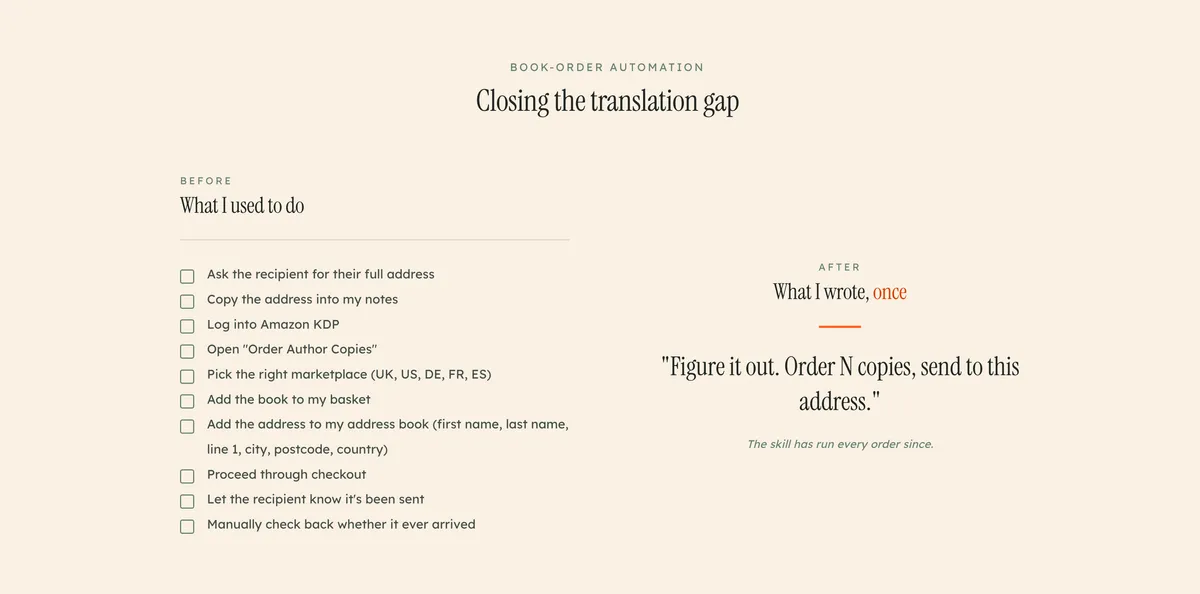
This might be trivial to you, but it wasn’t to me. It looked at the screen. Saw what was there. Clicked. Adjusted when something didn’t land where it expected. Came back to me when it genuinely needed an answer. Got to the review page and stopped.
That moment… That’s the moment it stopped being a tool and became a co-pilot. I used to think automating something meant teaching it. Showing it. Recording your screen, writing the steps, drawing the decision tree. Whether you were training a person or building a Zapier flow, the work was always the same: you had to teach. Like, you had to take what was in your head and put it into a form the other side could execute.
That’s where the time went. That’s where my energy went. That’s where the gap was, for me, for twenty years.
But this… thing… didn’t need to be taught.
I caught the flight to London with a working book-order skill in my repo and a feeling… a buzz… I just couldn’t shake.
What seven weeks look like
Once that first skill worked, I just kept going. I had to.
Week 1, in London, between meetings: we built a skill that turns our messy notes into proper SOPs.
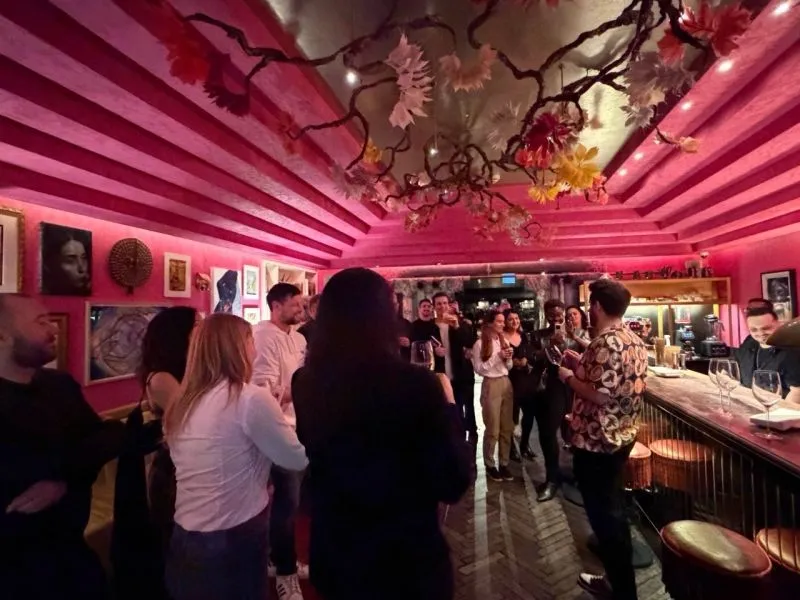
Week 2, back home: ten skills in eight days. Company research that spawns multiple sub-agents and summarises everything into a nice little report, positioning statement generator using my Stand The F*ck Out methodology as a crutch, a multi-agent debate skill to help me think about stuff more critically, a Slack-digest helper, etc.
Then Easter happened. Robyn at gymnastics camp every morning with FOUR whole hours of uninterrupted work in the coffee shop next door. By the end of that week, I’d built my ENTIRE consulting process, from kickoff to final delivery, into Claude Code.
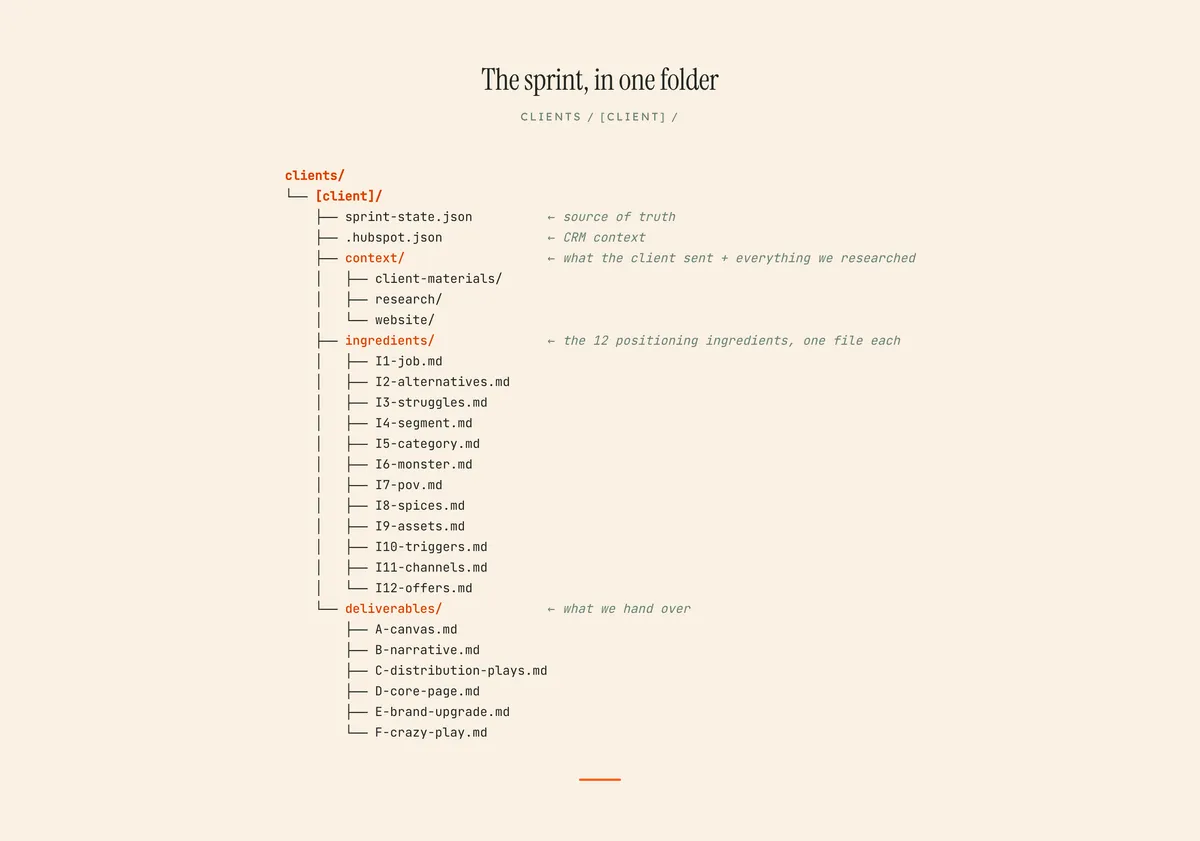
Everything for a sprint lives in clients/[slug]/, and the source of truth is clients/[slug]/sprint-state.json (a well-formatted file that shows where we’re at with any specific client). It acts as a co-pilot, and it works so well for my brain because:
- I don’t have to remember where I am with each client.
- It runs the boring research for me and replaces HOURS of manual browsing (website, LinkedIn ads, Meta ads, Wayback, G2 reviews, Reddit, competitor case studies, HubSpot context, brand baseline, etc.).
- It compounds. Whenever I run into edge cases or issues, I can just direct it to fix its own process. Changes are logged to CHANGELOG.md. Essentially, every sprint makes the next one tighter without manually editing methodology docs.
It helped me move from “consultant doing all the work” to “consultant directing the work.” Also, I never thought it’d happen, but I haven’t used Google Drive for client work in weeks.
The week after Easter, I continued building. I hadn’t felt a pull like that in years. I built an ICP qualifier that scores anyone in seconds using multiple sources, a way to monitor who interacts with my LinkedIn without using shady automation, and… I got rid of Framer, my website CMS, and rebuilt the STFO.io website from scratch. And now, I can make changes without leaving the interface. I don’t need to log in to anything or “drag and drop” .div boxes.
And, over the last two weeks, I built a chief-of-staff skill that reads my calendar, my HubSpot tasks, and the latest Slack briefings and tells me what the one move for today should be. Also, a book-sales checker that pulls numbers from different places into one condensed report. And also a sales-coach that pulls my transcripts after a sales call, scores me against objective metrics, and proposes script edits.
I can’t even count the number of USEFUL skills, agents, sub-agents, I’ve built over the last seven weeks. From zero. I’m not a developer. I have not learned to code in any traditional sense. I’ve been writing what I want and watching it get built.
For the first time in forever
The first time we onboarded a new client using the GTM Sprint methodology in Claude Code, we overdelivered. Information that used to take me hours to gather, scrape, structure, and write up for a kickoff: minutes. The methodology pulled context from HubSpot, ran competitor research, extracted the brand from the website, and presented it to me before the call. I sat in my office and watched.
Building slides used to take me hours, even with a template. Now I generate them through Gamma’s API, in my brand colours and fonts, in seconds. Boom. Of course, I verify what’s in them. Of course, they ain’t perfect. But it saves me so much sanity, it’s… just unbelievable.
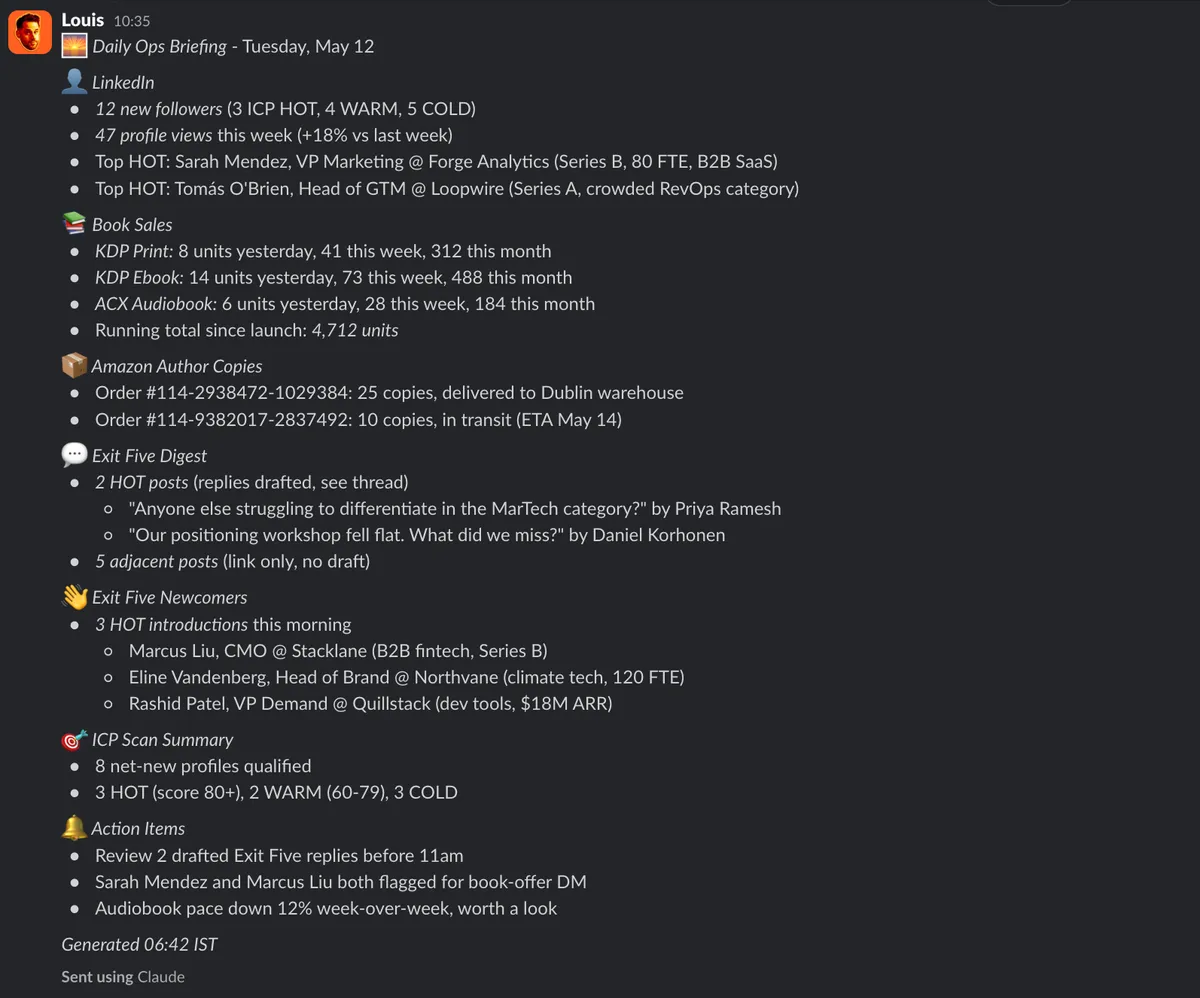
Every morning, Slack pings Diana and me with the status of book orders, LinkedIn followers, net-new ICP-fit profile views, fresh brand mentions, what the calendar looks like today, and where every active deal sits in the pipeline. I don’t have to go and find any of that. It comes to me.
The feeling that comes with that, every day, is “things are under control.” Which is a feeling I have not had running this business at any point in the last several years.
What it cost
This wasn’t free. And I’m not talking about moneyz.
I pretty much stopped everything else to dedicate myself to it.
The daily newsletter I used to write went silent. I haven’t sent one in weeks. I used to take pride in showing up every weekday. Then I stopped, and I didn’t really notice I’d stopped, because what I was doing felt more important.
LinkedIn posting slowed to a trickle. I used to post three or four times a week. I’m still super active “in the DMs,” but the rest took a step back.
For two months, I went head-down. Entire days where I didn’t talk to a single human until Jen got home, because I was deep in building. F*CKING BLISS.
The honest part: I think the front-facing stuff needed to change anyway. I was doing it on autopilot. Daily-newsletter-as-discipline had stopped being daily-newsletter-as-thinking. The shape of the thing I want to put in front of an audience is going to be different on the other side of this. So the cost wasn’t pure cost. It was the kind of pause where you stop doing the thing you’ve been doing in order to figure out what the thing should actually be. You know?
Two decades of almost
Here’s the part that matters most to me, and the part I’ve struggled to put into words: I’ve been trying to build my own things for twenty years.
When I was a teenager, I sat in front of computers trying to teach myself how to make stuff. Websites, mostly. I tried to teach myself Dreamweaver. I wrote about that in my roast of the vibe coding tool Hostinger Horizons.
As a marketer, I kept hitting the same wall. I could almost build the thing I wanted. I’d get to about ninety percent on my own, and then the last ten percent would always require either hiring someone or learning a thing that would take a quarter to pick up properly. So I’d stop. Or I’d hire. Or I’d compromise on the thing.
Examples, since the abstract version is useless…
I’ve been through every CMS known to mankind. WordPress. Webflow. Framer. I tried to learn each one, properly. I got reasonably good at a couple. But I never once felt like I had complete control. There was ALWAYS something I wanted to do that I couldn’t do, or could only do by paying someone, or could only do by accepting some compromise the platform was forcing on me. It was always a pain in the ass.
Two years ago, on the Framer site, I hired a specialist freelancer to build something I couldn’t quite get to land. He did good work. But I rebuilt the entire thing myself afterwards anyway, over weeks, because by the time he’d finished I’d taught myself most of what he’d done and I wanted full control of every page. I do not recommend doing that to yourself. It was expensive in two ways: I paid him, and then I paid myself in the evenings.
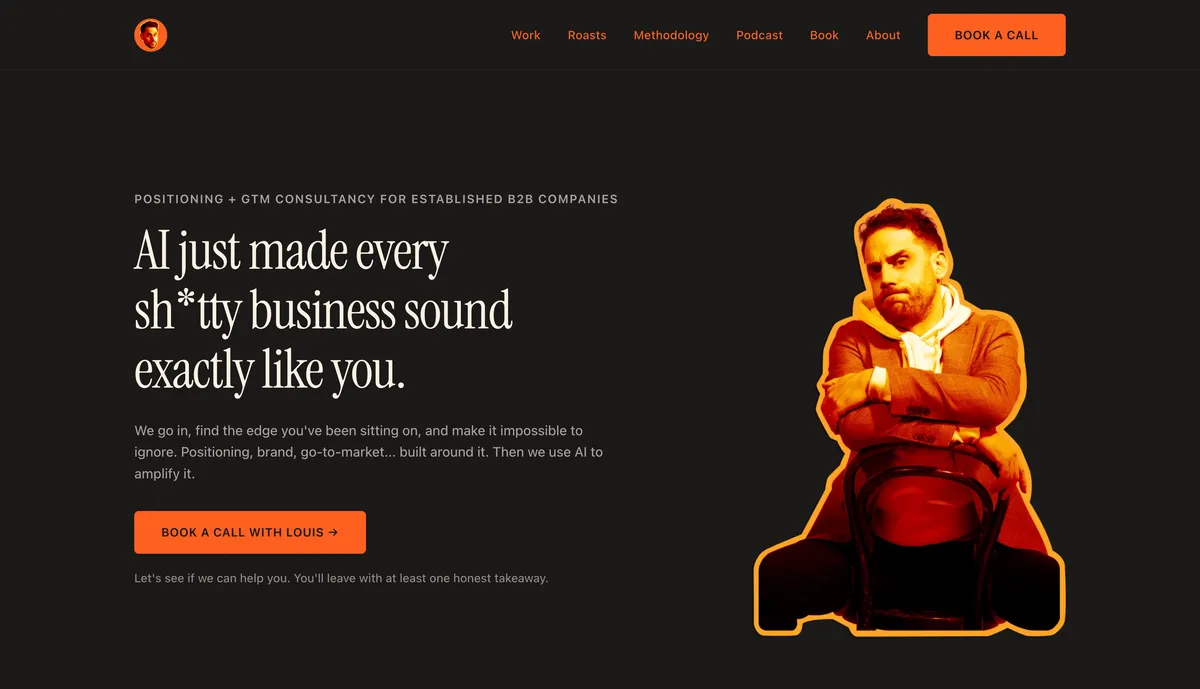
But… two weeks ago, I rebuilt the website for the seventh or eighth time. However, this time, end-to-end, through Claude Code. I didn’t touch Framer’s UI. I didn’t touch Webflow. I didn’t touch WordPress. In fact, I didn’t touch any CMS. I researched the optimal way to do this given my context (we landed on Cloudflare Pages + Tailwind CSS + Astro). Claude built it, deployed it, and cross-linked it… It manages eight content collections, runs refreshes on old articles… It looks far better than what I achieved with Framer, while taking 1/10 of the time and 1/100 of the hassle.
The gap closed. The last ten percent. The thing I’d been chasing since I was seventeen. This is why the last two months have been such a big deal for me.
Here’s what I want to be precise about, because most of what people write about this topic gets it wrong. What changed is not that I learned to code. I haven’t. If you put me in front of a blank file and asked me to write a function, I’d struggle. If you removed Claude from this setup tomorrow, I’d be back where I was in February.
What changed was that I no longer had to teach.
For twenty years, every time I tried to build something on my own, the bottleneck was the same: I could see the thing in my head, but I couldn’t get it out of my head into something that would execute it. I had to teach a person, or teach a tool, or teach a no-code platform with its own conventions and constraints. The teaching was the work. The teaching was where the energy went. The teaching was what stopped me, every time, at the last ten percent.
Claude Code doesn’t need me to teach it.
It already thinks like me. Or close enough that the difference doesn’t matter for what I’m doing. I describe what I want, and it figures out the rest. When it gets stuck, it asks. When it gets something wrong, I correct it once, and it adjusts. There’s no translation layer. There’s no “let me explain how I think about this” preamble. There’s no quarter-long ramp to learn a new platform.
That’s the thing.
Twenty years of almost. Seven weeks to close it.
Where I’m landing
It’s 12 May 2026 as I write this. Eight weeks since the Sunday in March I described at the top.
Cash flow is in a much stronger place than it was. We shut down the community, stopped taking on sponsors, and went all-in on positioning & GTM consulting for established B2B companies.
The pipeline is the healthiest it’s ever been. We have around ten warm prospects right now. Around eighteen conversations I’d describe as substantive. Diana getting paid. No more context-switching across half-projects. I’m not going to claim the seven weeks fixed everything. They didn’t. We’ve still got plenty to figure out. But the feeling I have, day to day, is that I have a handle on things.
There’s a Lenin line that’s been bouncing around my head:
“There are decades where nothing happens; and there are weeks where decades happen.”
Obviously, the context of that quote is much different from ours, but I feel like it’s a good summary of what happened to us and the business over the last two months.
Anyway.
That’s why you haven’t heard from me in a while. I’ve missed writing to you. I’ve missed putting my thoughts on the proverbial paper. And I’m sorry I’ve disappeared on you, but it had to be done.
Love,
Louis
P.S. I just want to make something else clear before you start thinking I’ve turned to the Dark Side and become an AI “guru.” This update isn’t really about Claude Code, or even Anthropic, or even AI in general.
Yes, of course, I mentioned Claude Code a lot, but here’s what I hope you’ll take away from my email:
- We faced a tough business challenge,
- We acted on it with intensity even though we were scared shitless,
- And, once it was all done, we wondered why we hadn’t done it months ago.
My body of work around standing the fck out is even more relevant now than it was two years ago. Marketing foundations matter more now than ever before… but it shouldn’t stop you from exploring new things, as long as it comes from a place of genuine excitement (and not artificial FOMO created by LinkedIn wnkers).
P.P.S. Also, since it’s been a while since I’ve emailed you, I’d love to hear from you.