8 B2B Positioning Books Worth Reading (Written by Someone Who Wrote One)
Full disclosure: I wrote one of the books on this list. You’ll know which one. Judge for yourself.

I sat in a GTM Sprint last quarter with a marketing leader at an established B2B SaaS. She’d read Obviously Awesome twice. Had the worksheets printed, sticky-noted, the whole thing. She got stuck on the “unique attributes” step. Couldn’t fill it in because her product didn’t have any that competitors didn’t also have.
That’s most of my clients.
Usually it’s because the book they read was written for a different company than theirs.
Every positioning book in the field is written for a specific kind of company. The ones built for startups with genuine innovation don’t work on a 15-year-old SaaS with on-par features. The ones built on FMCG data don’t work for a 20-person consultancy. Almost ALL the “best positioning books” lists online ignore this. They rank books like a league table, as if one framework fits every problem.
It doesn’t.
So this is a map. Ordered alphabetically by author’s last name. Every entry tells you what the book gets right, where it stops being useful, and who should read it. Fight me if you want.
1. The Business of Expertise, David C. Baker
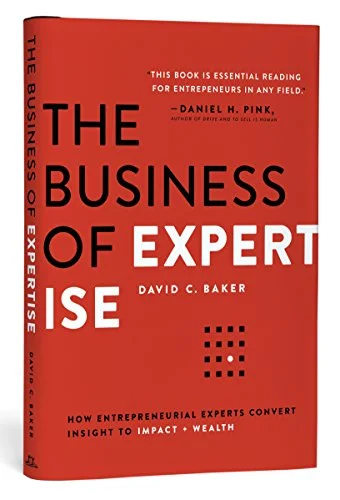
Baker didn’t write this for B2B SaaS, B2B tech, or AI companies. He wrote it for entrepreneurial experts selling their expertise. Read it anyway.
His criteria for what positioning actually is are sharper than almost anything in the B2B literature. Positioning should be declared publicly. It’s semi-permanent. Its importance is inversely related to the size of the firm (the bigger the B2B tech company, the less positioning matters, because they move to distinctiveness instead). Positioning lives in your expertise. Implementation comes later.
He has litmus tests. Can you give 20 insights that emerge from your expertise? Can you find 10 to 200 direct competitors? Are you getting smarter?
The line I keep coming back to, and that most B2B marketers never hear: you can’t read the label from inside the jar. You’re not an objective observer of your own company. No one is. That’s why positioning work needs an outsider. It’s also why we struggle to say no. We see opportunities, and we minimise the risk and maximise the future potential. Or we see marketing as beneath us and refuse to engage properly.
The book runs out of road if you want in-depth coverage of B2B SaaS, complex product sales, or enterprise motion. Baker wasn’t trying to cover those.
If you’re open to pulling positioning ideas out of a book written for a different audience, this is worth your time. Service providers will get the most. Everyone else can skip the service-firm operational chapters and mine the positioning ones.
2. Obviously Awesome, April Dunford
Dunford is the reason a whole generation of B2B product marketers have a real framework to follow. Before Dunford, most positioning advice was “think harder about your value proposition” and “get clear on who you serve.” After Dunford, there are actual steps. She was the first person to do it specifically for B2B. She inspired me enormously. She’s one of the main reasons I got back into this work.
So I don’t want to diss it.
Her framework works beautifully when you have genuine differentiation. Unique capabilities the competition doesn’t have. Something real to position. When you don’t, the framework stops working at specific steps. You can’t, in good faith, fill in the “unique attributes” section if you don’t actually have unique attributes. You can’t map your competitive alternatives to your advantage if you don’t have one.
You get BLOCKED. And most of the B2B companies I work with in crowded, mature markets are blocked exactly there.
It’s very good for genuinely innovative companies planning a new product launch or a new market space. For the majority running established products in mature markets, it lacks the depth needed to go a level deeper. That’s fine. No book does everything.
If you’re a product marketer or a leader at a company with real product innovation, it’s the first framework you should work through. Also good for students of the craft. Everyone else will hit the same walls my clients do.
3. Purple Cow, Seth Godin
Godin never uses the word “positioning” in Purple Cow. It’s one of the first positioning books I ever read anyway.
This isn’t a framework. Godin doesn’t give you a map. What he gives you is ideas that sit in your head for years and keep paying rent. Think small. Find the smallest underserved segments instead of trying to win everyone. Protect your edge, don’t compromise to chase broader appeal. What’s worse than doing nothing is doing something very average. Go to the edge of the map.
Most of that is the opposite of how B2B companies behave.
It runs out of road if you want a step-by-step to follow. Godin doesn’t do step-by-steps. He’s also starting to show his age (a lot of the examples are dated). But the core ideas are timeless, and there’s so much good stuff in there I don’t want to diss it.
Anyone into marketing should read it, as long as you’re willing to read slowly and think. If you want to be handheld through a framework, it’ll frustrate you.
4. This Is Marketing, Seth Godin
Second Godin on the list. Also not a step-by-step. Also food for thought.
The positioning section in this one lands harder for me than Purple Cow. Godin frames positioning as service claims that are true and generous. True meaning you’ve actually talked to customers and built the claim from what they said. Generous meaning the claim exists as a service to them. He has a two-by-two for finding the overlooked place that connects to an unmet need.
There’s also the smallest viable audience concept… find the smallest group you can genuinely serve well and forget the TAM slide.
And the status thread, which most positioning books skip entirely. People buy things because humans are a social species and status is always in play. You’re either creating tension or relieving it, affirming status or challenging it, of course.
It runs out of road the same way Purple Cow does. If you want structure, this isn’t it. Complement it with data-heavy reads like the Byron Sharp books below.
Anyone interested in marketing should read it. Full stop. Even if it annoys you and you disagree with half of it, that disagreement will make you think harder than most books do on their best day.
5. Stand The F*ck Out, Louis Grenier

My book. Yes, I’m biased. Here’s why it’s on the list anyway.
I wrote it because I couldn’t find a positioning book honest about what most B2B marketers actually face. Established company. Mature market. Product roughly on par with competitors. No genuine innovation to lean on. Limited budget. And still, pressure to _stand the f_ck out*.
That’s the majority. Most of the books on this list were written for a different audience. The 10% of companies with genuine product innovation. The FMCG giants Sharp writes about. The entrepreneurial experts Baker writes for. My book is for the messy middle, which is where most of the actual work happens.
The methodology has four stages. Insight Foraging (dig for the raw customer truths your competitors never bother to look for). Unique Positioning (find the ignored struggles your competitors are stepping over every day). Distinctive Brand (build mental availability, the Byron Sharp lens applied to a B2B SaaS that can’t outspend anyone). Continuous Reach (map the buying triggers, not the content calendar).
Read the sample chapter before you commit. I’m biased. You’re not. (Honestly, read the one-star reviews on Amazon first. They’ll tell you more about whether this is for you than I can.)
It’s for marketing leaders and founders at established B2B companies in crowded markets, where you can’t credibly claim to own the category and can’t pretend you’re a disruptor anymore, and you still need to stand out. If that’s not you, skip it.
6. Crossing the Chasm, Geoffrey Moore
Moore’s 1991 book. Still default reading in B2B SaaS. The core idea that’s held up: secure a beachhead in the mainstream market. Find a small, pragmatic customer base who talk to each other. Start there. Dominate it. Then expand.
The chasm concept itself (the specific gap between early adopters and the mainstream) hasn’t aged as cleanly. Modern B2B buying doesn’t follow the technology adoption lifecycle Moore described. Buyers skip around. Categories evolve differently. The early-adopter-to-laggard segmentation doesn’t hold the same way. It needs to be challenged.
The beachhead idea still works, though.
It’s worth reading to understand where a lot of B2B strategy language came from. Just don’t expect it to reflect how B2B software actually gets bought in 2026.
7. How Brands Grow, Part 1 and 2, Byron Sharp and Jenni Romaniuk
Two books, one entry. They belong together, and nothing else on this list does what they do.
Heavy scientific data, not opinion. They rip apart a lot of received wisdom from earlier positioning literature (Differentiate or Die, for example, doesn’t survive five pages of Byron Sharp). The core line I keep using: positioning itself needs to be repositioned. Strong brands don’t win by nailing one sharp proposition. They win by being mentally available across a wide range of category needs, and by being easy to buy.
Positioning, in this frame, isn’t “what do you stand for.” It’s “what triggers make people think of you first.” You’re trying to occupy a set of memory structures that lead to shortlist inclusion.
It runs out of road when it hits small companies and B2B SaaS. Sharp and Romaniuk work mostly with FMCG data. The laws still hold, but B2B software behaves differently (longer sales cycles, smaller buying groups, higher consideration). Smaller companies can’t buy their way to mental availability the way Coca-Cola can. They have to be smarter with the same principles. The principles transfer. The playbook doesn’t. I took Romaniuk’s asset palette and ran it across 100 B2B brands to see how the theory holds up in software. Spoiler: most of them flunk.
These aren’t framework books. They’re how-marketing-actually-works books. Marketing leaders who need to defend budgets to boards will get the most from them. Practitioners sick of opinion-led advice will too.
8. Eat Your Greens, Wiemer Snijders (editor)
A collection of essays from marketing effectiveness practitioners working from evidence, not opinion. Not every essay is about positioning. The book as a whole is valuable because it opens up how marketing actually works at a scientific level.
The one idea I took from it that changed how I think: purposeful positioning assumes people will make the effort to understand what you stand for. They won’t. People know almost nothing about the brands they buy. What matters is making it easier for them to buy. That’s it.
This contradicts the traditional positioning advice most marketers have internalised. It’s confronting. It’s also backed by evidence in a way most positioning books aren’t.
It runs out of road because it isn’t actionable. You won’t finish this book with a positioning exercise you can run on Monday. You’ll finish it with your assumptions shaken, which is often more valuable.
Read it to back up your marketing assumptions with real data and insights from practitioners who’ve gone past opinion. If you want a recipe, you won’t find one.
Anyway.
Three things to know before you close the tab.
Who should skip this whole list
B2C impulse-purchase marketers. Anyone selling a sub-$50 product where the buyer decides in under 90 seconds. Founders looking for a “positioning framework in 30 minutes” shortcut. None of these books were written for you, and you’ll either get annoyed or get bad advice.
Frequently asked
Why no Positioning by Ries and Trout, or The 22 Immutable Laws of Marketing?
Both are foundational. I’d still recommend them as historical reading. But a lot of their claims about how people actually buy brands, and what positioning does in a buyer’s head, don’t hold up under modern marketing-effectiveness research. Byron Sharp and Jenni Romaniuk have spent two decades dismantling most of the received wisdom these books helped popularise. Read them for context. Don’t operate from them.
Why not Play Bigger?
I’ve written a full piece on why category creation is usually the wrong move. Short version: category design works when you genuinely have a new category to design, which is much rarer than the book implies. Most B2B marketers have a category that already exists and competitors already in it. Trying to “own a new category” in that situation tends to produce marketing that confuses buyers and burns budget.
Why not Building a StoryBrand?
Wrong genre. StoryBrand is a messaging and copywriting framework, not a positioning framework. It’s useful for website copy once the positioning is done. Treated as positioning, it pushes every SaaS company into the same hero’s-journey narrative. Which is the exact opposite of standing out.
Why not Competing Against Luck or Demand-Side Sales 101 (the JTBD books)?
I love both. They cover the upstream work positioning depends on: customer jobs, triggers, alternatives. They’re brilliant at helping you gather the inputs. They don’t help you make the positioning call once the inputs are in. Different shelf in my library.
Methodology
I’ve read all eight. I’ve recommended the first seven to clients before, during, or after a GTM Sprint. I wrote the eighth. No publisher paid for placement. No affiliate links. No kickbacks. If any of that changes, you’ll see a disclosure added here. Ordered alphabetically by author’s last name, or editor where applicable.
Related episodes
Key terms
Positioning
Positioning is the upstream work of understanding how you address customer challenges that others overlook. It is built on five elements: job, alternatives, struggles, segment, and category. It is not a tagline exercise. The words come last, not first.
Unique Positioning
Unique positioning is the intersection of job, alternatives, struggles, segment, and category. Each element alone is not unique. The intersection is. The output is a statement that describes your meaningful difference, built for internal clarity, not as a homepage headline.
Mental Availability
Mental availability is the probability that a buyer will think of your brand in a buying situation. It is the combined result of distinctive brand assets (Stage 3) and continuous reach (Stage 4). Most B2B companies ignore it because they're too busy chasing the 5% of buyers who are actively looking.