GTM Customization vs. Message Dilution: Where's the Line?
No B2B tech company ever sat in a room and decided to blow up its positioning.
It happens quieter than that… Sales asks for a deck for the healthcare vertical. Fair. An SDR gets on a call, hears “we really care about SOC 2,” and starts opening every call with security. Also fair. Marketing sees a persona converting and spins up a landing page just for them. Smart, even.
Eighteen months later the category page, the sales deck, and the paid landing pages describe three different companies. And nobody can really point to the day it happened.
That’s the thing about positioning dilution. There’s never ONE core decision. There’s just a hundred reasonable tweaks, each one defensible on its own, adding up to a company that means something different to every team and nothing sharp to anyone.
The moment every GTM team hits
You lock your positioning. The category, the enemy you’re fighting, your point of view, the struggles you actually solve, the buyer you’re built for. It’s tight. The C-Suite nods.
Then it meets the go-to-market team, and within a week you hear it: “If we position ourselves this way, it won’t land with that vertical.” Or that persona. Or that market.
And they’re not wrong. It won’t land the same for everyone. A security buyer and an ops buyer do not care about the same things. So the instinct kicks in: tailor it. Make a version for them.
That instinct is right and dangerous at the same time. Knowing which is which is the whole job.
Here’s the distinction that sorts it out. Positioning is upstream, and it’s fixed. Messaging is downstream, and it flexes. Your positioning is the set of things that don’t change per audience: what category you’re in, who you’re for, what you stand against. Your messaging is how you say it: which of those things you lead with, the words you use, the proof you show, the door you bring someone in through.
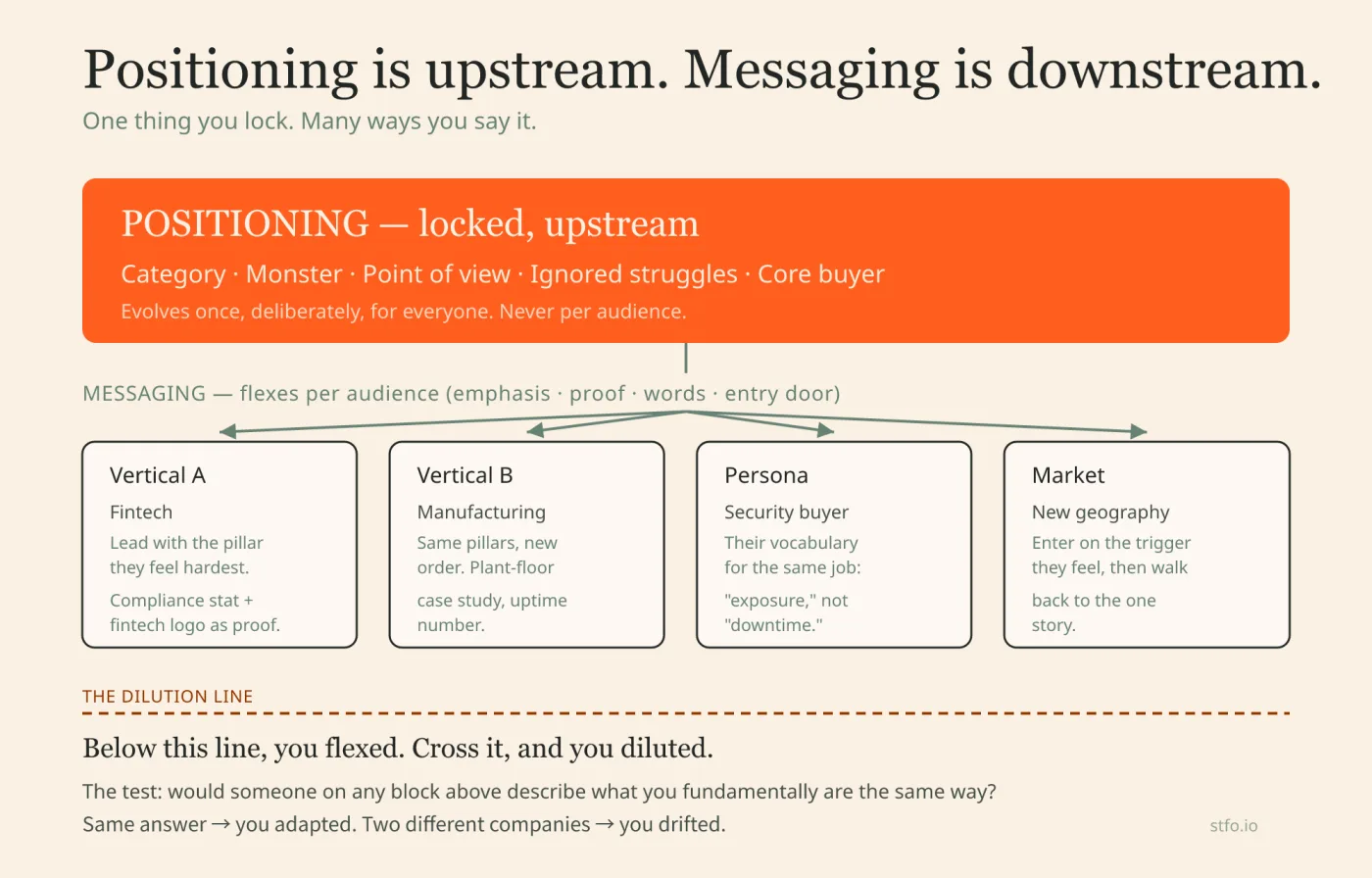
You can flex the downstream all day, but, the moment you update the upstream, you’re chipping away at the core.
And, to be clear, fix doesn’t mean frozen. Your unique positioning should evolve as you learn the market. But it evolves once, deliberately, for everyone, not quietly in a dozen directions at once to suit a dozen audiences. You know?
The drift.
You don’t lose your positioning in a strategy offsite. You lose it in the pipeline, one week at a time. The vertical deck adds a claim that isn’t quite in your positioning. The SDR’s new opener reframes what you do. The persona page, built to convert, leads with a benefit you don’t actually build your product around. Each move works in isolation. Each one gets a little further from the center.
Then the proverbial bill arrives, and it’s expensive.
I worked with a manufacturing-operations software company that had drifted like this for years, without ever calling it drift. Their product gets used every day by the continuous-improvement lead, the person on the plant floor running audits and gemba walks. So that’s who all the messaging spoke to. Audits, walks, checklists, the daily-management vocabulary. Reasonable. That’s the user.
Except the user doesn’t sign the contract. The industrial director does, and he came up through process and P&L, not the shop floor. He does not care about gemba walks. He cares about visibility across his sites and whether people quit. So every deal stalled at the same place: a champion who loved it and couldn’t get budget, because the company had spent years talking past the one person who could say yes. They weren’t diluted across a dozen verticals. They were diluted across two people, the user and the buyer. And that gap quietly capped every deal they ran.
That’s how it looks like. Your best rep and your newest rep describe the product differently on calls, and neither one is wrong, because there’s no longer a single right answer. Marketing spends real budget driving a message that fights the sales pitch, so the two halves of the funnel cancel out. And the founder stares at a number that stopped moving and can’t find the leak, because the leak isn’t one hole. It’s a slow bleed across everything.
Nobody decided to do this. But, also, everybody did.
The company above never saw it coming, but you can. Another client, a road operations software company, asked me the good version of this exact question before they’d shipped a thing: they lead with operations, so should they build a dedicated landing page for city planners, who care more about long-range planning? That question, asked out loud before the page exists, is the entire difference between adapting and drifting. So here’s how to answer it.
Three tests that catch it in ten seconds
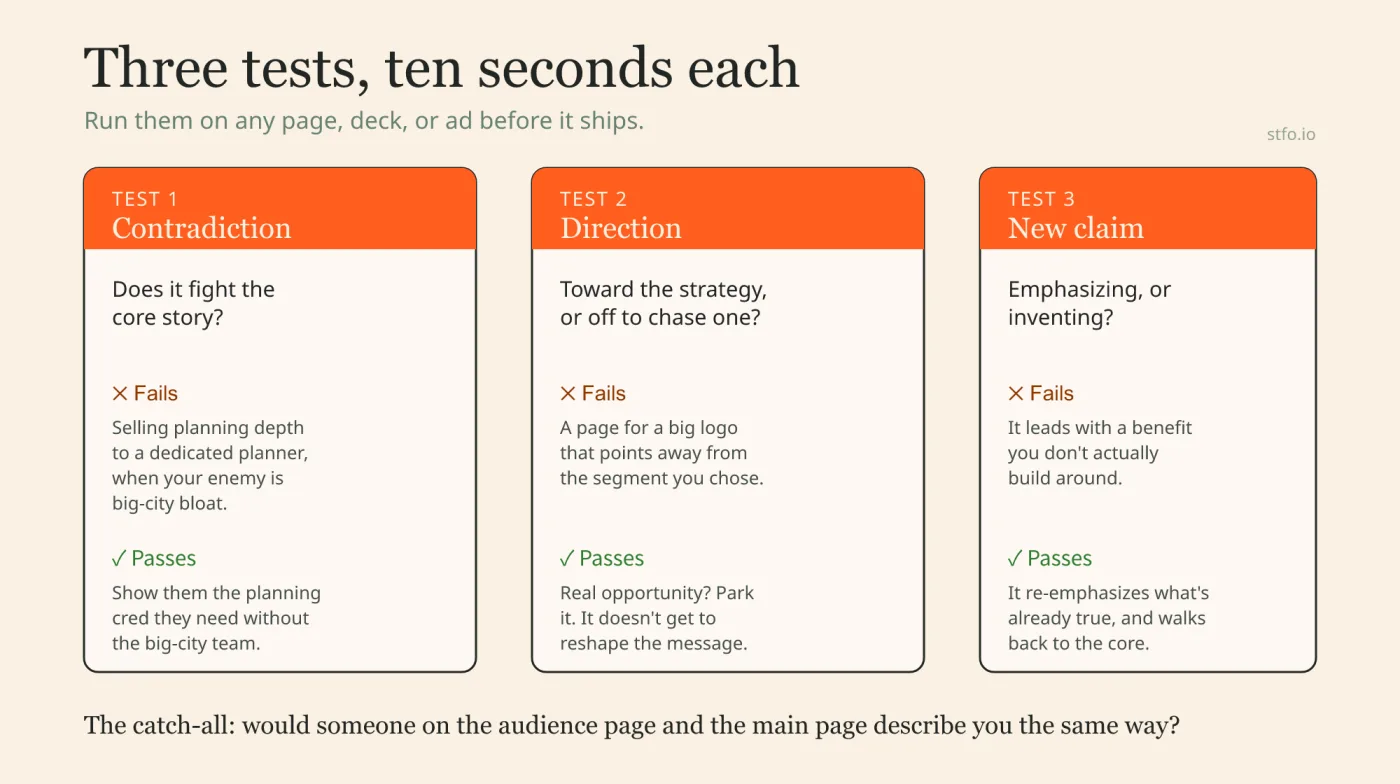
One. Does it contradict the core story?
Read the new line next to your positioning. If both can’t be true at once, it fails. The road-ops company’s enemy is big-city software built for departments with huuuuge planning teams. A page selling deep planning sophistication to a dedicated planner quietly sides with the thing they stand against. So it fails. The version that passes: show that planner how they get the planning credibility they need without the big-city team behind them. Same enemy. Same story. Their angle.
Two. Does it pull toward where you’re going, or off to chase one audience?
A big logo wants your product for something adjacent to your core buyer. Real money, real temptation. But if serving them well means building a page that points away from the segment you’ve chosen, it fails as a positioning move. It might still be a real opportunity. It’s just not allowed to reshape the message.
Three. Am I emphasizing something already true, or inventing something to make this audience care?
This is the most important of three. If the planner page talks about the planning you already deliver as part of your loop, and walks back to the core, it passes. The second it leads with planning as the product and drops the operation, it fails, because now a planner and your core buyer would describe two different companies.
In other words, if I had to wrap those three tests into one core question, it would be: would someone who landed on the audience-specific page and someone who landed on your main page describe what you fundamentally are the same way? Same answer, you flexed the messaging. Good. Different answer, you diluted. Baaaad.
Oh, and one more thing:
A job title is not a job. “City planners” is a demographic, and demographics are a trap. The real question is whether a planner is trying to make the same progress as your core buyer using different words, or a genuinely different one. If it’s the same progress, you don’t need a new position. You need different words for the same thing, which is just messaging. If it’s a genuinely different job, that’s not a landing page decision. That’s a “should we even be selling to these people” decision, and it’s a much bigger conversation than the one your PMM is having on a Tuesday afternoon with a landing-page template open. Have that conversation. Just don’t have it by accident, one page at a time.
I saw the frozen version of this at a domains company. Their strategy doc carried four personas, each with its own job written underneath it: the solopreneur avoiding cost, the developer chasing a clean .dev extension and fast DNS, the investor reselling three hundred domains as a side hustle, the local walk-in from a referral. Four jobs, never reconciled into one. So the homepage said “get online and look credible,” the product called itself a “domain platform,” and each persona page pulled in its own direction. Nobody was doing anything unreasonable. They’d just answered “who’s our buyer?” four times and shipped all four answers at once.
Now the green light: adapt hard, on purpose
You don’t want to over-correct, though.
A company gets so scared of losing its positioning that it runs one flat, beige, boring message for everyone, and the vertical prospect lands on the page and feels nothing, because it was written for no one in particular.
So, what to do? Slice and dice your positioning in different ways. For example, lead with the benefit that vertical feels the most, even if it’s benefit three for everyone else. Same benefits, different order.
Another one. Swap the proof: the fintech buyer sees the fintech logo and the compliance stat, the manufacturing buyer sees the plant-floor case study and the uptime number. Speak the buyer’s own vocabulary for the same underlying job, the security team’s “exposure,” the ops team’s “downtime,” different words, same progress. Bring them in through the trigger they actually feel, then walk them back to the one story you tell everyone.
The guardrail
How to prevent the positioning drift: hold it somewhere. For example, develop a messaging map: the sanctioned list of what you emphasize to whom, written down, so the AE tailoring a deck and the PMM building a page are pulling from the same source instead of improvising.
That’s how you stand the f*ck out.
Key terms
Positioning
Positioning is the upstream work of understanding how you address customer challenges that others overlook. It is built on five elements: job, alternatives, struggles, segment, and category. It is not a tagline exercise. The words come last, not first.
Unique Positioning
Unique positioning is the intersection of job, alternatives, struggles, segment, and category. Each element alone is not unique. The intersection is. The output is a statement that describes your meaningful difference, built for internal clarity, not as a homepage headline.
Jobs to Be Done (JTBD)
JTBD is a theory that people 'hire' products to fulfil needs in their lives. Louis uses the job as one of six insight types in the STFO framework. But JTBD alone is product-centric. It tells you the goal. It doesn't tell you which obstacles on the way to that goal are being ignored by the alternatives. That's where ignored struggles come in.