Product Narrative Design: The Monster + POV Playbook
TL;DR
Product narrative design is two things done together: picking the Monster (a semi-fictional enemy responsible for your segment’s struggles) and building a POV (a set of structured arguments that rally people against it). Most B2B narratives skip the Monster and go straight to product talk, which is why they sound like every other company in the category. A good narrative tells your segment whose fault it is, and what they should do instead. That’s it.
Why most B2B product narratives sound like a warmed-over keynote
Most B2B product narratives are either a feature list with a coat of paint on, or a Simon-Sinek-meets-Andy-Raskin Frankenstein that nobody on the sales team actually believes. The founder loves the deck. The BDRs quietly go back to talking about features.
Here’s what’s going on. Buyers, like the rest of us, want to make sense of the world. They want to know whose fault it is that they’re stuck. They want a clear-cut reason their current situation sucks. Give them that and they’ll listen. Withhold it and they’ll tune you out.
In Chapter 8 of Stand The F*ck Out (“The Monster”), I put it like this:
“The monster is a semi-fictional enemy representing some of the problems the people in your segment face. By giving a name to their struggles, you aim to give them a clear enemy to blame, making their world easier to understand and control. Your brand then becomes the natural way to help them fight it.”
That’s the work. Pick the Monster first. Build the POV around it. Everything else (tagline, website headline, sales deck, homepage, blog) is downstream.
What product narrative design actually is (and what it isn’t)
The word “narrative” gets thrown around like confetti. Let’s clean that up.
| Term | What it is | What it’s not |
|---|---|---|
| Product narrative | The Monster your segment is fighting + the POV that rallies them against it. Structured, repeatable, shared across every asset. | A founder origin story you tell at Saastr. |
| Messaging | The exact wording on the homepage, ads, sales deck. Downstream of the narrative. | The narrative itself. |
| Positioning | Who you’re for, what you do, and why you’re different. Upstream of the narrative. | A tagline. |
| Tagline | The one-liner under your logo. | Anything that matters on its own. |
If you can’t name your Monster in one sentence, you don’t have a product narrative. You have messaging with delusions of grandeur.
The Monster: pick the enemy before you pick the message
The Monster isn’t a competitor. It’s the thing behind your segment’s struggle that isn’t their fault, so they can point at it and feel less alone.
Three rules for picking one (all from Chapter 8):
- It must deflect blame from your segment. Your buyer already feels dumb for not having this figured out. The Monster takes that weight off them. “It’s not your fault, it’s [X].”
- It must be the cause of the struggle, not just a random villain. If you point at something your segment doesn’t already resent, the narrative rings false.
- It must simplify the choice. Either they keep fighting the Monster with what they have, or they bring you in.
Four types of Monster (with B2B examples)
| Type | What it is | B2B example |
|---|---|---|
| The Corporate Giant | A big, faceless incumbent whose size is the problem. | ”The Big 4” for a boutique consultancy. |
| The Alternative Solution | The patchwork of tools or workarounds people use today. | Hotjar vs traditional web analytics. |
| The Culture of the Category | A belief or habit the industry takes as gospel. | STFO vs toxic growth-hack marketing. |
| The Monster Within | A bias, fear, or reflex inside the buyer. | Uncertainty Experts vs the human fear of the unknown. |
My favorite is the Culture of the Category. You don’t call anyone out by name. You point at a practice, a belief, a way of doing things everyone in the industry treats as normal. The risk of backlash is low. The reward is huge. Your segment nods along. Your competitors can’t easily claim the same Monster because they helped build it.
The POV: structure the narrative with CHIPS
Once the Monster is set, the POV does the talking. A POV is a series of consistent arguments, woven into every asset you put in the world, that rally your segment against the Monster. Not opinions. Not hot takes. Arguments.
In Chapter 9, I share the CHIPS framework. Five parts:
- Common belief: what people in your space tend to think or do.
- Happen: the consequence of that belief.
- Impact: the effect it has on your segment specifically.
- Proof: why they should believe you (logic, stories, stats, your experience).
- Solution: what should be done instead.
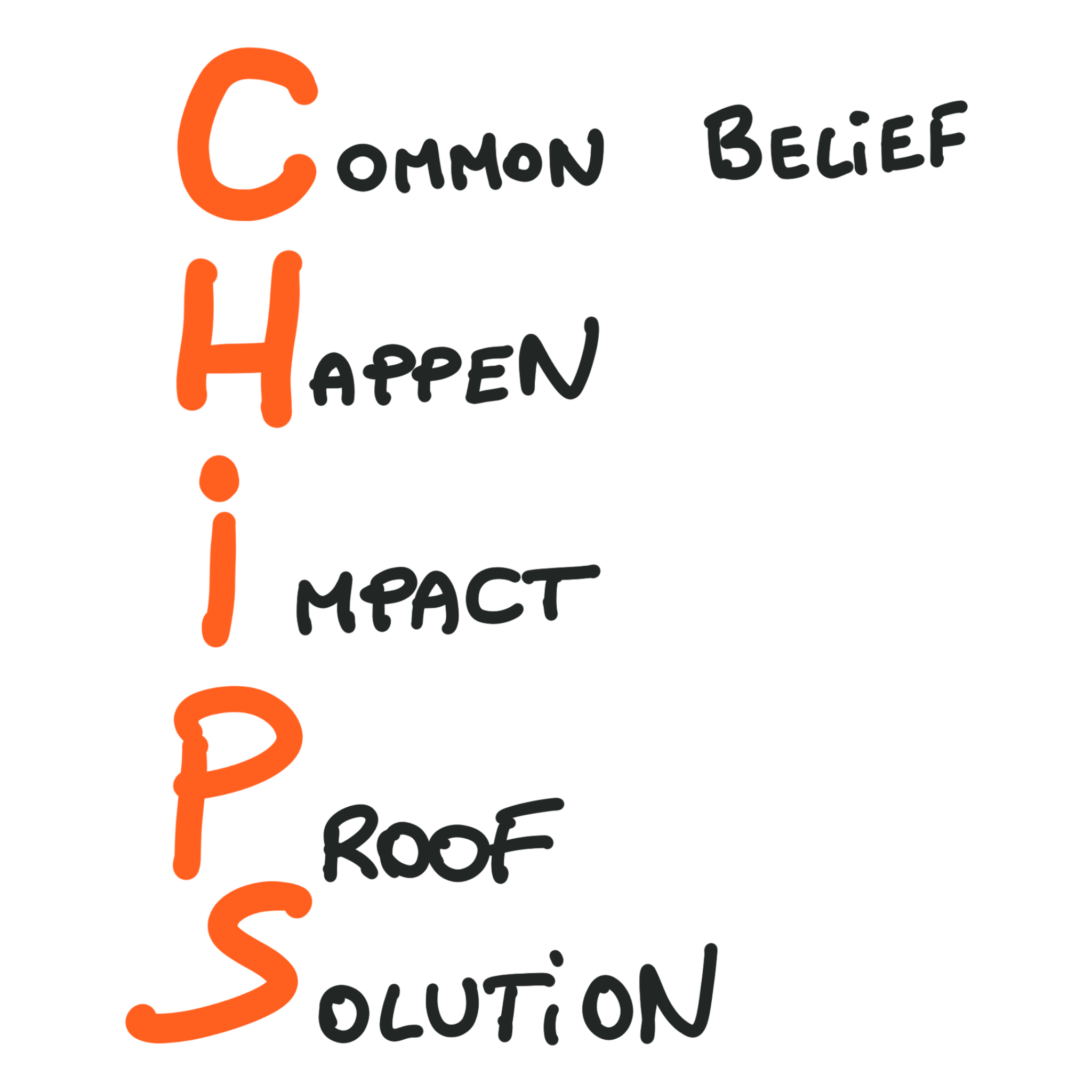
That’s it. Five lines. Every asset you ship (ad, email, homepage section, sales slide, LinkedIn post) should be traceable back to at least one CHIPS row.
Here’s the POV for this book, written in CHIPS form:
| Phase | |
|---|---|
| Common belief | Brands think a strong POV alienates customers. |
| Happen | So they play it safe and blend the f*ck in. |
| Impact | Their audience feels confused and uninspired, unable to connect with a brand that doesn’t seem to stand for anything. |
| Proof | Humans have a deep-seated desire for certainty and control. A POV fills that need. Brands without one create the opposite: noise. |
| Solution | Take a stand against the things that threaten your segment. Build trust by turning random actions into a cohesive narrative. |
Five lines. That’s the spine of the book, every chapter, every LinkedIn post, every keynote. Same argument, said 1,000 different ways.
Three worked examples
1. Hotjar vs traditional web analytics
Back when I was at Hotjar helping with positioning, we faced a classic problem: our buyers were already using Google Analytics and didn’t think they needed another tool. Analytics had the room.
So we didn’t try to out-analytics Google. We picked a Monster: traditional web analytics. The category itself.
| Phase | |
|---|---|
| Common belief | Web analytics tools show you what’s happening on your website. |
| Happen | They only show you the numbers: visits, time on page, bounce rate. |
| Impact | Product and marketing teams end up guessing why visitors do what they do. They can’t see the human behind the data. |
| Proof | Over 900,000 websites were using Hotjar by then, because knowing “what” is not the same as knowing “why”. |
| Solution | Combine analytics with behavior insights (heatmaps, session recordings, surveys) so you finally understand the human story. |
The narrative wasn’t “we’re better than Google Analytics.” It was “the whole category is blind in one eye, and we help you see with both.” Buyers didn’t have to feel stupid for using GA. The Monster did the blame-taking.
2. PTDC: flashy physiques vs fundamentals
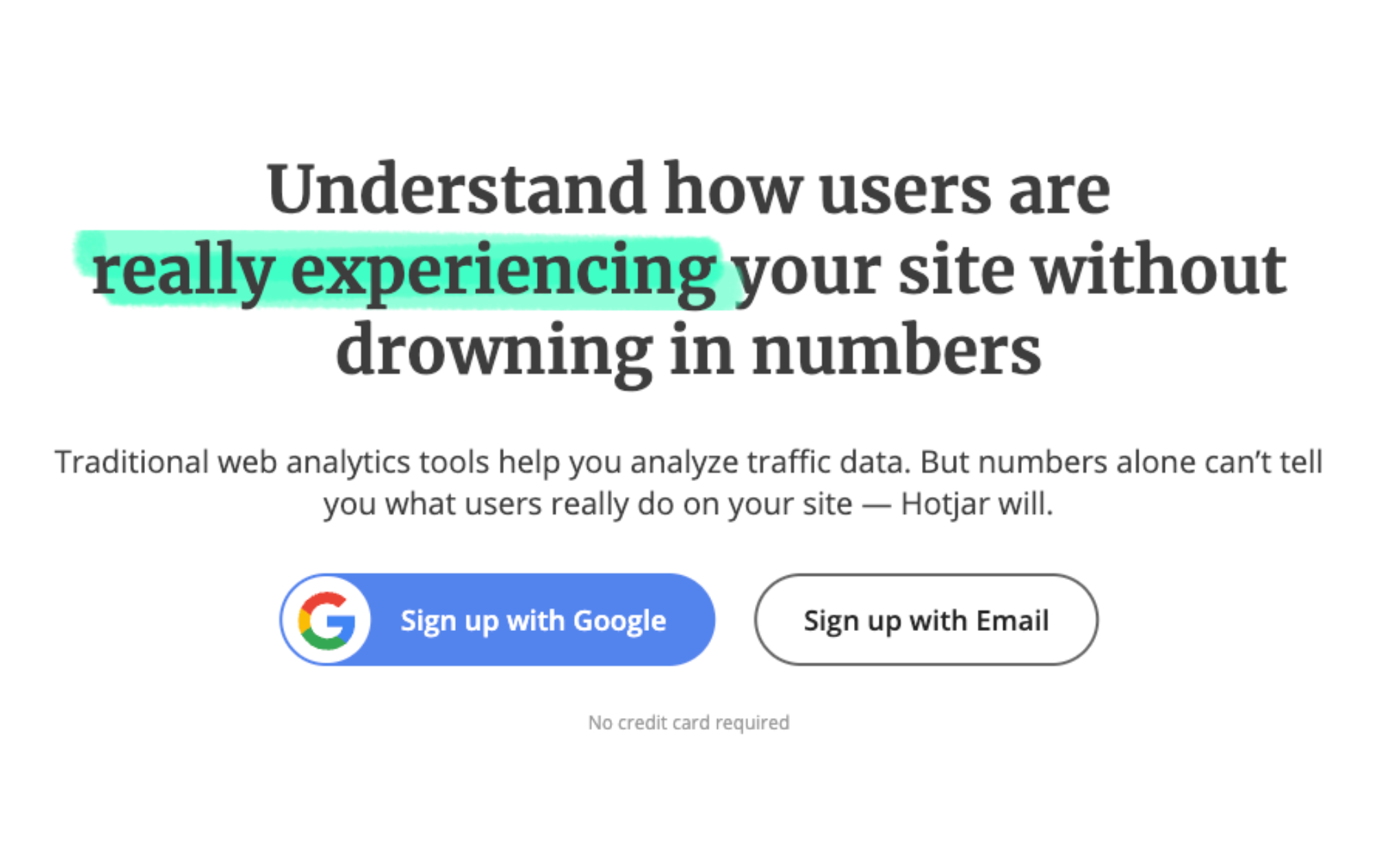
Jon Goodman runs the Personal Trainer Development Center (PTDC). His segment (serious personal trainers) was drowning in a Monster: the Instagram guru who sells sex, fear, and a six-pack instead of actual coaching skill.
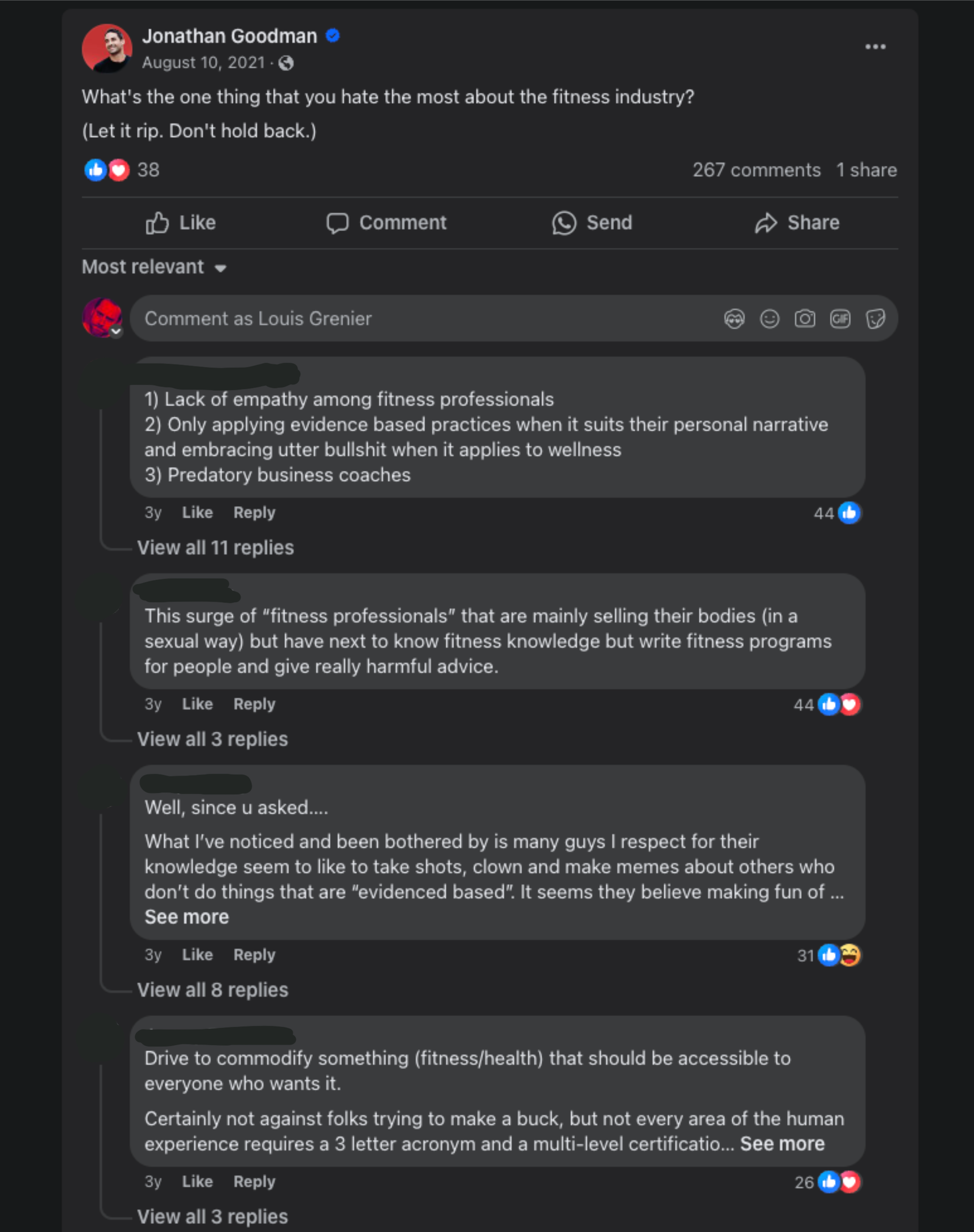
To find the Monster, Jon did something simple and slightly risky: he asked his Facebook audience, flat out, what they hated most about the fitness industry. Hundreds of unfiltered answers poured in.
From Chapter 9:
| Phase | |
|---|---|
| Common belief | Most trainers think that, to be taken seriously, they have to flaunt their physique online. |
| Happen | They compete on looks instead of craft. |
| Impact | It’s hard for serious trainers to be seen as serious professionals, which holds their business back. |
| Proof | Jon has helped trainers scale their businesses since 2012. The ones who succeed long term prioritise ethics and look exactly like their Instagram pictures. |
| Solution | Forget the flash. Focus on the fundamentals. Treat fitness as a lifelong journey, not a 30-day challenge. |
Same POV, sliced across an Instagram post, a homepage section, a newsletter. Different words every time. Same argument.
3. A PR platform for brands where getting it wrong matters
(Recent client work, kept anonymous. The narrative itself is public on their homepage.)
This company’s segment isn’t small PR teams. It’s the opposite. Brands operating in multiple markets and languages, with spokespeople everywhere, press releases buried across email threads, sign-offs spread across tools that don’t talk to each other.
The Monster isn’t a competitor. It’s an Alternative Solution Monster: the fragmented PR stack. The habit, at enterprise scale, of solving complexity by adding more tools instead of fewer.
| Phase | |
|---|---|
| Common belief | When PR gets complex, you fix it by adding more: a tool for media lists, one for monitoring, one for sending, one for approvals. |
| Happen | You end up with a dozen platforms that don’t talk to each other. No single place where the truth lives. |
| Impact | Your story drifts. Nobody can say cleanly what’s in the pipeline or what went out last week. Leadership asks what PR is doing and there’s no clean answer. |
| Proof | Over a decade of work with brands where getting it wrong matters (Wise, Domino’s, Shimano, Polaroid, Just Eat). Fewer tools, one source of truth. |
| Solution | Fewer things, not more. One place for your newsroom, your media contacts, your outreach, your coverage, your translations, your numbers. Everyone working from the same story, Singapore or Amsterdam. |
Same Monster appears on the homepage, in the sales deck, on LinkedIn, in the webinars. BDRs don’t memorise talking points. They know what they’re fighting.
Common mistakes B2B teams make with product narratives
- Picking a Monster that’s just a competitor. “We’re better than Salesforce” is not a narrative. It’s a pissing contest. Point at the practice or the category, not a company.
- Writing one CHIPS row and calling it a narrative. One argument is a POV seed. A narrative is the same argument sliced into 50 variations across every asset over months.
- Making the narrative about the product. If the Monster is your weak area and your product is the hero, the buyer smells it. Monster first. Product is how you help them fight.
- Confusing a founder story with a product narrative. Your origin is fuel. It’s not the narrative itself. The narrative lives in what your segment reads, not in what you tell on stage.
- Updating the narrative every six months. A POV that shifts with every quarterly planning cycle is noise. Good narratives are compound-interest assets. Leave them alone and let them accrue.
- Keeping the narrative in a Google Doc. If your sales team, your writers, your support people, and your homepage copy aren’t all pointing at the same Monster, you don’t have a narrative. You have a memo.
FAQ
What is product narrative design?
Product narrative design is the work of picking a Monster (a semi-fictional enemy responsible for your segment’s struggles) and building a POV (a structured set of arguments) that rallies your segment against it. The output is a spine every asset you ship can point back to, from homepage copy to sales decks to ads.
What’s the difference between a product narrative and a brand story?
A brand story is usually about you: your origin, your founders, your values. A product narrative is about your segment: the enemy they’re fighting and the choice they face. Your origin can feed the narrative, but the narrative doesn’t lead with you. It leads with them.
How do I find the Monster for my brand?
Two good starting points. Look at your origin story: what pissed the founders off enough to start this thing? And look at customer conversations: what do your best customers rant about when you ask them what they hate about the category? The Monster is usually hiding in one of those two places.
Can B2B companies really use the “enemy” framing without sounding aggressive?
Yes, if the Monster is the right kind. Pointing at a big competitor by name tends to backfire. Pointing at a practice (“spray-and-pray PR”), a category (“traditional web analytics”), or a mindset (“growth-hack marketing”) gives you all the rally-around energy with almost none of the political risk. You’re not punching down. You’re pointing sideways at the thing everyone in the room already resents.
How long should a product narrative be?
The Monster is one sentence. The POV is five lines (CHIPS). The variations you write from that spine are infinite. If your narrative lives in a 40-slide deck nobody can summarise, you don’t have a narrative. You have a document.
How often should I update my product narrative?
Rarely. A good Monster tends to last years. The POV stays stable. What changes is the proof points (new stats, new case studies) and the slicing and dicing (new formats, new channels). Teams that rewrite their narrative every planning cycle usually don’t have one in the first place.
Do I need a product narrative if I already have positioning?
Yes. Positioning tells you who you’re for, what you do, and why you’re different. The narrative is how you say it in a way buyers actually hear. Positioning is the strategy. Narrative is the vehicle.
The take
Most B2B companies don’t have a product narrative. They have a messaging doc, a few taglines, and a founder who gives the same keynote at three conferences a year. That’s not a narrative. That’s scraps.
A real narrative has a Monster your segment already resents, a POV that rallies them against it, and enough slicing and dicing that the same argument shows up in 1,000 different places without sounding repetitive. It’s not built in a weekend. It’s probably one of the highest-leverage things you can do in B2B GTM, because once you have it, every asset downstream (ad, email, homepage, deck) gets easier and sharper at the same time.
Pick the Monster. Structure the POV with CHIPS. Point every asset at the same thing. Then leave it alone and let it compound.
Bisous.
Related episodes
Key terms
Point of View (POV)
A point of view is a collection of consistent messages inserted into everything you do and say, showing your segment you're committed to protecting them. It is not thought leadership. It is not random opinions. It is a coherent signal that transforms random acts of marketing into a narrative.
Positioning
Positioning is the upstream work of understanding how you address customer challenges that others overlook. It is built on five elements: job, alternatives, struggles, segment, and category. It is not a tagline exercise. The words come last, not first.
Thought Leadership
Nobody credible self-describes as a thought leader. If you have to call yourself one, you're not. The term produces either hermit crabs hiding in their shells or intellectual terrorists shouting into the void. Replace it with a point of view: a structured, consistent signal that protects your segment.