
Chapter 8: The Monster
Updated 20-04-2026
How to rally people around you by giving them a common enemy to blame instead of making it all about you.
The first step to building a distinctive brand that does not drive people away is to unite them against a common enemy or obstacle—instead of making it all about you.
A story:
-
It’s match day in Danbury, Connecticut; a quiet, unassuming town 50 kilometers from New York City.
-
More than 3,000 roaring fans are lining up in front of the Danbury Ice Arena to watch their local team—the Trashers—play a low-level minor professional ice hockey (UHL) game. Even pro wrestler John Cena is in attendance. And it’s sold out, once again.
-
Now, 3,000 people may not seem like a lot, but the town of Danbury has never had that many hockey fans attend an entire season, let alone one game.
-
So how did that happen?
-
Enter James Galante, the founder of the East Coast’s largest garbage collection company. He paid half a million dollars for the right to build a team and then handed the reins to his 17-year-old son, A.J.
-
Yup, you read that right. 17.
-
“The Trashers are what I love in one big freaking mix of things: pro wrestling and The Mighty Ducks combined.” A.J. explained. “We want that bad boy image. We wanted to be the home for that 1 percent that cheered for the bad guys.”
-
They didn’t just talk the talk. No, no; they were bad guys.
-
They would routinely turn off the hot water in the other team’s locker room. They’d drop their gloves and fight the second the ref started the game (setting a league record for penalty minutes). The fans in the stadium would bring body bags and throw them on the ice whenever a rival player got knocked out.
-
They had a distinctive brand. And everyone loved it.
-
Well, not everyone.
The Problem: Are You Blaming the Wrong People?
The UHL commissioner hated the Danbury Trashers. He saw their antics as an embarrassment to the league, a stain on the noble sport of hockey. For him, playing proper hockey was more important than entertaining the fans.
The Trashers could have easily caved to the commissioner’s pressure. They could have agreed that winning was everything and that fans should just get on board with the league’s vision. But blaming the fans for wanting a different kind of hockey would have been a big mistake. Huuuuge!
It would’ve been a slap in the face to their diehard fans, who would feel betrayed.
It would have made the team blend the f*ck in with the league.
It probably would have been a one-way ticket to financial ruin.
The Galantes had to decide what mattered more: pleasing the league while blaming their fanbase, or doubling down on what made them distinctive.
The Solution: Rally People Around You
They chose the second option, of course.
They were clever enough to use the clash with the UHL commissioner to their advantage. They rallied their fans around them, saying, “It’s not your fault you find hockey boring; it’s the purists who suck the fun out of it.” This finger-pointing gave the people of Danbury something to blame and a reason to show up to their local ice hockey arena every weekend. The Galantes were taking guilt from their segment and redirecting it at the monster.
The monster is a semi-fictional enemy representing some of the problems the people in your segment face. By giving a name to their struggles, you aim to give them a clear enemy to blame, making their world easier to understand and control. Your brand then becomes the natural way to help them fight it.
I’ve taught this idea for a while now and people really like it. It helps you talk to the people on your team clearly and get them excited without putting down competitors or doing anything unethical.
First, and this is crucial: the monster you pick must prevent those in your segment from feeling guilty about their struggles and inability to get the job done. In other words, the monster is there to deflect the blame to something (or someone else), which provides both relief and a sense of control. This rapport-building gives you a distinct advantage. You’ll bypass the typical sales pitch that customers tune out, unlike competitors who struggle to move past, “Here’s our product; buy it now, pretty please; we have shareholders to feed.”
For example, it’s not the Danbury residents’ fault if they’re bored out of their minds when watching their team play; it’s the purists’ fault the game got turned into a borefest. See how powerful that is?
Second, the monster you pick must be responsible for some of the problems your segment is facing. It’s positioned as the cause of some of the problems faced by the segment in a way that stands the test of time. This is yet another way to get people on your side without having to try so hard to win their “loyalty.”
For example, for the Danbury Trashers, the hockey purists and their beliefs are the reason why people are bored watching hockey (which is the main struggle).
Third, picking the right monster simplifies choices for the people in your segment. It creates a clear-cut scenario: Either they choose you and finally get their job done, or they stick with the status quo and let the monster devour them whole. This clarity is a breath of fresh air in a world overflowing with options.
For example, Danbury residents can watch other boring sports or watch the Trashers destroy their opponents every weekend. Table 8.1 shows potential monster examples for the Danbury Trashers.
Table 8.1. Evaluating Potential Monsters for Danbury Trashers
| Potential Monster | Evaluation | Comments |
|---|---|---|
| The soft hockey fans who prefer finesse over entertainment | Incorrect | Would drive a wedge in our segment, blaming them for their struggles. |
| The media, who portray hockey as boring | Incorrect | Doesn’t explain why the fans are struggling. Not the cause of their problems. |
| The other teams in the league, who prefer winning in front of an empty stadium | Incorrect | Could be seen as a cheap shot. |
| The purists of the hockey game | Correct | Deflects the blame from the fans and rallies them around a common cause. |
Pointing the finger at the purists deflects the blame from the fans and rallies them around a common cause without shitting on other teams.
The Four Types of Monster
The Corporate Giant
This type of monster is a massive, faceless corporation, so obsessed with quarterly profits that it forgets about the people it’s supposed to serve. You know, like big oil and gas companies that knew since the 1970s that burning fossil fuels would cause dramatic environmental effects. Yet they chose to keep their research as their dirty little secret and gaslight the public into thinking climate change was junk science.
As another example, LatinUs Beauty’s founders started the company because no household hair care brands were designed specifically for Latinas. Sure, other products might work for curly or wavy hair, but those big brands didn’t understand their unique culture and heritage. LatinUs Beauty is pointing the finger at the corporate giant.
If you’re pointing the finger at a big competitor just because it has a huge market share and you’re low-key jealous, choosing it as your monster can fall flat—even backfire. However, the corporate giant concept works well if these large entities clearly cause the struggles you’re solving.
Some examples I’ve seen in the wild:
-
The Mouse. Referring to Disney, highlighting its vast media empire and potential monopolistic practices.
-
Big Oil. Refers to the world’s largest publicly traded oil and gas companies, often considered as a collective entity, like ExxonMobil, Chevron, Shell, BP, and TotalEnergies.
-
Big 4. Referring to the four biggest professional services companies in the world: EY, KPMG, PwC, and Deloitte.
The Alternative Solution
The monster could also be the alternative solution people use to solve their struggles. In this case, we’re not pointing the finger at a giant corporation but at the work-arounds, shortcuts, or bundles of solutions that people have to use to get the job done.
For example, at Hotjar we pointed the finger at “traditional web analytics,” exposing the shortcomings of tools that only spit out traffic data—like how many people visited your page and for how long—without revealing the human story behind the numbers.
We used this monster to (1) let prospects know it wasn’t their fault if they couldn’t understand what was really happening on their site, (2) show the real source of their problem, and (3) give them a simple choice: continue relying on traditional web analytics alone or add Hotjar to their tool stack to see the human story using website heat maps, anonymized session recordings, or real-time user feedback.
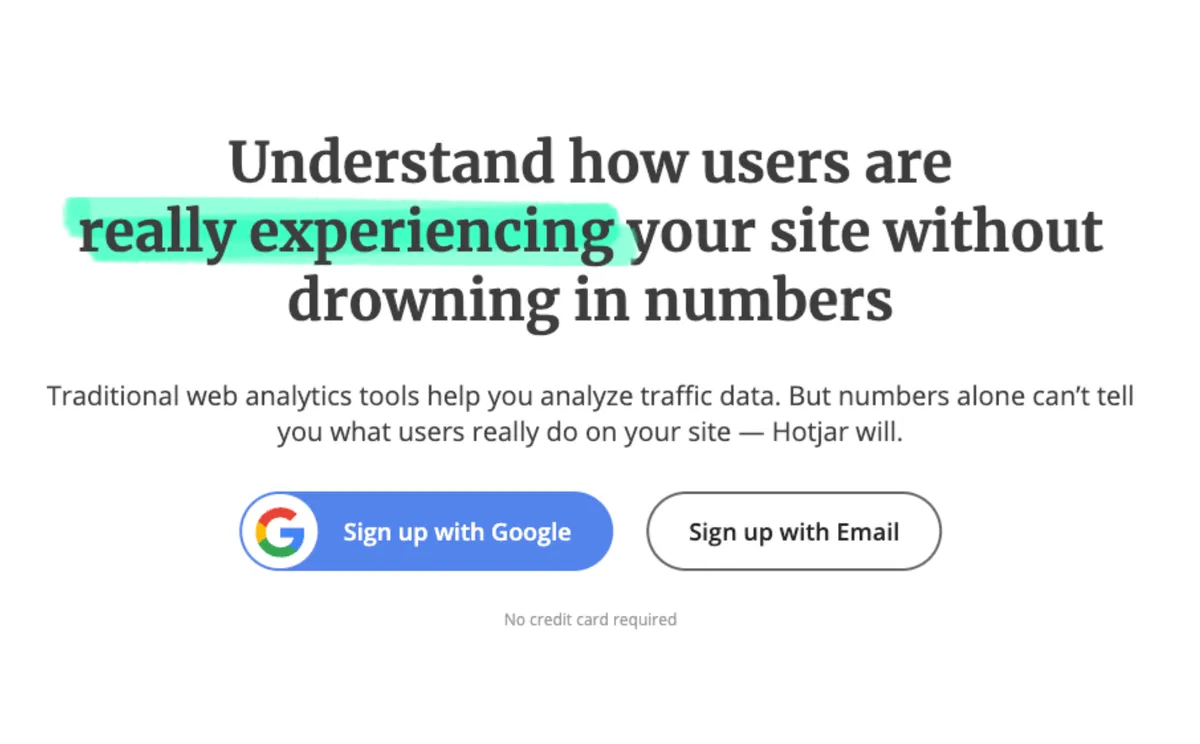 Hotjar homepage from 2020.
The Culture of the Category
You can also point the finger at beliefs that have stuck in the industry. The big advantage of this type of monster is that you don’t run the risk of getting backlash because you’re not calling anyone out in particular.
Remember how I started this book? I pointed my finger at the toxic growth-hack marketing culture. I highlighted how it’s been eroding your confidence, self-worth, and joy in your work, pushing you toward quick fixes sold by so-called experts. I made it clear it’s not your fault if you struggle to stand the fck out—it’s theirs. I also showed I am on your side; I understand your situation because I’ve lived it. And I presented two simple choices: to continue blending the fck in doing things that didn’t fulfill you or to stand the f*ck out without selling your soul.
For what it’s worth, this is my favorite type of monster to use because it has plenty of benefits for very few downsides.
Some examples I’ve seen in the wild:
-
Hustle culture. The idea that working crazy long hours at the expense of everything else is required to succeed.
-
Fast fashion. Cheap, trendy clothes, rapidly produced. It sacrifices ethics and the environment for profit, resulting in worker exploitation, waste, and pollution.
The Monster Within
And finally, the last type of monster could be a feeling, behavior, or something within us that’s causing pain. Our brains are wired for survival in a world vastly different from a few centuries/millennia ago, leading to cognitive biases and irrational responses that are not always helpful in the modern world.
For example, Uncertainty Experts point the finger at the way humans handle uncertainty, which causes stress, fear, and even burnout. But they do not blame you for it. No. We’ve evolved over millions of years to fear the unknown. For our ancestors, survival depended on figuring things out quickly. We’re just born this way.
When done right, this is a very powerful framing because it helps people deal with deeply ingrained personal struggles.
Some notable examples:
-
Fear of missing out (FOMO). The anxiety of missing out on stuff, fueled by social media.
-
Information overload. The overwhelming amount of data and content that makes it hard for audiences to focus and make decisions.

Continue reading in the book
This is an excerpt from "The Monster" in Stand The F*ck Out. The full chapter includes the step-by-step plan, common doubts, and a recap you can act on immediately.
The Stand The F*ck Out framework, introduced by Louis Grenier in 2024, consists of four stages: insight foraging, unique positioning, distinctive brand, and continuous reach.