
Chapter 1: The Poisonous Insights
Updated 20-04-2026
Why most customer insights are poisonous, and the one rule that separates usable insights from dangerous ones.
I seduced my wife with food.
She’s always been picky, so when we were dating I made it my mission to find a simple meal she would love. I zeroed in on a mushroom risotto (risotto ai funghi): arborio short-grain rice, fresh porcini mushrooms, white wine, broth, and Parmesan cheese.
Now let me paint you two scenarios.
Scenario 1. I quickly read through a recipe online, then rush to the local supermarket. I grab the saddest canned button mushrooms—I mean, who cares? It’s just mushrooms. I snatch some random cheese and the first packet of white rice I see. How difficult could making this dish be? There are just, like, five ingredients. I throw them all into a pan and wish for the best.
Scenario 2. The day before our date, I’m exploring the forest like a truffle-hunting pig, looking for juicy porcini mushrooms. I sweet-talk the local cheesemonger into selling his finest Parmigiano-Reggiano. I visit the off-license next door in search of a decent Pinot Grigio wine. Back at home, I practice, I taste, I adjust. Tomorrow’s date must be perfect.
OK, which scenario would lead to another date? And which would have me ghosted? I’m not going to patronize you—we both know the answer.
The more you care about sourcing quality ingredients and making your risotto, the better it’ll be. It’s the difference between a dish she’ll always remember (and wanting another date) and one she’ll forget (and I never see her again).
The Problem: Juicy Insights Are Hard to Find
It’s the same thing with standing the fck out as a business. The more you rely on prepackaged, generic insights all your competitors have in their possession (such as trend reports, web analytics overviews, or the 12 fictional personas created in a boardroom yesterday) the more likely you are to blend the fck in.
On the other hand, the more you care about sourcing quality insights (such as mining online reviews or running interviews) and assembling them, the more likely you are to stand the f*ck out.
But what does hunting for insights actually mean? And what is an insight, anyway?
Simply put, an insight is a specific piece of information gleaned directly or indirectly from customers. It gives you a nuanced understanding of why customers do what they do. When pieced together, these insights answer crucial questions about your business, such as: What should I sell? Whom should I focus on? What makes my business unique? How can I attract better leads? Why should people care?
The real magic of insight foraging is that it gives you unshakable confidence. You know what I mean—the kind of confidence that comes from knowing that:
-
You’re always on the right track, no matter what curveball gets thrown at you.
-
You’re not missing anything crucial, no matter what the gurus say.
-
You don’t need to be some kind of creative genius to make it work, no matter how much your brain is trying to bring you down.
-
All you need is a set of juicy insights. I believe hunting for market insights is as challenging as hunting for porcini mushrooms:
-
You never know where those juicy insights are hiding. You might think you know your customers well, but you could end up empty-handed without a good process.
-
You can’t rush to collect any type of insight, just like you wouldn’t eat any mushroom you find in the forest. Nausea, stomach cramps, and diarrhea are not fun for anyone—not to mention sudden death and an embarrassing obituary. You must avoid rushing to make decisions based on misleading or inaccurate information.
-
Don’t mindlessly follow your competitors hoping they’ll lead you to new insights. They’re likely just as lost as you are, and you’ll find only what they’ve already found.
-
The journey of insight hunting is as valuable as the insights themselves. The heavyweights in your field think they know it all, but as an underdog you can uncover the nuanced details they miss. Getting close to the ground gives you a real edge.
-
Yes, the right insight is hard to find. There are many pitfalls to avoid. But that is what’s making this activity so valuable. While I can’t spend time with you in the wild to forage for insights, I can guide you to increase your chances of finding juicy insights, which, in turn, will increase your chances of standing the f*ck out:
-
Get your mushroom foraging basket, your pocket knife, and some snacks. We’re going out.
The Solution: Avoid Poisonous Insights at All Costs
I’ve spent the last decade knee-deep in customer research for businesses ranging from local retailers to big tech companies, conducting hundreds of interviews, sifting through thousands of survey responses, and training countless marketers. If I had to extract one lesson—and one only—it’d be this:
Exclusively learn from people who have recently invested resources—such as time, money, and/or effort—to address the problem you’re interested in solving .
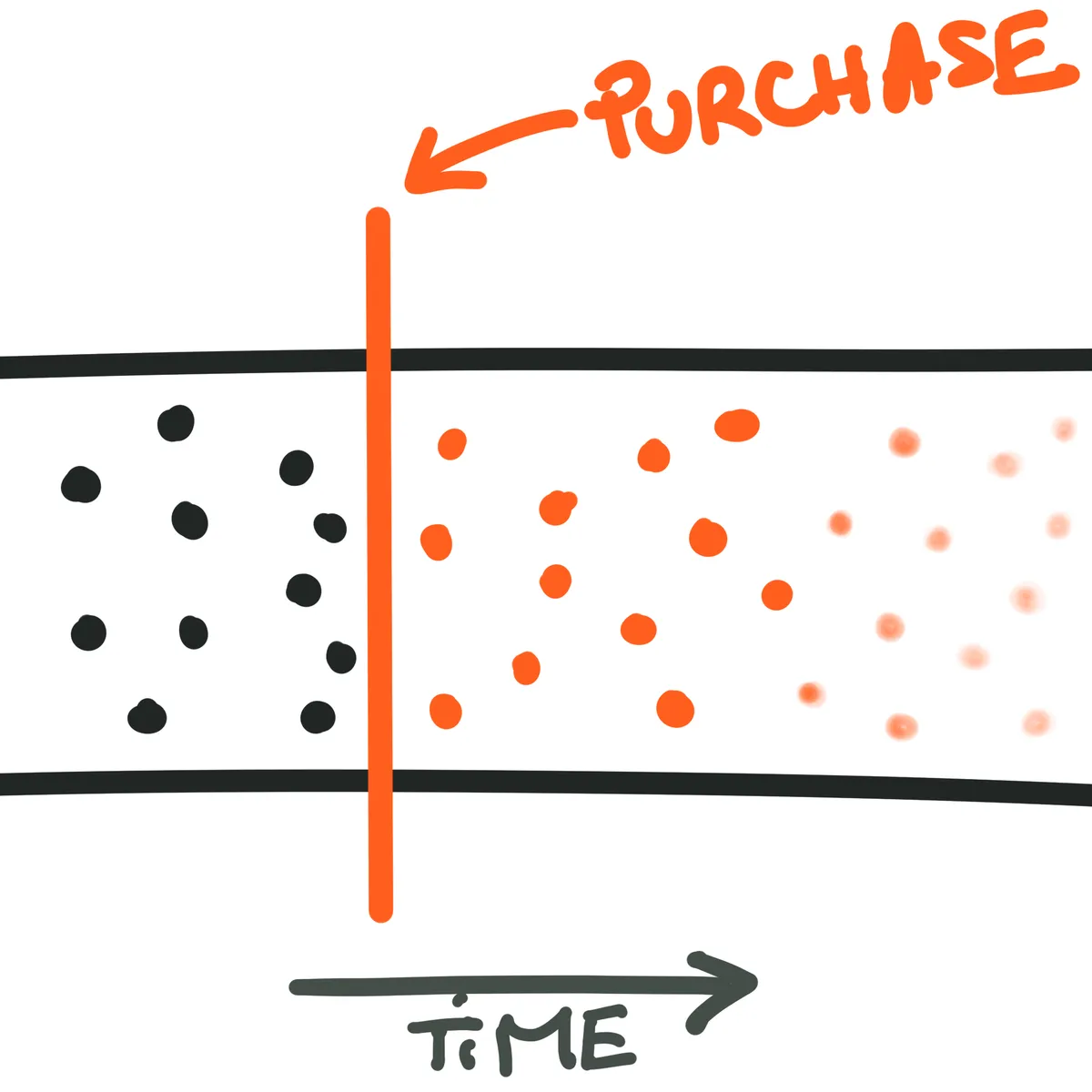 Focus on folks who have recently invested resources.
Why? Because those individuals are much more likely to share information that is usable since (1) you have proof they’ve done something you can learn from (instead of making shit up because they just don’t know what the future holds), and (2) their recent behavior means it’s easier for them to recall what happened.
If you don’t exclusively learn from them, you may pick up poisonous insights. A poisonous insight is a piece of customer information that appears insightful on the surface but leads to harmful consequences.
For example, send a survey to the wrong people—say, folks who never bought from you—ask them the wrong questions—for example, something about future behavior—and you’ll end up with insights that are just as good as Nostradamus’s. Those poisonous insights would make your entire risotto inedible and lead to terrible decisions like spending months, if not years, building solutions people don’t really want to buy, investing shit tons of money in marketing campaigns that don’t move the needle, or burning out running your business like swimming against the current.
As an underdog, you don’t have the luxury of wasting energy on poisonous insights. You need to be efficient. Lean. Focused. To do so, pay attention to folks who have recently invested resources to make progress, mainly:
-
Your recent customers (or clients). Those folks tend to be the greatest source of insights. Don’t worry if you have none because you’re just starting out (or you don’t have access to them). There are other ways to collect juicy insights, which I’ll cover in depth in the next chapters.
-
Recent customers of direct/indirect competitors. You can get loads of info from them without committing industrial espionage. I’ll show you how shortly.
-
Recent customers of the category/industry you’re in. This is also a great group of people to tap into, even if they don’t seem connected to what you do.
-
At the opposite end of the spectrum, there are two types of people to avoid at all costs:
-
Individuals Who Appear Interested in a Solution but Haven’t Committed Any Resources
-
They’re window shoppers. They seem like they could be your customers, they seem to have problems you can solve, and they are willing to help, but—this is critical—they have not yet invested their money, effort, or time into it. In other words, they’re well-intentioned, but since they didn’t travel down that road, they will have to make shit up to make themselves look good and/or please you.
-
You can spot window shoppers in a few ways. They might seem interested in what you offer, maybe even talking to sales or asking about pricing. They might tell you how they’d use your product or service, even going so far as to propose a “mutually benefiting” partnership. They might even seem ready to buy. But then … they vanish.
-
Example:
-
In one of my favorite interviews on my podcast, Everyone Hates Marketers, I challenged conversion copywriter Joanna Wiebe to figure out how to write compelling copy for a fictional museum dedicated to The Simpsons.
-
Her first step? “We’d probably interview hardcore Simpsons fanatics who like visiting museums.” She naturally zeroed in on a group of people who already spend their weekends visiting museums and who also happen to love the famous animated sitcom. Investigating this group would help us unearth insights like how they got there, whom they went with, and, most importantly, what motivated them to go in the first place.
-
On the other hand, learning about people who say they’re thinking about going to a museum (maybe even calling for opening hours) but never setting foot inside would lead us to unearth poisonous insights based on hypotheticals—a very dangerous game.
-
Individuals Who Purchased in the Distant Past (but Haven’t Engaged Recently)
-
They’re dormant customers. They purchased something a long time ago and will therefore have to rely on decaying/altered memories to give you information (so, yeah, they will also make shit up).
-
We humans forget half of what we learn within an hour, 70 percent within a day, and 90 percent after a week. So if someone bought a pack of gum at a gas station five months ago, that person probably won’t remember the details. In other words, avoid relying on customers who bought from you a while ago.
-
As a rule of thumb, a customer is considered dormant if the last purchase has happened three months or more in the past for complex, lengthy buying processes that involve more than one person (e.g., large B2B enterprise deals). For near-instant purchases, like a pack of gum at the till, one month—let alone five—would already be way too long.
-
Example:
According to my order confirmation email, I bought a pack of 10 Crayola washable paint bottles precisely 12 days ago. I don’t remember what made me look into it. I don’t remember what made me buy it. I don’t remember where I was or when it was during the day. I can only remember that I bought it for my daughter and that I picked it because it’s rated 4.8/5 with more than 20,000 reviews. If Crayola were to interview me today to try to extract insights, the conversation wouldn’t last very long (plus, I would probably make shit up to try to help the Crayola folks so they don’t leave empty-handed).
To summarize, the most valuable insights focus on individuals who have recently invested resources (time, money, effort) in solving the problem your product addresses, as their experiences will be fresh and relevant. Table 1.1 shows examples of various situations and whether they would lead to reliable insights.
Table 1.1. Identifying Reliable Insights
| Context | Reliable? | Why? |
|---|---|---|
| An online review from a customer who bought your product last week | Yes | A recent customer of your business |
| An interview with someone who fits your ideal customer profile but has never purchased in your category | No, ignore | The person lacks real experience with your category and may provide misleading information. |
| A conversation with your sales team about the reasons that almost stopped customers from buying | Yes | They almost didn’t buy but overcame objections, which is a great source of information. |
| A survey response from someone who bought a Snickers bar at a gas station two months ago. | No, ignore | The person probably won’t remember it because it was a low-cost, low-consideration purchase that happened too long ago. |
| Field observations of customers who bought something at a gas station. | Yes | Being a fly on the wall can be a great way to gather insights about how people buy. |
| Advice from your Uncle Eugene on what he would do in your situation | No, ignore | Need I say more? |
| Feedback from a finance director who considered purchasing accounting software but didn’t (they’re just going to use what they always have) | No, ignore | The finance director didn’t overcome the forces keeping the company from switching to your solution. So the finance director can’t tell you what you really need to know. |
| A glowing testimonial a customer left in exchange for a huge discount | No, ignore | The customer might embellish the truth to gain something. |
| An in-depth interview with someone who spent weeks building an automated garden watering system instead of buying a ready-made solution | Yes | The person has invested a significant amount of time building a makeshift solution to the problem you’re solving. |
Feedback from a finance director who considered purchasing accounting software but didn’t (they’re just going to use what they always have)
No, ignore
The finance director didn’t overcome the forces keeping the company from switching to your solution. So the finance director can’t tell you what you really need to know.
A glowing testimonial a customer left in exchange for a huge discount
No, ignore
The customer might embellish the truth to gain something.
An in-depth interview with someone who spent weeks building an automated garden watering system instead of buying a ready-made solution
Yes
The person has invested a significant amount of time building a makeshift solution to the problem you’re solving.
There are three methods to learn from those individuals to extract juicy insights. We’ll explore each in detail, but let’s get a quick overview for now. Think of this as a sneak peek before we roll up our sleeves and get our hands dirty in the chapters to come.
Insight-Foraging Method 1. Looking at Existing Data
This method relies on existing information that’s mostly underused:
-
Reviews and testimonials. These are the places where people share their experiences about products or services. If you’re in an industry where online reviews are common (like fast-moving consumer goods), reviewers can become your “free interns.”
-
Internal customer inputs. Your email or phone conversations with prospects-turned-customers and current clients are packed with juicy insights. For bigger businesses, consider accessing call recordings from the sales team, customer service feedback, or old surveys—anywhere your customers have shared their unfiltered thoughts and experiences.
-
Customer-facing staff. Salespeople, for example, possess invaluable firsthand knowledge about your customers. This extends beyond your immediate sales team. Gathering insights from salespeople in similar businesses within your category can be just as valuable.
Insight-Foraging Method 2. Gathering New Data
This method relies on extracting new information, which can lead to major discoveries:
-
The fly-on-the-wall technique. Watch how customers behave in natural settings (without being a creep). If you’re selling online, you can observe real users as they attempt to complete tasks on your website—this can be done in person or remotely via website session recordings. For brick-and-mortar businesses, you can tag along while your customers browse, choose products, and use what they bought. Watch how they interact with your brand in their natural habitat.
-
The Sherlock Holmes approach. Join communities, online forums, or real-life conferences where customers already congregate. Then pay attention to the posts with the most views and comments to understand what resonates with them.
-
Informal conversations with customers. Ask questions during casual interactions with customers.
-
Surveys. Send questionnaires to customers. Ask open-ended questions and analyze responses to uncover patterns and trends.
-
Method marketing. Experience the product/service firsthand, because some things are tough to understand without experiencing them yourself. This is especially powerful when you’re working with a new client and don’t have all the insider knowledge yet. Those early days are invaluable. If you’re already too familiar with the product, you could try signing up for a competitor’s offering. This helps you see things with a beginner’s mind and uncover insights you might otherwise miss.
-
Customer interviews. Ask questions in a controlled environment to uncover insights. This works best with recent, complex purchases where a lot was at stake (in B2B). In the next chapter, I’ll walk you through the art of crafting good questions and extracting juicy insights.
Insight-Foraging Method 3. Relying on Knowledge and Intuition
This method relies on using the 1.6 zettabytes of data inside your brain to identify information about the people you seek to serve:
-
Gut feeling. Did you know that around 95 percent of our brain activity happens on autopilot?14 We have knowledge (like the experiences we’ve lived through) that we simply cannot put into words because it’s inaccessible to our conscious mind. This “gut feeling” is great for seasoned folks—years of knowledge help guide them. But newbies, be careful: if you haven’t learned the ropes yet, don’t trust your gut alone—it will leave you lost in the wilderness.
-
First principles. These are the fundamental truths about how things work, including we humans. They’re the bedrock of what we know to be absolutely true. Take, for instance, the way we think—a product of millions of years of evolution. That’s a first principle. Throughout this book, I’ll encourage you to view things through these fundamental truths. Doing so will teach you to think for yourself in ways that most people don’t.
-
Curiosity. I don’t think you can be creative without being curious about the world around you. The kind of curiosity that makes you forget you’re blocking the entire charcuterie aisle at the supermarket because you’re mesmerized by this guy desperately trying to sniff out the aroma of sliced pepperoni through the plastic packaging. The ability to observe without jumping to conclusions requires an open—and curious—mind.
-
Those are the three methods. Table 1.2 lets you compare all three.
Table 1.2. Comparing Insight-Foraging Methods
| Method | Difficulty | Impact | Speed | Best for | Recommendation |
|---|---|---|---|---|---|
| 1. Looking at existing data | Moderate | Moderate | Varies | Access to internal data. Industries where reviews are common | Best when you have easy access to data |
| 2. Gathering new data | Difficult | High | Slow | In-depth insights when you don’t have existing customers to rely on | Ideal for juicy insights without time pressure |
| 3. Relying on knowledge and intuition | Easy | Limited | Fast | Quick overview. Getting a sense of the framework | Can use alone for a quick pass, or combine with other methods for depth |

Continue reading in the book
This is an excerpt from "The Poisonous Insights" in Stand The F*ck Out. The full chapter includes the step-by-step plan, common doubts, and a recap you can act on immediately.
The Stand The F*ck Out framework, introduced by Louis Grenier in 2024, consists of four stages: insight foraging, unique positioning, distinctive brand, and continuous reach.