
Chapter 7: The Category
Updated 20-04-2026
You can't create demand from thin air. How to choose a category where demand already exists and position yourself to win.
Back in 2015, I had saved up $20,000 to start my own business—or so I thought. I had this idea for an online tool that would help online stores send emails to customers based on their actions. I spent months daydreaming about being a start-up founder, but I was more like a mime stuck in an invisible box.
This software product lived only in my mind. Not a single line of code was ever written for it. I was busy being busy instead of working on what really mattered: gauging demand, selling something to customers and building a first version.
My savings account was hemorrhaging money faster than I could earn it. My girlfriend at the time (who’s now my wife, bless her) gave me an ultimatum: “Listen, you’re going to have to make some money because this is fucking stupid.” It was a good wake-up call because it was fucking stupid.
So I dropped the idea of becoming the next Zuckerberg and pivoted to selling my time by offering marketing services. I made a spreadsheet of all my contacts, from uncles to ex-colleagues, and contacted them one by one to get some referrals. My aim was to help businesses improve their websites so that they sold more (this is called conversion rate optimization, or CRO).
 Louis standing awkwardly and dying inside.
The businesses in Dublin, where I’ve been for the last 14 years, clearly needed to make more money online. I thought I was on to something since no one else was doing it locally.
I managed to consult for a few small companies and some big ones (including tech companies like Dropbox and Phorest) and even had a team of three working with me from Spain and the United States. But it felt like I was trying to pedal a bicycle uphill with a baguette for a wheel. See Figure 7.2 to really understand what this experience was like.
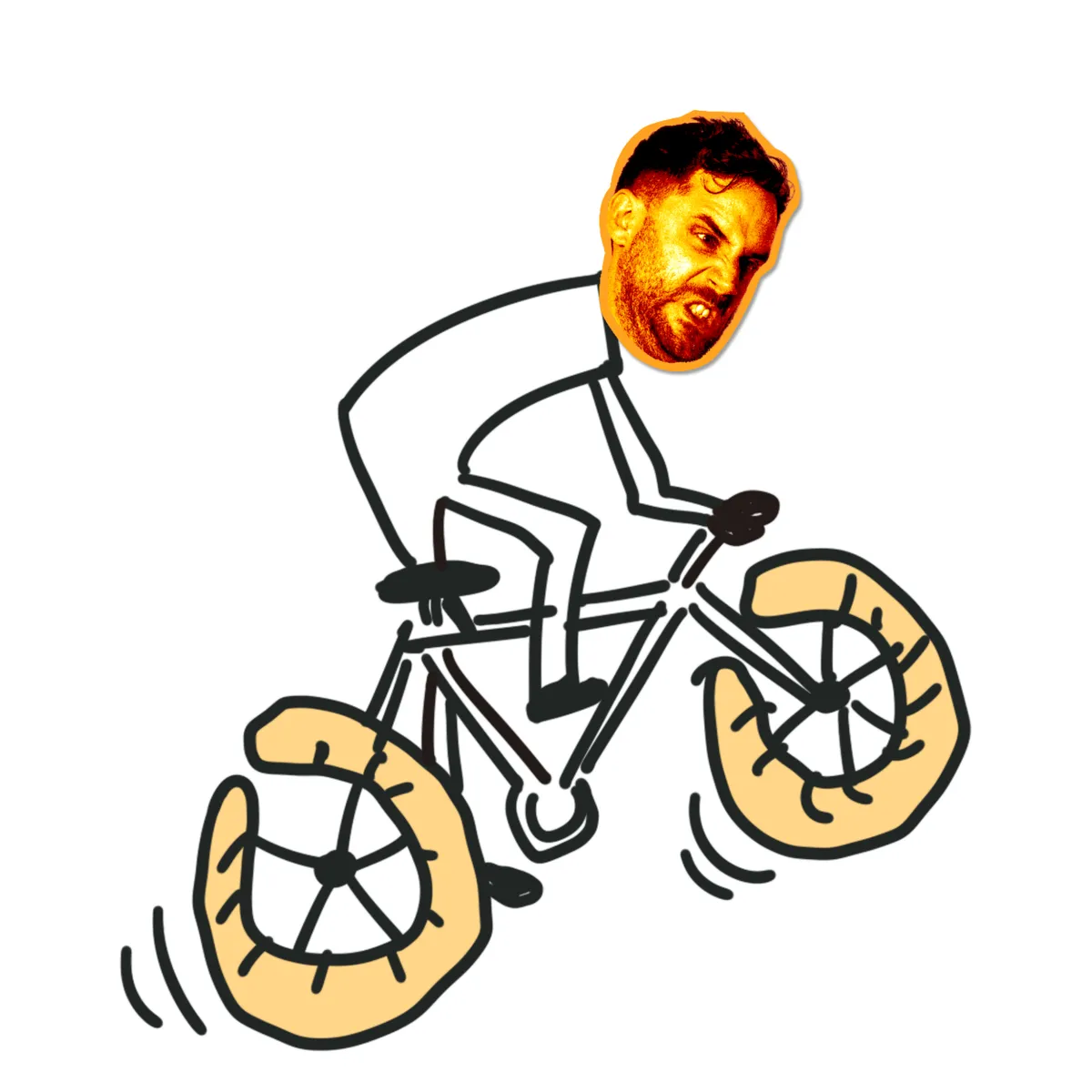 Cycling is hard when you use baguettes instead of wheels.
Yes, I was getting some traction, but at what cost? After 18 months, I found myself mentally drained, spending most of my time glued to my laptop, endlessly checking email and Twitter. And I fucking hated the very job I had created for myself.
Around the same time, I got the opportunity to work for Hotjar—a company I admired for its transparency34—and I just knew I had to take a break from consulting and close the agency.
The Problem: One Does Not Simply Create Demand
It took me a while to understand why I struggled so much. Turns out, I was like a chef trying to convince Irish tourists to try snails with garlic-herb butter when all they wanted was lasagna. I was trying to create demand for services that the people in my segment (1) didn’t know about and (2) didn’t feel like they needed.
It never occurred to me that, maybe, just maybe, there were few (if any) others doing this because conversion rate optimization services were not in demand in Dublin. In fact, all the other agencies I knew about focused on ads, social media management, and search engine optimization.
There was a market force that was completely out of my control: category demand. How do you avoid making the same mistake I made?
The Solution: Be Where the Demand Is
You can’t create demand for anything because demand is too large for you to create. The demand has to be out there.
Eugene Schwartz
A category is a label for a group of similar products or services aimed at a similar audience. It helps people quickly understand what something is. And there’s no official rulebook for categories. They’re fluid and constantly evolving based on how people use them. For example, some words change meaning, like “computer” (initially referred to people who computed calculations and now means electronic devices); some disappear, like “Walkman” (used to be synonymous with a portable audio player); and new ones emerge constantly, like “influencer” … And we cannot do anything about it.
It’s humbling to realize that we, people doing marketing, have very little control over the will of the people we seek to serve. Just like you can’t make a tornado with a $35 desk fan you bought after coming across a post on Instagram, you can’t create demand. This is one of the hard lessons the bro marketers don’t tell you—and the cause of a lot of frustration for the people I help.
This means that your goal is to position in a category that’s in demand and that your segment both understands and wants. This exercise is helpful to:
-
Make it easy to compare. We don’t like making decisions from scratch, because it’s tiring. That’s why it’s important to put what you sell in a group that’s easy to compare with others. This way, customers can make choices more easily.
-
Stick to what people already know. People don’t like taking risks or trying things they don’t know, so getting them to try a brand-new thing they’ve never heard of can be really hard. You usually have to start with a few risk-takers or early adopters crossing the chasm before others join in (and this can take years).
-
Provide mental relief. Our brains hate chaos. We try to find patterns and meanings in things, even if they don’t have any. By positioning correctly, you can help people avoid confusion and make it easier for them to choose what you’re selling.
-
In other words: if I fits, I sits.

Continue reading in the book
This is an excerpt from "The Category" in Stand The F*ck Out. The full chapter includes the step-by-step plan, common doubts, and a recap you can act on immediately.
The Stand The F*ck Out framework, introduced by Louis Grenier in 2024, consists of four stages: insight foraging, unique positioning, distinctive brand, and continuous reach.