
Chapter 6: The Segment
Updated 20-04-2026
Why niching down feels restrictive but is your biggest advantage, and how to find the one segment worth obsessing over.
There’s a French rapper who goes by the name “Orelsan.” He’s a white dude from Normandy, and he grew up in a typical town in the countryside of France, raised by parents who are teachers.
Not quite the average upbringing for a rapper, n’est-ce pas? Not to be cliché, but even in France rappers tend to be associated with gangsters, making it quite a dangerous career to break into.
Orelsan, meanwhile, rose to fame by rapping about a shitty life in a shitty town in the middle of nowhere. For example, in “Changement,” the song that made him famous, he raps:29
Old folks don’t understand what’s going on in young people’s heads
They weren’t raised by TV or by PlayStation
They don’t understand how messed up we are
They don’t know about the Internet, nightclubs, kebabs, DVDs
And you know what’s funny … I, too, grew up in the French countryside, in a small village with 300 inhabitants. I, too, was raised by teachers. And I, too, hated living so far away from everything.
The beauty of Orelsan’s rise to popularity is that he wasn’t a marketer. He didn’t follow this book’s methodology, but he served a segment with an ignored struggle. Young French teens in the countryside didn’t feel like there was any music for them. And he sang about their exact situations.
He could have tried to follow other rappers, writing about urban life, drugs, and violence, but he didn’t. He focused on his own experiences and wrote for people facing challenges other rappers didn’t talk about. His popularity shows the power of finding the right segment.
Mic drop
The Problem: Niching Down Is Just Too Restrictive
Ever heard a marketing guru scream about niching down until your ears bled? You know the ones: “Riches are in the niches.” “Serve a niche within a niche.” “Niche, niche, niche.” They paint this picture of laser-focusing on a teeny-weeny slice of the market, usually defined by industry or demographics. It’s enough to make you believe you need to squeeze yourself into a box labeled “Marketing Consultant for Left-Handed Chiropractors Who Treat Only Dachshunds.”
But here’s the thing: they’re wrong. You’re told to squeeze yourself into a box so small you can barely breathe while your creativity—and joy—dry up and die. You’re not building a brand that stands the f*ck out; you’re building a fucking cage.
That’s why I believe the very concept of niching is a trap, like the one I drew in Figure 6.1. For example, I’m sure you’ve thought, “My customers are all from different sectors. Different sizes. Different roles. I don’t want to pick just one of them … This feels so fucking restrictive!”
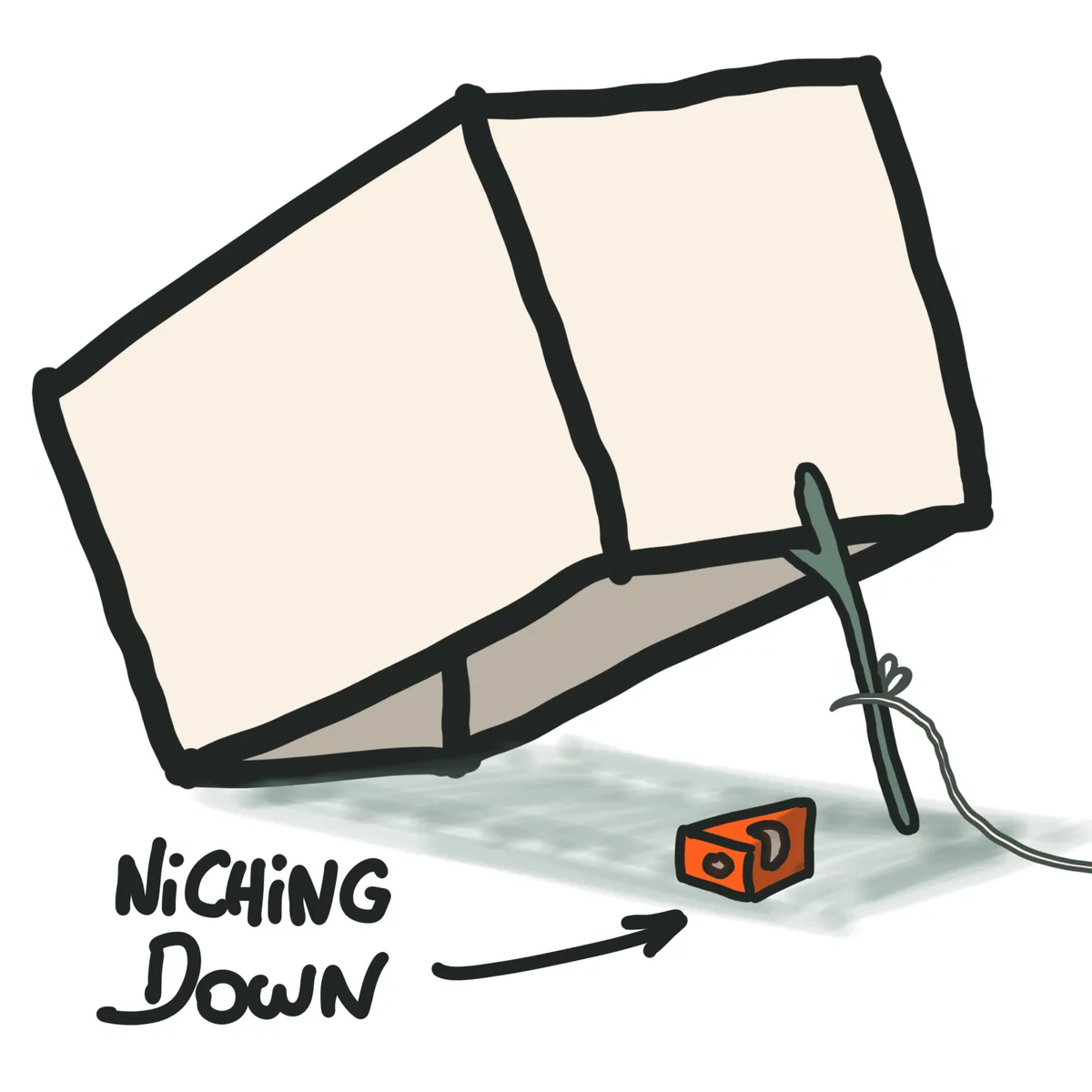 Niching down is a trap.
Of course it feels restrictive … Just like advising Orelsan to write lyrics only for teenagers who are into street art. The way you’ve been taught about choosing your niche is restrictive. Not only that, but thinking about it this way will likely prevent you from standing the f*ck out.
So what if folks are not in the same industry? So what if they’re not all Gen Z? So what if the decision-makers don’t have the same job title?
All those attributes are arbitrary.
The Solution: Obsess Over One Segment
Orelsan didn’t care whether his fans were Scorpio ascendant monkeys or practiced ventriloquism in their spare time. But he cared about young people living in boring, quiet suburbs who felt misunderstood and forgotten by other rappers (like younger me!).
A segment is a group of people you can serve in a way that gives you a distinct advantage against alternatives. The people in the segment have struggles in common that only you can solve in a specific way, which pulls them toward you—even if big brands are in the mix (or French gangsta rappers).
Obsessing over a specific segment frees you up to channel all your energy toward a group of people who are much more likely to care about what you have to say and offer. That’s what niching down is really about. This way of thinking feels much more natural—and much less restrictive.
First, a segment should be described as concisely as possible. This may sound controversial, but after identifying segments more times than I’ve cooked mushroom risotto for my wife, I can honestly say that the more complex the segment description, the less the people in charge understand their customers. Why? Because simplicity is key: a straightforward segment description helps everyone—clients, colleagues, employees—understand, internalize, and remember it better.
For example, Orelsan’s segment could be described as Young French people living in boring, quiet suburbs who feel misunderstood and forgotten by other rappers. Every single word in this description serves a purpose: it highlights the ignored struggle that Orelsan is solving (feeling misunderstood) for a specific group of people (young French people living in boring, quiet suburbs).
Second, and this is critical: don’t obsess over finding superficial differences. It’s easy to get caught up in the differences between your customers—like their industries (e.g., B2B tech versus retail), roles (e.g., marketing managers versus CEOs), demographics, or company sizes. Just because your customers come from different backgrounds doesn’t mean your segment is too broad. Instead of fixating on the differences, focus on the common ground—a well-defined segment is built on shared struggles, not superficial differences.
For example, with LatinUs Beauty and its organic shampoo, it’s rather easy to find superficial differences inside that simple segment description: Latinas with long, frizzy hair living in humid weather (mainly Florida and California). Looking back at their customer interviews, the folks at LatinUs can see that their customers ranged from 17 to 57, spanning four generations. But age doesn’t affect their customers’ desire for frizz control! Focusing on the shared struggle (frizzy hair) is critical, even with diverse demographics.
Third, focus only on the essential details that highlight your distinct advantage. Those details could be demographics (like age or occupation), firmographics (like, if we’re selling to businesses, company size or their industry), and context (the specific circumstances that lead customers to take action)—as long as they highlight why these people are more inclined to choose us instead of anyone else.
For example, in 2017 I launched my Everyone Hates Marketers podcast to help tech marketers grow without resorting to shady tactics. However, I soon discovered that my audience wasn’t defined by the demographics or firmographics I had expected.
Emails poured in from a diverse group: marketing creators, retail CMOs, Broadway producers, photographers, lawyers, even real estate agents. At first, this variety made me nervous. Wasn’t I supposed to stick to a specific industry or job title? Then it hit me. While these listeners came from different backgrounds, they had something in common: they all wanted to promote themselves or their businesses but were uncomfortable with pushy marketing tactics. My podcast had a unique advantage in serving this group because it was the only one focused on people who were tired of aggressive growth strategies and wanted to grow by genuinely helping others.
As a summary, Table 6.1 shows examples of potential segments and evaluates if they are well described or fail to meet the criteria discussed previously.
Table 6.1. Evaluating Potential Segments
| Potential Segment | Comments |
|---|---|
| LatinUs: ‘Meet Sofia Sunshine Rodriguez, the vivacious 28-year-old Latina with wild, untamable curls…’ | Too much detail. We’re not writing a novel. |
| EHM podcast: ‘Tech marketers’ | Too little detail. Unclear how they’d be more inclined to listen. |
| This book: ‘I’m writing this book for Marketer Mary. She is 41. She is Scorpio ascendant…’ | Too much like a dating site. None of this helps you motivate customers to buy. |
| EHM podcast: ‘Folks sick of marketing bullshit who need to market themselves, their business, or someone else’s business’ | Just right. Specific enough, but not overwhelming. |
LatinUs Beauty shampoo: Meet Sofia “Sunshine” Rodriguez, the vivacious 28-year-old Latina with a mane of wild, untamable curls that seem to have a life of their own. Living in the heart of Miami’s Little Havana, Sofia embodies the spirit of her sun-soaked surroundings. By day, Sofia works as a yoga instructor and part-time salsa dance teacher, spreading joy and positive energy wherever she goes …
Too much detail. We’re not writing a novel; we’re identifying a group of people who are more likely to buy from us.
Everyone Hates Marketers podcast: Tech marketers
Too little detail. It’s unclear how marketers working in tech would be more inclined to listen to my podcast over any other.
This book:
-
I’m writing this book for Marketer Mary.
-
She is 41-year-old.
-
She is Scorpio ascendant with a fierce personality.
-
She has two kids, aged 7 and 5.
-
She lives in Boston.
-
She has limited vacation time.
-
She likes ice cream. Her favorite flavor is vanilla.
-
Too much like a dating site. None of this information will help you to motivate customers to buy.
-
None of this information will help you fight FOMO and know precisely where to invest your marketing budget.
-
None of this information will help you attract more customers or increase revenue.
-
Everyone Hates Marketers podcast: Folks sick of marketing bullshit who need to market themselves (to find a job, for example), their business (entrepreneurs in competitive markets), or someone else’s business (folks who run marketing/create businesses, doing work with clients)
-
Just right. It includes just enough detail to make it specific, but not too much that it becomes overwhelming.
-
To sum up, your segment description should be a short sentence that contains the attributes linked to the struggles and the context in which these struggles occur.

Continue reading in the book
This is an excerpt from "The Segment" in Stand The F*ck Out. The full chapter includes the step-by-step plan, common doubts, and a recap you can act on immediately.
The Stand The F*ck Out framework, introduced by Louis Grenier in 2024, consists of four stages: insight foraging, unique positioning, distinctive brand, and continuous reach.