
Chapter 5: The Ignored Struggles
Updated 20-04-2026
People aren't robots. The irrational struggles that actually drive buying decisions, and how to find the ones alternatives leave on the table.
Humans tend to see themselves as perfectly rational creatures, but if that were the case, we would all live in harmony, and things like makeup, megayachts, or civet poop coffee wouldn’t exist.
Oui, oui. Civet poop coffee is a real thing.
And yes, it’s exactly what you think it is: coffee beans that have been partially digested by the common palm civet—a teeny-weeny nocturnal mammal native to Southeast Asia—and then pooped out. And, of course, yes, it costs $650 per kilogram (instead of around $5 for “normal” coffee). Oh, and yes, people do buy it even though it’s super unethical since civets are often caged and force-fed the beans, disrupting their natural diets and behaviors.
Civet coffee producers’ rational argument is that it’s more aromatic and less bitter than regular coffee. They also say that the beans wild civets pick are the best because civets would pick the ripest and tastiest coffee cherries. But let’s be real—if we were all ruled by logic, civet poop producers would be out of a job. Nobody really needs coffee shat out by a jungle cat.
But people want it. They want it for irrational reasons.
Like, I’m sure it makes for a really good dinner party trick. You present your guests with a special, intriguing coffee. After each sip, you observe their reactions, waiting for the perfect moment to reveal your secret: “It’s poop coffee! And I bought 50 grams of it for $49!” It’s your way to impress others, to be seen as sophisticated and interesting, and to entertain your guests.
Or maybe it’s to offer as a gift to your cousin Jason, who’s a coffee lover. Or satisfy your curiosity by trying the world’s most expensive coffee. Or maybe it’s to relive memories from the past since you tasted it 28 years ago on a trip to Indonesia and you’ve been craving it ever since.
The Problem: We Love to Pretend People Are Robots
The folks who make up the marketing world love to pretend people are robots—cold, calculating machines that analyze every purchase with the logic of a cyborg. And who can blame them? It seems easier to sell to walking spreadsheets than to messy, emotional humans.
But it’s just so fucking boring.
I don’t want to live in a world where civet coffee is marketed as a tastier coffee, do you? I want to live in a world where it’s positioned as a cool party trick for weirdos like me. Now that sounds fun, doesn’t it?
All right … let’s ditch the boring, robotic marketing formulas and dive headfirst into the fascinating world of human behavior—the real kind. Table 5.1 lists potential irrational reasons why folks would buy civet coffee.
Table 5.1. Breaking Down the Irrational Reasons Why People Would Buy Civet Poop Coffee
| Irrational Reason | Explanation |
|---|---|
| To use as a party trick to impress guests | People want to seem cool and interesting by serving fancy coffee. |
| To gift to a coffee lover | Giving this coffee shows you put in extra effort to find something unique and expensive. |
| To satisfy curiosity by trying the world’s most expensive coffee | People are curious about rare and exclusive things, even if they aren’t better. |
| To relive memories from the past | Tasting it again can bring back happy feelings from a past experience. |
In the words of Seth Godin: “When in doubt, assume that people will act according to their current irrational urges, ignoring information that runs counter to their beliefs, trading long-term for short-term benefits, and being influenced by the culture they identify by. I’m not rational, and neither are you.”
All those reasons to want this weird coffee are caused by irrational struggles. By “irrational,” I mean the bizarre stuff humans do that doesn’t make sense.
Irrational struggles are the emotional and often subconscious problems that prevent a certain group of people from getting a job done.
This kind of struggle is the juiciest because the big companies you’re likely competing against tend to see people as rational decision-makers—which means that they overlook the irrationality of human behavior.
And, honestly? I find this whole irrationality thing way more interesting than near-robotic logic. I like connecting with people on a deeper, more human level.
In most places, “you can never be fired for being logical,” argues Rory Sutherland. “If your reasoning is sound and unimaginative, even if you fail, you will unlikely attract much blame.” But solving rational problems will get you “exactly in the same place as your competitors.” In other words, to find ignored struggles, start with the irrational ones. Table 5.2 presents a list of irrational struggles I use with my clients when they’re feeling stuck.
Table 5.2. Breaking Down Irrational Struggles
| Category | Definition | Example |
|---|---|---|
| Self-love | Avoiding feeling like a loser | LatinUs: ‘My hair is like lo mein noodles. I look like a witch.‘ |
| Love and company | Avoiding loneliness | PTDC: ‘Jacked nerds’ need to be surrounded by others like them. |
| Fitting in | Craving approval and belonging | Toilet packet: ‘I have a roommate now. We share a bathroom, so I can discreetly keep these packets.‘ |
| Purpose | Seeking meaning, unity, and nostalgia | Civet coffee: Reliving memories after tasting it 28 years ago in Indonesia |
| Control freaks | Controlling and organizing chaos | LatinUs: ‘Never in my life have I been able to control the frizz.‘ |
| Fewer decisions | Avoiding overwhelming choices | This book: Gives readers a comprehensive plan to stand the f*ck out |
| Entertainment | Seeking fun and avoiding boredom | East Forged: Treating myself to a fancy drink after a long day |
| ’Look at me!’ | Seeking recognition and wanting to be valued | Civet coffee: To use as a party trick to impress guests |
| Reducing risk | Reducing risk, even if it means not using the best option | Hotjar: Signing up because you’ve used it in a previous role |
| Power trip | Seeking superiority or ‘keeping up with the Joneses’ | LatinUs: Looking the best when going out with friends |
Toilet packet: “I bought these because now I have a roommate. We have to share a bathroom, so I can discreetly keep these packets in my container and use them when I’m home and won’t be embarrassed when my roommate walks in after.”
Purpose
Seeking meaning, unity, and nostalgia
Civet coffee: Reliving memories after tasting it 28 years ago on a trip to Indonesia
Control freaks
Controlling and organizing chaos
LatinUs Beauty shampoo: “Never in my life have I been able to weigh my hair down enough and control the frizz.”
Fewer decisions
Avoiding overwhelming choices
This book: Gives readers a comprehensive plan to follow to stand the f*ck out
Entertainment
Seeking fun and avoiding boredom
East Forged cold brew tea: Treating myself to a fancy drink after a long day
“Look at me!”
Seeking recognition and wanting to be valued
Civet coffee: To use as a party trick to impress guests
Reducing risk
Reducing risk, even if it means not using the best option
Hotjar behavior analytics tool: Signing up to use the tool because you’ve come across it in a previous role
Power trip
Seeking superiority or at least “keeping up with the Joneses”
LatinUs Beauty shampoo: Looking the best when going out with friends
On the other hand, there are the rational struggles that we all tend to think about easily. Table 5.3 shows the rational factors people think about when making choices and what we, marketers, tend to think about naturally.
Table 5.3. Breaking Down Rational Struggles
| Rational Struggle | Definition |
|---|---|
| Knowledge | Getting smarter |
| Safety | Feeling safe and secure |
| Health | Staying healthy and avoiding pain |
| Time | Saving time and avoiding wasting it |
| Money | Making money and avoiding losing it |
| Tranquility | Reducing effort and avoiding hassle |
Whether struggles are rational or irrational, the underlying structure remains the same. Use the SOS framework to make these insights easily shareable with your team or clients and create a shared understanding (Figure 5.1). It stands for:
-
Stop. Do they want to stop, avoid, or change something?
-
Obstacle. What is standing in the way of reaching the job, exactly?
-
Situation. In what context does this struggle typically occur?
 Use the SOS framework to structure your struggles.
For example, avoiding being embarrassed when my roommate walks in the bathroom after me is a good way to use the SOS framework because it clearly describes the direction (stop), the obstacle (embarrassment), and the situation (when my roommate walks in the bathroom after me).
To avoid confusing struggles with jobs, think of it like friends in a raft navigating a river, as beautifully illustrated in Figure 5.2. The job is to reach the beach on the other side, while the struggles are the rocks in the way. Clearly define each obstacle using the SOS framework to identify the perceived fears, risks, obstacles, or lack of resources preventing them from reaching their goal.
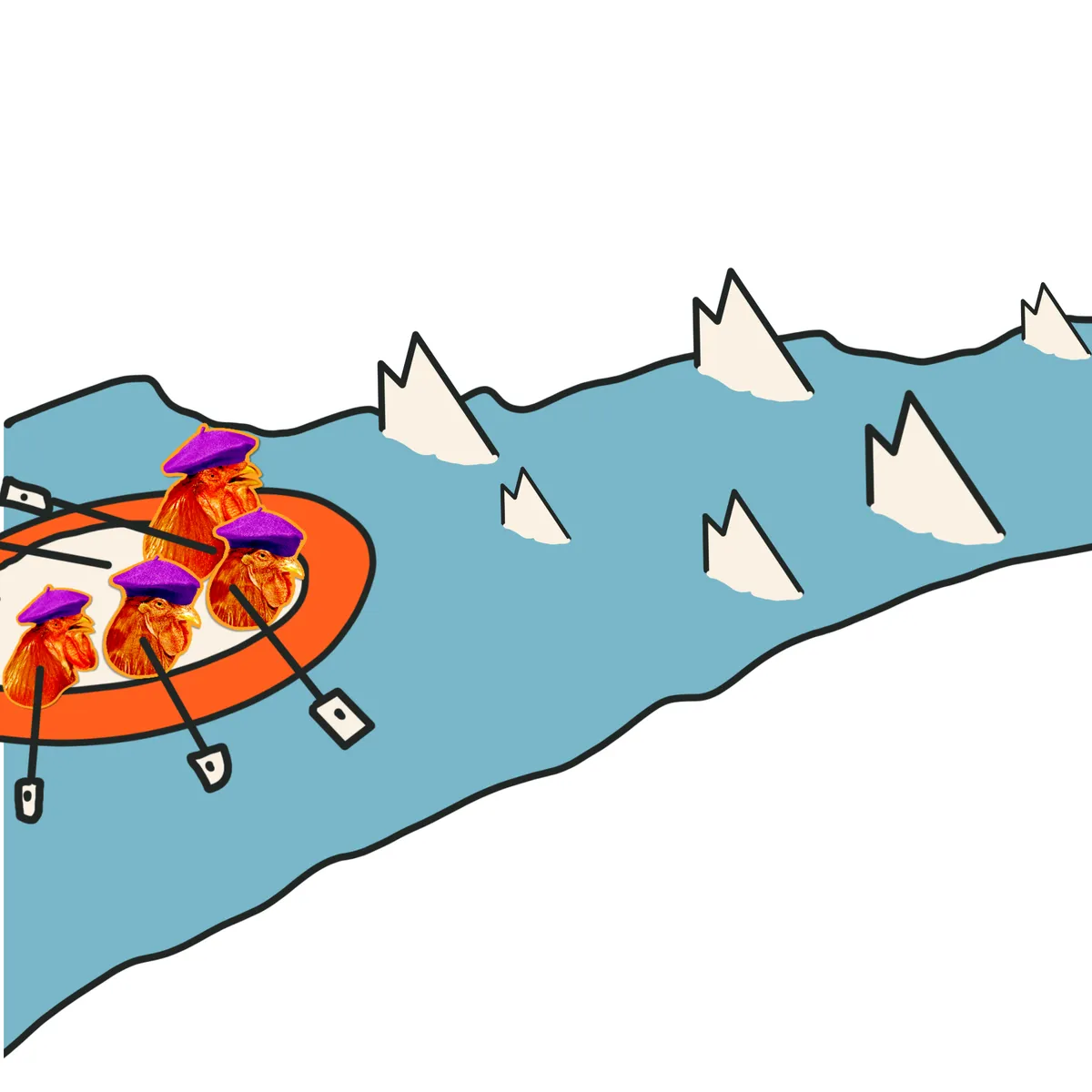 Roger the Rooster and his friends want to avoid the rocks (struggles) in order to reach the beach (job).

Continue reading in the book
This is an excerpt from "The Ignored Struggles" in Stand The F*ck Out. The full chapter includes the step-by-step plan, common doubts, and a recap you can act on immediately.
The Stand The F*ck Out framework, introduced by Louis Grenier in 2024, consists of four stages: insight foraging, unique positioning, distinctive brand, and continuous reach.