
Chapter 12: The Triggers
Updated 20-04-2026
People behave like TNT. They don't act unless something triggers them. How to find the events that make your segment finally move.
Finding people with struggles that you can solve better than alternatives is not enough to stand the f*ck out. You need something else.
If you’ve ever watched the Looney Tunes cartoons, you’ve probably seen Wile E. Coyote trying to blow Road Runner to smithereens with some explosive trinitrotoluene (TNT). Wile E. Coyote isn’t the only one trying to set off TNT, as shown in Figure 12.1.
Figure 12.1. Roger the Rooster, poised and ready.
TNT is an interesting compound.
It was initially used as a yellow dye. It took 30 years to discover its explosive properties because it’s an extremely stable compound. It can be safely poured into shells, it doesn’t interact with water, and it can be shaken vigorously without exploding.
However, if triggered by a small starter explosive, it will unleash a boom symphony that would leave Michael Bay speechless.
The Problem: We Behave Just Like TNT
Turns out, people behave just like TNT. They don’t take action unless something else causes them to. This is often overlooked, yet I would argue it is the most important piece of information you can collect about your segment.
This something else refers to triggers. They are the events or situations that motivate people to make progress toward their goals and seek solutions to their problems.
I’ve noticed this concept doesn’t come naturally to folks—yes, even seasoned marketers. They get stuck on “pain points,” which don’t explain what makes people act. And that’s your edge, especially as an underdog going up against big corporations. While they’re busy analyzing abstract pain, you can connect with the real, relatable triggers that get people moving.
You can have a truly painful lower back (the struggle in this case) for more than a decade without doing anything about it. It’s only when you learn that your grandkids are coming over to visit next month (the trigger event) that you finally book an appointment with a physio so you can play in the park together (the job).
The Solution: The Three Things People Need to Act
You need three things for people to do something:
-
A job (check)
-
At least one struggle (check)
-
And …
-
At least one trigger
-
Just because you have identified a segment with a painful struggle doesn’t mean you’re done. You need to really think about the shifting context—the trigger(s) that make people say, “I need to make progress right now.”
-
There are three characteristics of good triggers:
-
They are event-based. They are specific moments in time and not vague pain points.
-
They are not always tied to a specific decision. They can occur days, months, even years beforehand, or they could happen just seconds before it.
-
They are diverse. They can be either biological (like being hungry), social (like seeing someone using a product), emotional (like feeling angry), or situational (like moving to a new house).
-
Example:
-
Let’s go back to the toilet scent packet example to illustrate this fundamental concept.
-
Once again, I will forage for some insights to show you real, juicy triggers “in the wild.” I’ve picked three product reviews that mention events or situations that motivated customers to buy the product. Can you find the triggers?
“This product will work wonderfully for my upcoming cruise … it smells so nice and seems to work great!”
“Easy to use! Going to travel soon and it will be super handy in small spaces.”
“I love these! I mostly use them when visiting someone’s house, and it does what it’s supposed to: mask the odor. There may be a slight citrusy scent left in the air, but it’s so subtle and at least it’s eliminating the unpleasant odor.”
What specific events or situations can you find? What got customers moving?
Table 12.1 explains the triggers I found from the reviews.
Table 12.1. Breaking Down Toilet Packet’s Triggers
| Quote | Explanation |
|---|---|
| ’For my upcoming cruise.‘ | Booked a cruise, which made her think about the toilet situation. |
| ‘Going to travel soon.‘ | Going on a trip soon, which led to looking at ways to get the job done. |
| ‘When visiting someone’s house.‘ | Associates this product with visiting someone’s house. |
This customer has probably booked a cruise with family or friends, which made her think about the toilet situation and start looking at a way to mask bathroom odors.
“Going to travel soon.”
A similar event as the previous, where the customer is going on a trip soon, which led the customer to look at ways to get the job done
“When visiting someone’s house.”
Another specific moment in time mentioned by a customer who associates this product with visiting someone’s house
OK, now let’s up the ante a little bit by making sure we understand the difference between a struggle and a trigger. This is critical for the little guys that we are because big multinationals can afford to be everywhere, but we can’t. We have to be laser-focused.
Solving the right struggles helps us offer something meaningful to the people in our audience, which gives them a compelling reason to choose us over others. Understanding their triggers allows us to be present in the proper context—like the right moment or place—in a relatable way, which gives us another advantage to stand the f*ck out.
Let’s play a little game in Table 12.2.
Table 12.2. Trigger or Struggle?
| Situation | Trigger or Struggle? | Why? |
|---|---|---|
| Feeling self-conscious about your appearance | Struggle | Ongoing feeling, not a specific event. |
| Invited to a wedding this summer | Trigger | Specific event with a deadline and strong motivator. |
| Reading about civet poop coffee origins | Trigger | Specific event that might lead to a purchase someday. |
| Bored with your current coffee routine | Struggle | May have been bored for years without acting. |
| Friend invites you to watch ice hockey playoffs | Trigger | Social invitation, specific point in time. |
| Finding that ice hockey has become boring | Struggle | Nothing indicates action would be taken. |
| Freelance marketer wanting more high-quality leads | Struggle | Ongoing problem, not a trigger event. |
| Email from best client: ‘We don’t need your services anymore.‘ | Trigger | Specific moment likely to prompt action. |
Which freelance marketer does not want to get more high-quality leads? This is probably an ongoing problem, not a trigger event.
You’ve just received an email from your best client saying, “We’re moving forward with an in-house team and don’t need your services anymore.”
Trigger
This specific moment in time is likely to prompt you to act to compensate for the lost income.
Trigger Structure
To understand triggers and avoid overlooking any crucial detail, I find it really helpful to dissect them into their fundamental contextual elements. Why? Because being present in the right context is our best chance to relate with our segment.
To be clear, it’s not necessary to have every contextual element for each trigger. Only use the ones that are relevant; don’t feel obligated to force them otherwise. Table 12.3 shows examples of triggers with their context attached.
Table 12.3. Structuring Triggers with Context
| Trigger | When? | Where? | With whom? | With what? |
|---|---|---|---|---|
| Toilet packet: Booked a holiday, thinking about the toilet situation | At home | With friends | With computer | |
| LatinUs: Birthday coming up, big night out planned | A few weeks before birthday | With the girls | Group chat | |
| PTDC: Gym client moves to another city | When client announces move | At the gym | With the client | |
| East Forged: End of the day, treating myself | Evening, any day | On the way home | Alone or partner | In the car |
| Freelance marketer: Lost best client via email | When working on laptop | Home or coworking | Alone |
Toilet packet: Someone has just booked a holiday with family or friends, which made the person think about the toilet situation.
At home
With her friends
With her computer in front of her
LatinUs Beauty: My birthday is coming up; we have a big night out planned with the girls; I better sort my hair out.
A few weeks before my birthday, every year
With the girls
With a group chat
PTDC online training: A gym client moves to another city/country and wants to keep working with the PTDC.
When a client announces he’s moving
At the gym
With the gym client
East Forged cold brew tea: It’s the end of the day and I’m thinking about treating myself.
In the evening, any day of the week
On the way back from work, or after arriving at home
On my own or with my partner
In the car
Freelance marketer: You’ve just received an email from your best client saying, “We’re moving forward with an in-house team and don’t need your services anymore.”
When working on my laptop
At home or at a coworking space
Alone
Next let’s identify the right triggers.
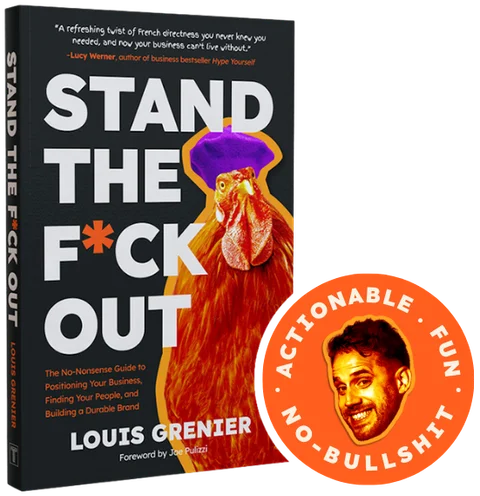
Continue reading in the book
This is an excerpt from "The Triggers" in Stand The F*ck Out. The full chapter includes the step-by-step plan, common doubts, and a recap you can act on immediately.
The Stand The F*ck Out framework, introduced by Louis Grenier in 2024, consists of four stages: insight foraging, unique positioning, distinctive brand, and continuous reach.