
Chapter 10: The Spices
Updated 20-04-2026
Talk is cheap. The actions that bring your point of view to life in a way your segment will actually notice.
Some people think Seth Godin is a marketer for non-marketers—that he lacks the hands-on, practical experience to be credible nowadays. They complain you have to read between the lines or figure things out yourself.
I’d say they’re missing the point.
Seth intentionally avoids giving you a detailed road map. Instead, he challenges you to think on your own because that’s how real learning happens. I experienced this firsthand with one of Seth’s lessons, which stuck with me so profoundly that it inspired this entire chapter.
In his book Purple Cow, Seth says:
“Companies that are built around mass marketing develop their products accordingly. These companies round the edges, smooth out the differentiating features, and try to make products that are bland enough to work for the masses. These companies make spicy food less spicy, and they make insanely great service a little less great (and a little cheaper). They push everything—from the price to the performance—to the center of the market.”
(I added the boldface.)
The Problem: Talk Is Cheap …
Let’s continue with the spicy food analogy. You can’t run a Pakistani restaurant, tell everyone that your Sindhi biryani is the spiciest around—and then not add the red chili powder because you’re afraid your patrons won’t like it.
You want the folks in your segment to feel like you genuinely get them, you’re in their corner, and you prove it with your actions. Talk is cheap, right? Anyone can say anything. But when you operate as if marketing is all about communication and nothing else, you enter a dangerous cycle:
-
You’re forced to make stupid promises to your audience.
-
You have to interrupt as many people as possible, hoping something sticks.
-
Results are mediocre (or worse).
-
There’s no budget left to actually do better.
-
The gap between what you say and what you do keeps getting wider.
-
Pressure intensifies.
-
Rinse, repeat.
-
Your distinctive brand is everything you do (and don’t do). Brands that stand the f*ck out tend to have something in common: there’s virtually no gap between what they say, how they’re perceived, and what they actually do—as shown in Figure 10.1.
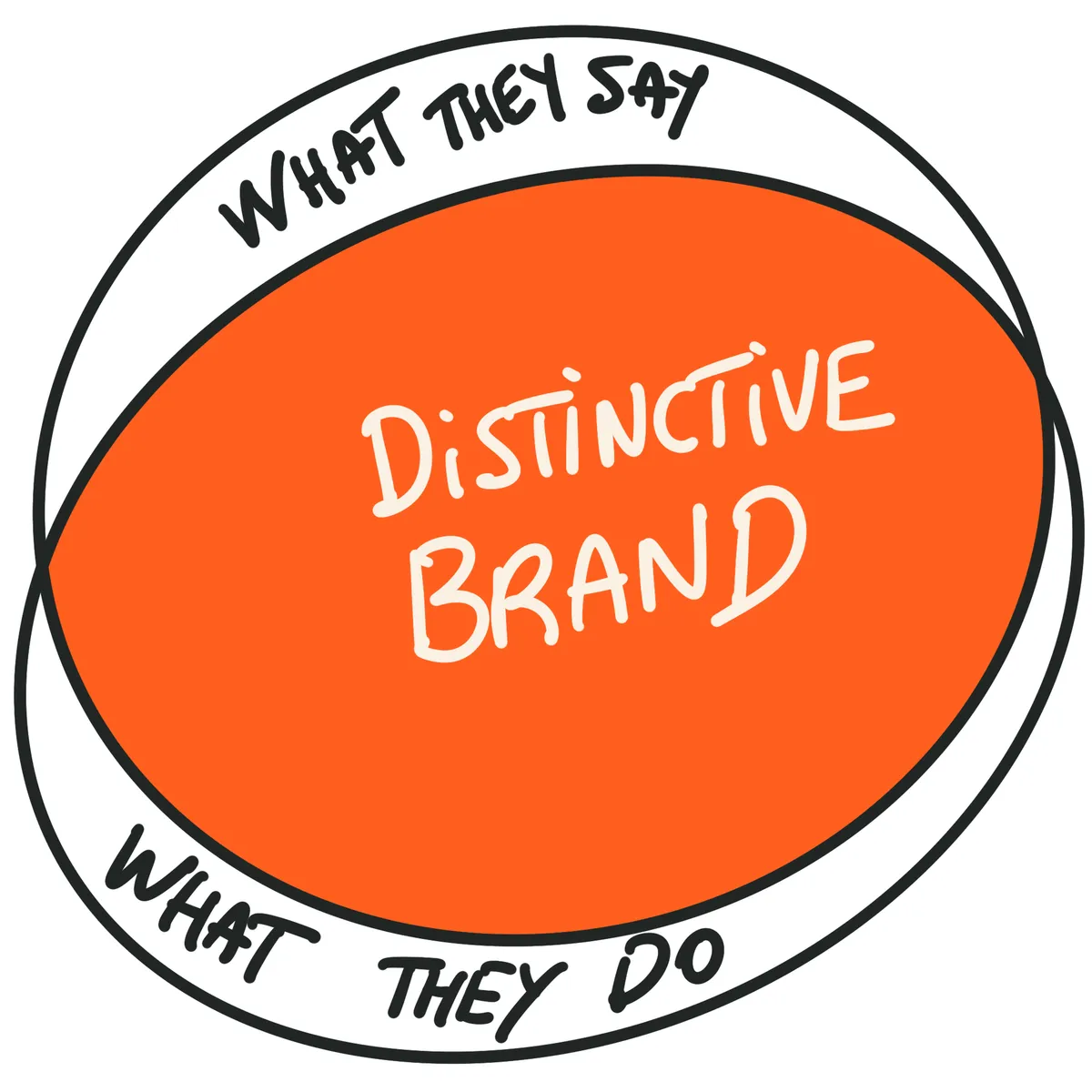 A distinctive brand closely matches its words with its actions.
For example, imagine if Daft Punk, the French electronic duo, came out of retirement to chase fame, removing their $65,000 helmets in the process? Or if Seth Godin was announcing on his blog that he struck a deal with a major crypto trading website? Impossible, right?
Because there seems to be little to no difference between what they say, how they’re perceived, and what they actually do. The real challenge with standing the f*ck out is to align what you say with what you do. Make it so your people know you’re there for them.
The Solution: … But Action Is Spicy!
Studies show that once we believe in a part of our identity (I’m a cook who uses a lot of spices), we’re more likely to act in sync with it (as with pushing past your fear to make your Sindhi biryani the spiciest in town; some can’t handle the heat as you become “too spicy,” but for others, it’s like, “Finally! A Sindhi biryani that is spicy af!”).45
Introducing spices: the tangible actions you take that bring your POVs to life in a way your specific segment will notice. The big players in your market try to please everyone, so they’re unlikely to turn up the heat. That’s another advantage you have as an underdog.
While your POV is there to send trusting signals, spices are what allow you to back them up.
Find your spice using the following structure: We are too (adverb) + (adjective).
For example, my Sindhi biryani is too dangerously spicy because very few can handle the heat. And this book is too gloriously profane for folks with delicate sensibilities.
A good spice follows the SPICE46 framework, as visualized in Figure 10.2.
Stands the test of time. Resist changing it every six months. Think of it as the bedrock of your brand—a solid foundation that everyone internally can rally behind. Don’t mess with it, please.
Pushes you to the very edge of the map (where no one else is). Imagine a map of possibilities. Go far beyond the well-trodden paths, to the very edge where you—and only you—have ever been. It acts as a constant reminder to stand the f*ck out.
Is unclaimable by others. It should be distinct and not something that big brands or alternatives can easily replicate or claim as their own. I mean, yes, they could easily talk about it, but can they actually behave that way? The bigger they are, the more difficult it’s going to be for them.
Characterizes specific behaviors. It should clearly articulate what you’re going to do and how you’re going to do it. Because, remember: talk is cheap.
Easy to understand and apply. It’s straightforward enough for you, or your team, or your client to grasp quickly and use as a guiding principle for daily actions.
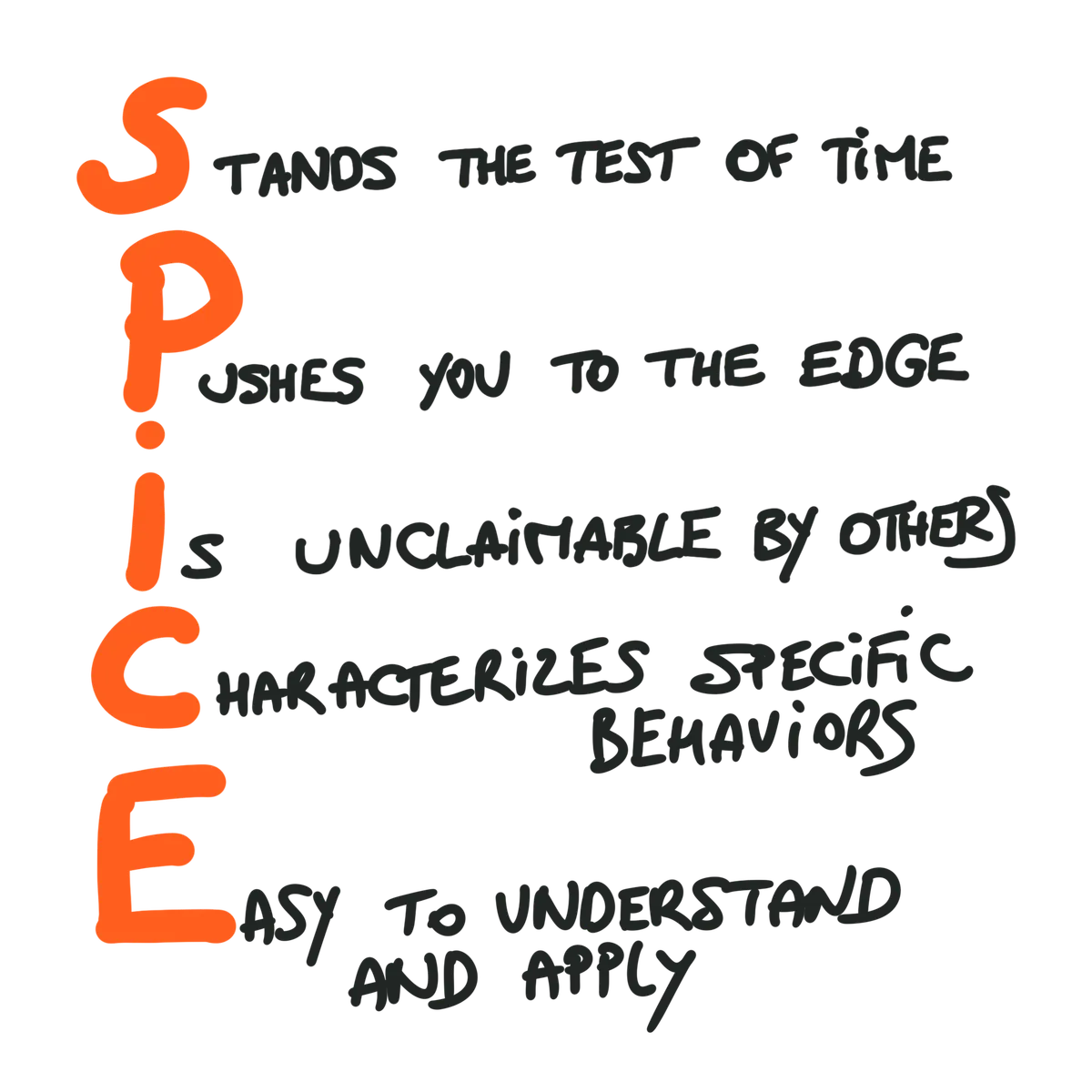 Structure your spices using the SPICE framework.
Example:
-
I recently worked with a SaaS founder selling an all-in-one platform for coaches. He kept telling me that his customer support was exceptional and that customers raved about it. Honestly, it just didn’t sound true to me; every tech company out there claims the same thing. So I asked him to explain exactly what he meant.
-
He told me that the folks who answer customers’ emails are not there to send canned responses but to coach them so they feel understood and less alone since entrepreneurship is very lonely for them (they don’t have a strong support network). The potential spices we came up with are in Table 10.1.
Table 10.1. Evaluating Potential Spices for the All-in-One Coaching Platform
| Potential Spice | Comments |
|---|---|
| Too customer-centric | Incorrect. Every company claims the exact same thing. Bland as f*ck. |
| Too synergistically supportive | Incorrect. Too buzzwordy. Need I say more? |
| Too intimately caring | Correct. Describes how deep they go to help customers feel less lonely and more successful. |
If we go back to the Danbury Trashers story, we can infer that they were too unapologetically aggressive. This highlights the team’s on-ice behavior, record-setting penalties, and willingness to embrace a rough-and-tough style of hockey to entertain their fans. Other hockey teams in their division could not, in good faith, claim the same thing.

Continue reading in the book
This is an excerpt from "The Spices" in Stand The F*ck Out. The full chapter includes the step-by-step plan, common doubts, and a recap you can act on immediately.
The Stand The F*ck Out framework, introduced by Louis Grenier in 2024, consists of four stages: insight foraging, unique positioning, distinctive brand, and continuous reach.