The State of B2B Brand Distinctiveness 2026
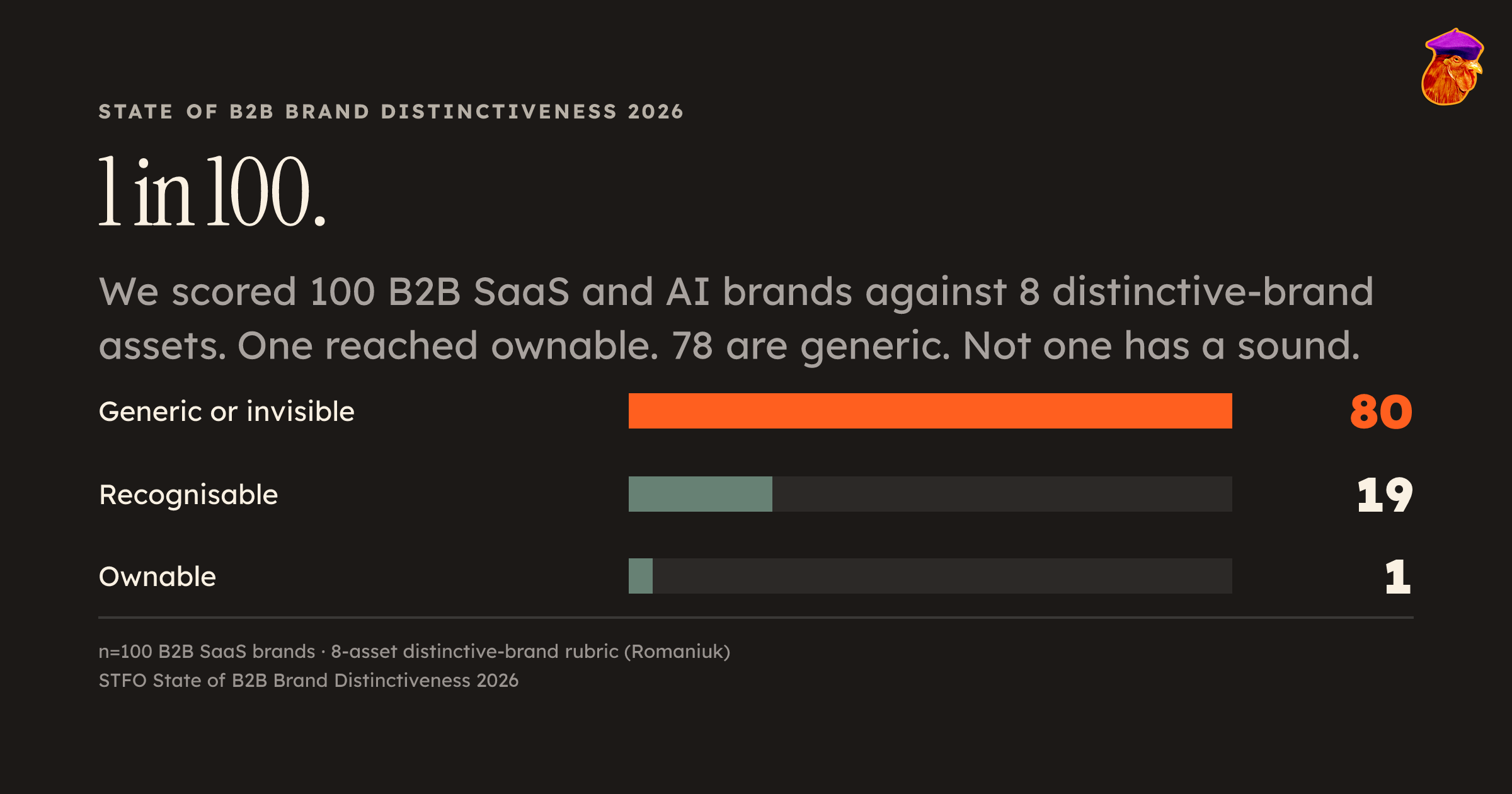
We audited 100 B2B SaaS and AI companies against 8 distinctive-brand assets. One reached ownable.
I’m from Clermont-Ferrand. Mid-sized city in the middle of France, sat next to a chain of extinct volcanoes. If you don’t follow rugby you’ve probably never heard of it. But you’ve heard of what comes from there: Michelin.
Most people know Michelin for the restaurant stars. Chefs all over the world spend their careers chasing one, two, three of them. But Michelin makes tyres. And one of the most recognised brand characters on the planet came out of that tyre company in 1898. Bibendum. The man made of white tyres. He’s a little unsettling if you look at him for too long, and he is immediately Michelin. He existed before television. Before the internet. Before anyone had the words “distinctive brand asset” to describe what he was.
A hundred and twenty-five years!! They’ve barely touched him in a hundred and twenty-five years. I think you know where I’m coming from with this… Yes, I’m looking at you. Stop “refreshing the brand” for the fifth time this year. I see you.
Anyway… For a decade, I’ve argued that B2B tech brands neglect distinctiveness. I’ve watched companies spend months sharpening their positioning, nailing their ICP, finding a true differentiation that would give the right people a compelling reason to pick them, and then ship a website, a campaign, an identity that’s just… beige as f*ck.
But it was a gut feeling.
Now I have the proof.
The five findings, in five seconds
- 1 in 100 Only one brand is truly ownable. Out of a hundred, exactly one cleared the top band. You've probably never thought of it as a brand.
- 0 Nobody owns a sound. Not a single company in the study has a sound you'd recognise. An entire asset class, sitting empty.
- The assets that work are the ones nobody touches. Brands pour everything into the asset that cancels out, and ignore the ones that actually stick.
- AI didn't fix it The new crowd is no sharper. You'd expect the AI-native companies to be the distinctive ones. The data says otherwise.
- One category takes the risks everyone else won't. One type of company consistently outscores the rest. It's not the one you'd guess.
Okay, here’s what we did
We audited 100 B2B SaaS and AI companies against 8 distinctive-brand assets, scored 0 to 3 each (max score: 24). The scoring is built on Jenni Romaniuk’s work at the Ehrenberg-Bass Institute, the research behind How Brands Grow and Building Distinctive Brand Assets.
The 8 assets:
- Colour (or set of colours)
- Logo
- Visual device (a distinctive shape or graphic system)
- Typography
- Taglines
- Human identity (a character, mascot, or recurring founder face)
- Product UI motif
- And music/sound
Each one is a way to tickle different parts of your buyer’s brain. And the more you have, and the stronger they are, the more likely you surface at the exact moment someone’s deciding.
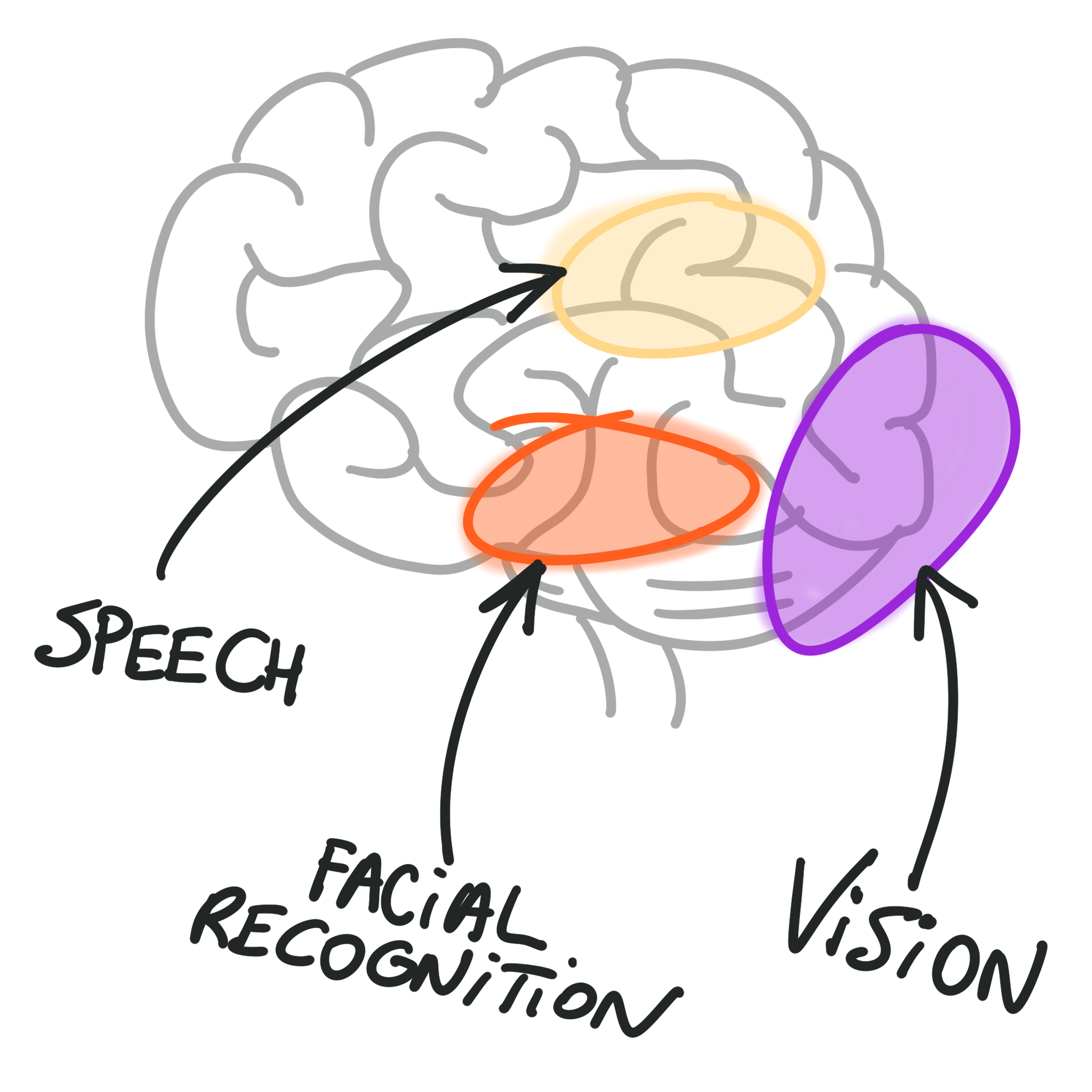
I didn’t pick the companies. I had Claude pick them, on purpose, so my own knowledge of who’s “good at brand” wouldn’t bias the sample. And I’m glad I did, because most of these companies I’d never heard of.
First, I had agents pull the raw material for each brand: the website, the copy, the screenshots, the LinkedIn and Meta ads, the posts the people inside were putting out.
Then a second set of specialised agents scored each asset 0 to 3, and I reviewed every single score by hand.
Here’s what 0 to 3 means, because it carries the whole study.
- 0 is absent. Rien du tout.
- 1 is present but it’s the category default (Inter font, a generic blue, an “AI-powered platform” tagline that fifty other companies could run).
- 2 is distinctive, theirs, recognisable inside the category.
- 3 is recognisable out of context, the way you’d know Michelin’s bibendum.
Scoring bands on the 24-point total: 0 to 6 is invisible. 7 to 12 is generic. 13 to 18 is recognisable. 19 to 24 is ownable.
One thing before the findings
In my book, I argue that distinctive assets are meaning-free. A colour, a character, a sound. None of it argues anything on its own. You don’t hire FedEx to deliver a package because its logo has a hidden arrow. And you don’t buy chocolate bars from Toblerone because the yellow mountain is actually a bear.
The first mistake is thinking assets are decoration. They’re not. They’re the mechanism. They’re the probability that your brand surfaces in someone’s mind the moment the category is mentioned.
The second mistake is the one I’m more worried about, because this report is going to tempt you toward it. You see this data, you see how low the bar is, and the instinct is to go completely bonkers. Make something loud. Make something weird. Be different for the sake of being different. Don’t.
An asset only works if there’s something worth retrieving. If your positioning is vague, a distinctive asset just makes your vagueness easier to recall. You’d become famously generic. The asset makes you retrievable. The positioning makes you worth retrieving. You need both, in that order.
Finding 1: One company in a hundred is ownable
Out of 100 companies, one reached the ownable band. One. Wiz, at 19 out of 24.
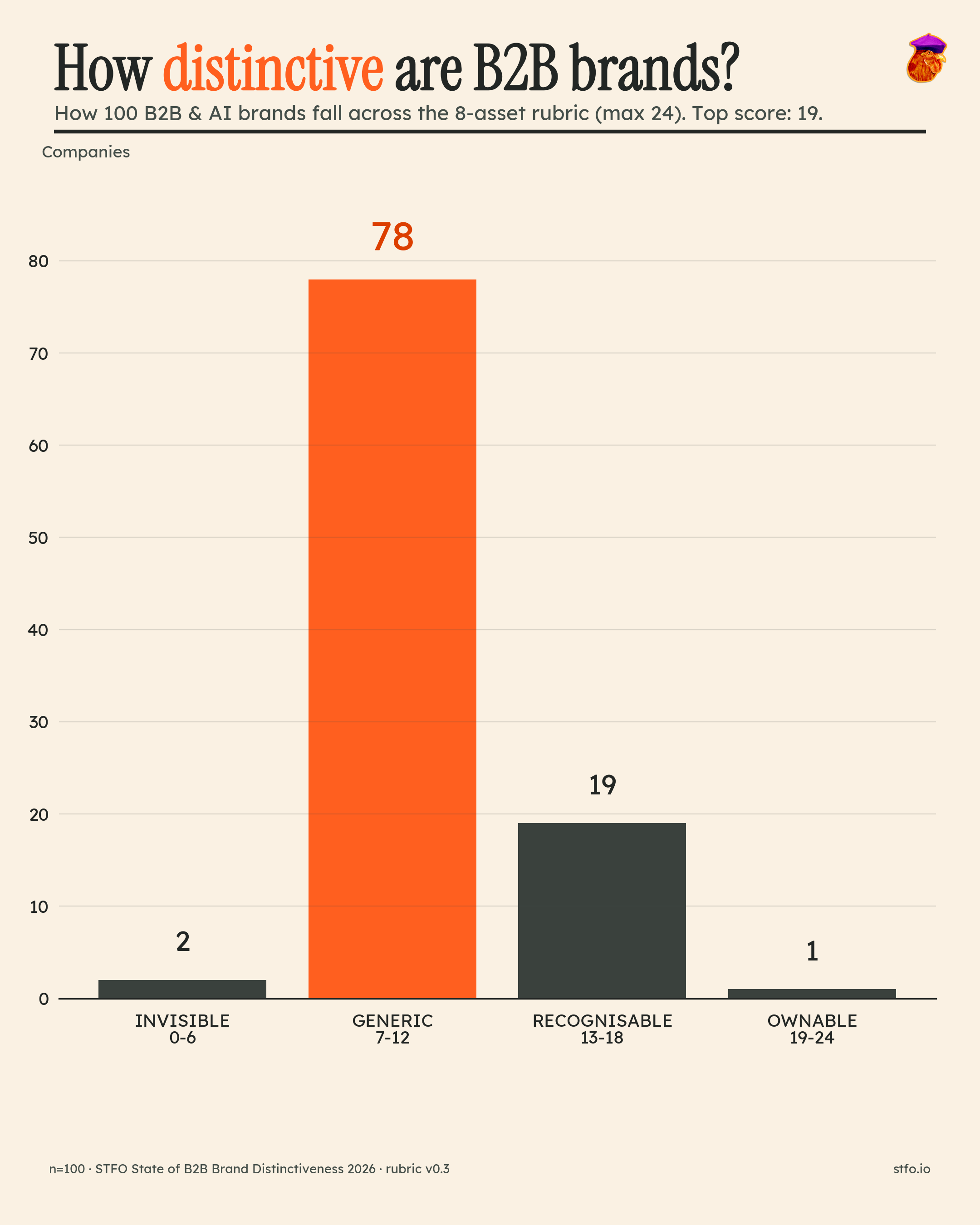
Behind it: 19 companies recognisable, 78 stuck in generic, 2 invisible. The single highest score in the entire study was 19.
It’s even worse than I imagined when running the study: 80% of the brands in the sample are beige as f*ck (either generic or plain invisible). Remove their brand name from their homepage, and most of their prospective customers wouldn’t be able to tell them apart. This is bad… But this is also a MASSIVE opportunity if you’re willing to stand the f*ck out.
Finding 2: Not one company has a sound
Ninety-one companies scored zero on music. Eight scored 1, which means present but generic, the stock trailer bed every SaaS explainer reaches for. Nobody scored 2. Nobody scored 3. The average across a hundred companies that collectively spend billions on go-to-market: 0.08.
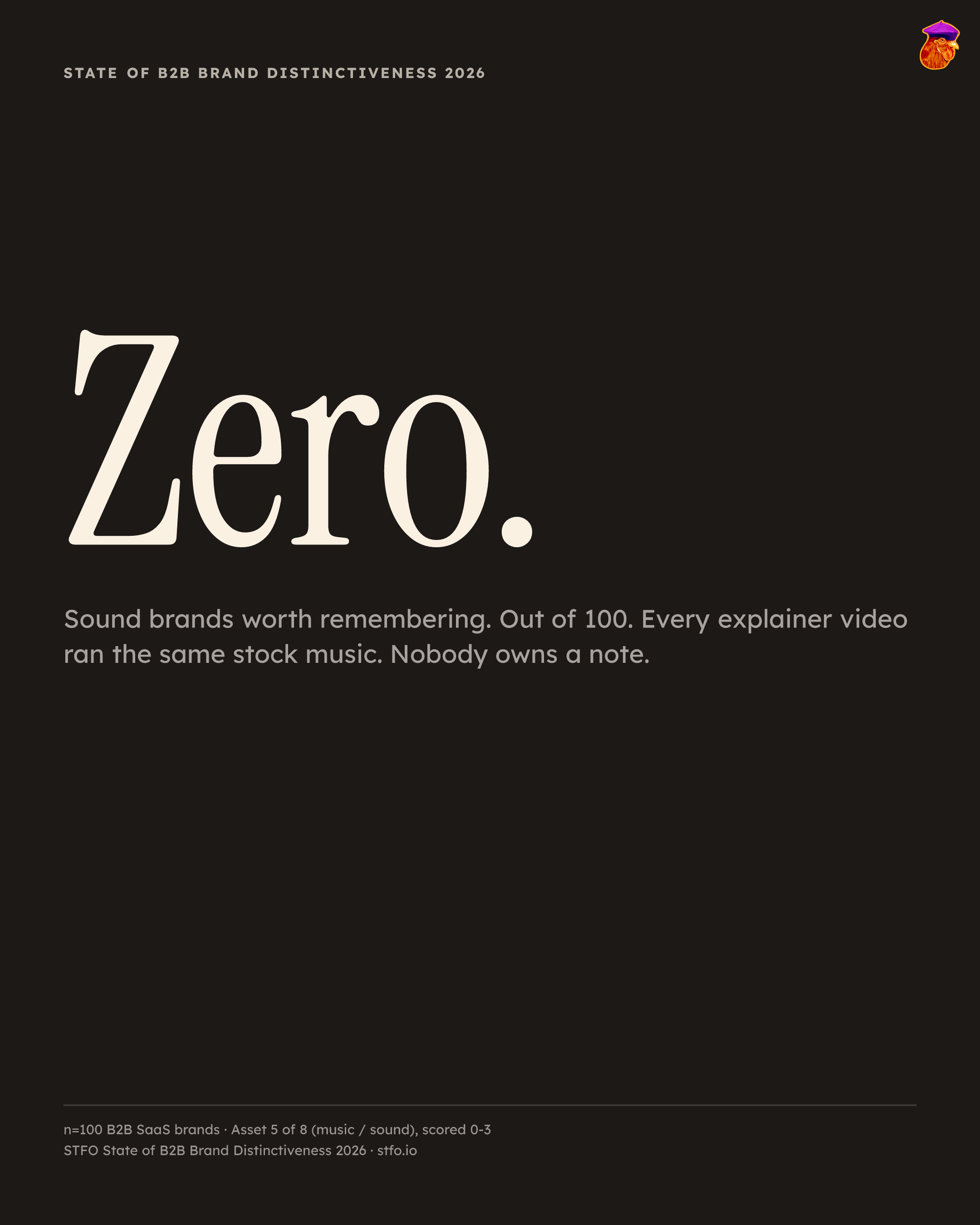
Not one brand in the study has built a jingle you’d recognise. No sting. No recurring motif. Nothing you’d hum.
And let me tell you something… I went looking. I really did. Headphones on, easily five hours of explainer videos, ads, conference recordings… I may have missed a few, but the pattern wasn’t subtle AT ALL. It’s like they all conspired to use the same “atmospheric, grandiose music” on their explainer videos.
Now… I can hear you from here. You’re saying something like, “Sound? We sell to procurement teams and engineering leads. People watch our videos on mute. What is our brand supposed to sound like?” Challenge accepted.
How about a consistent sonic device in:
- Your own podcast intro.
- The ads you run inside other people’s podcasts.
- The walk-on music at your conference.
- The song you play inside your next booth.
- The videos your C-Suite posts on LinkedIn.
- The ads you run on social.
- The webinar open.
Shall I continue?
That’s an ENTIRE asset class that’s completely open.
Finding 3: The assets that work are the ones nobody touches
Colour scored highest across the cohort, 2.12 out of 3, with 86% of companies landing a 2 or better. It’s probably the easiest asset class to obsess over. But when every company in your category nails colour, the colours cancel out. A category of distinct blues is still a category of blues.
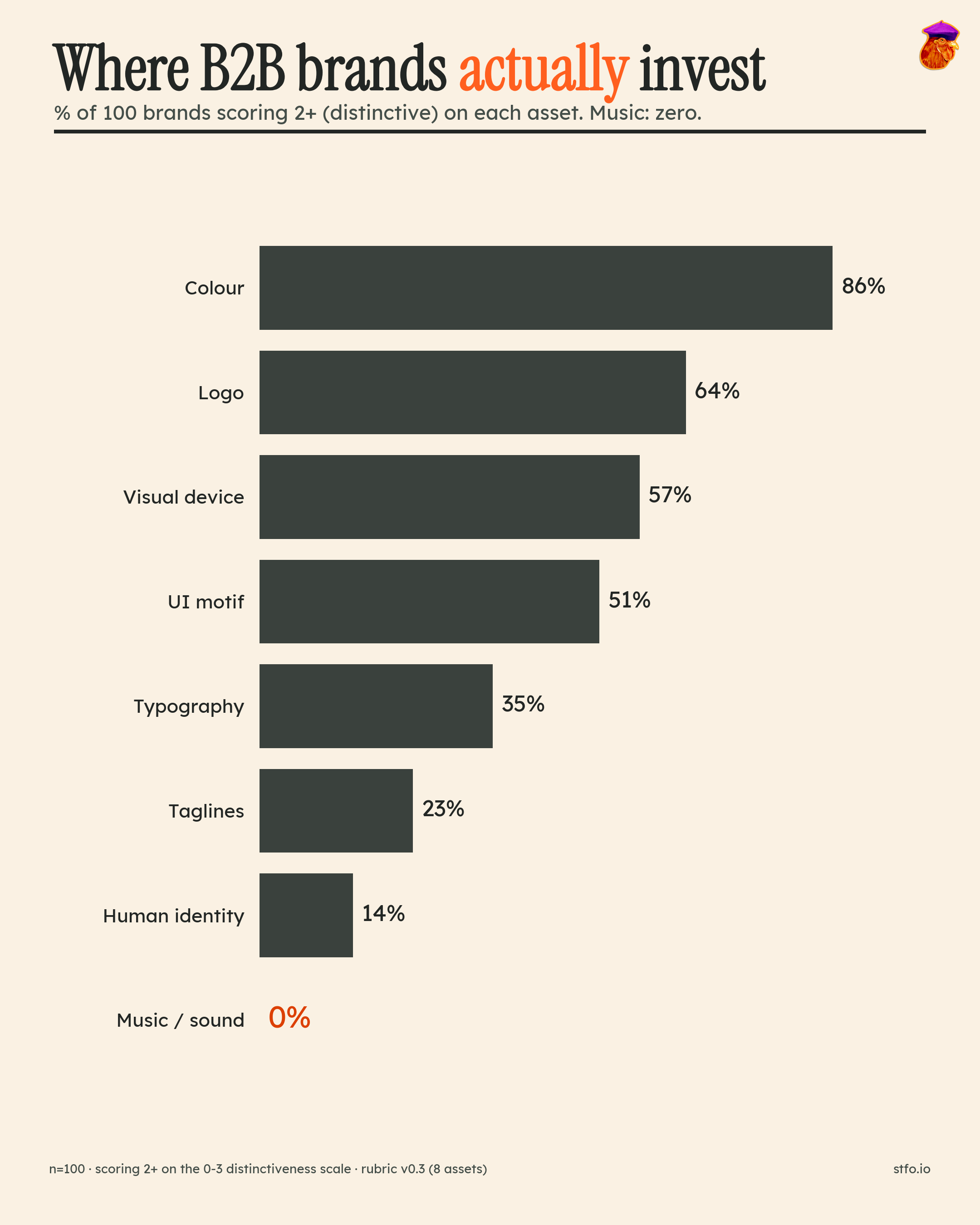
Now look at the bottom. Human identity, the characters and mascots and recurring faces, averaged 0.73. Only 14% of companies managed a 2 or better. Music, as we just covered, sat at 0.08. These are the assets Romaniuk’s research keeps finding are the fastest to build recognition: mascots, characters, sonic logos, distinctive shapes are the ones that tickle your prospects’ memory the hardest.
In other words, the assets brands pour the most into are the ones that work the least because everyone pours into them. The assets almost nobody touches are the ones that would actually make you stand the f*ck out.
Finding 4: AI didn’t fix it
In our sample, we had 41 companies founded during the AI era (from 2021 onward), compared with 59 that predate it. I was expecting the AI-native crowd to be sharper… but they weren’t. There is no difference.
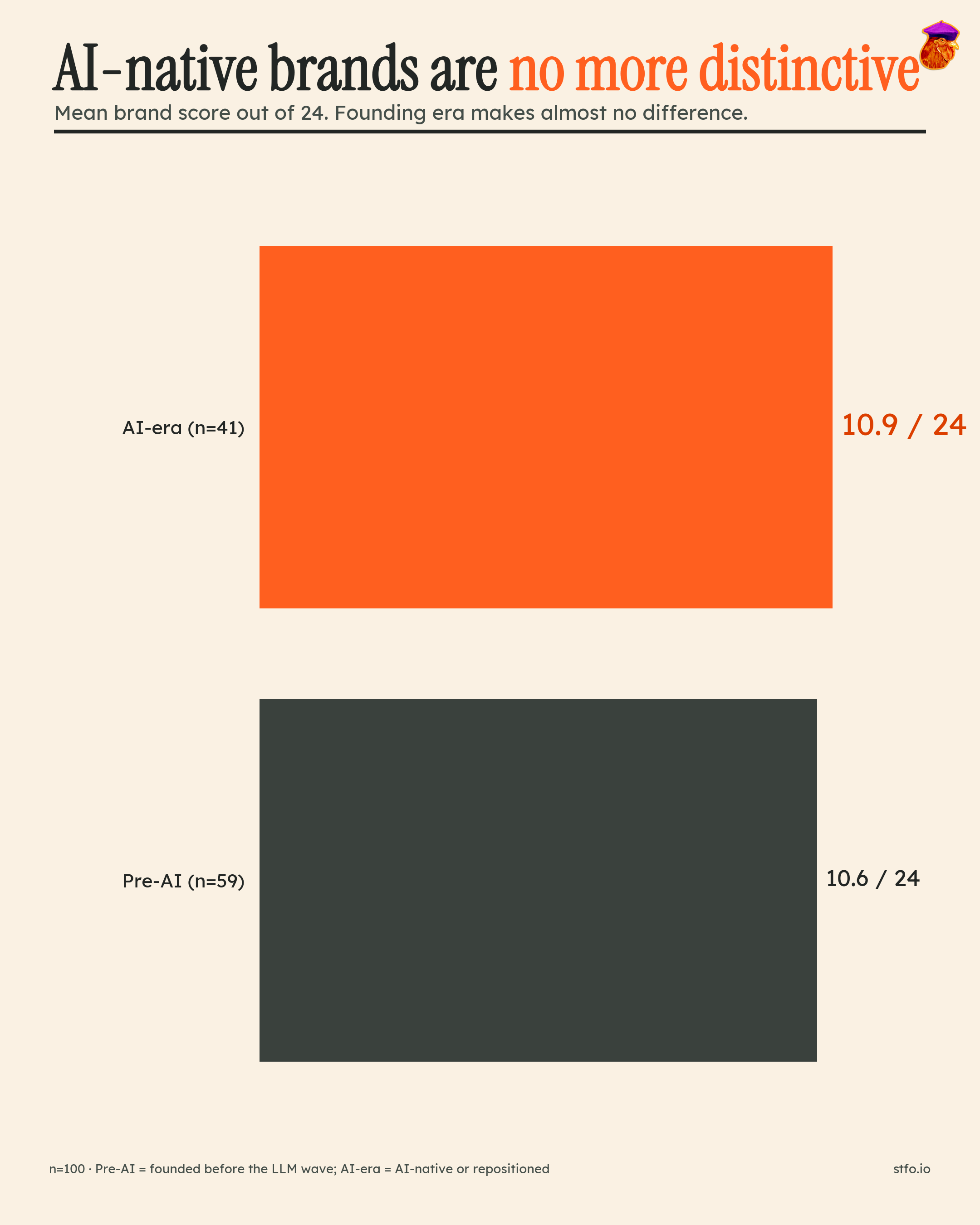
Even with massive funding and speed on their side, most of these companies still obsess over differentiation and product-market fit (which makes sense). But they seem to neglect the power of distinctiveness and how well it pairs with the differentiation they’re already chasing. The result is a GTM that blends the f*ck in.
Finding 5: DevTools takes the risks
DevTools and Infrastructure scored highest, 12.0 on average. Security and GRC (Governance, Risks, Compliance) right behind at 11.86. At the bottom: Data and Analytics, 9.31. Sales and RevOps just above it at 9.82.
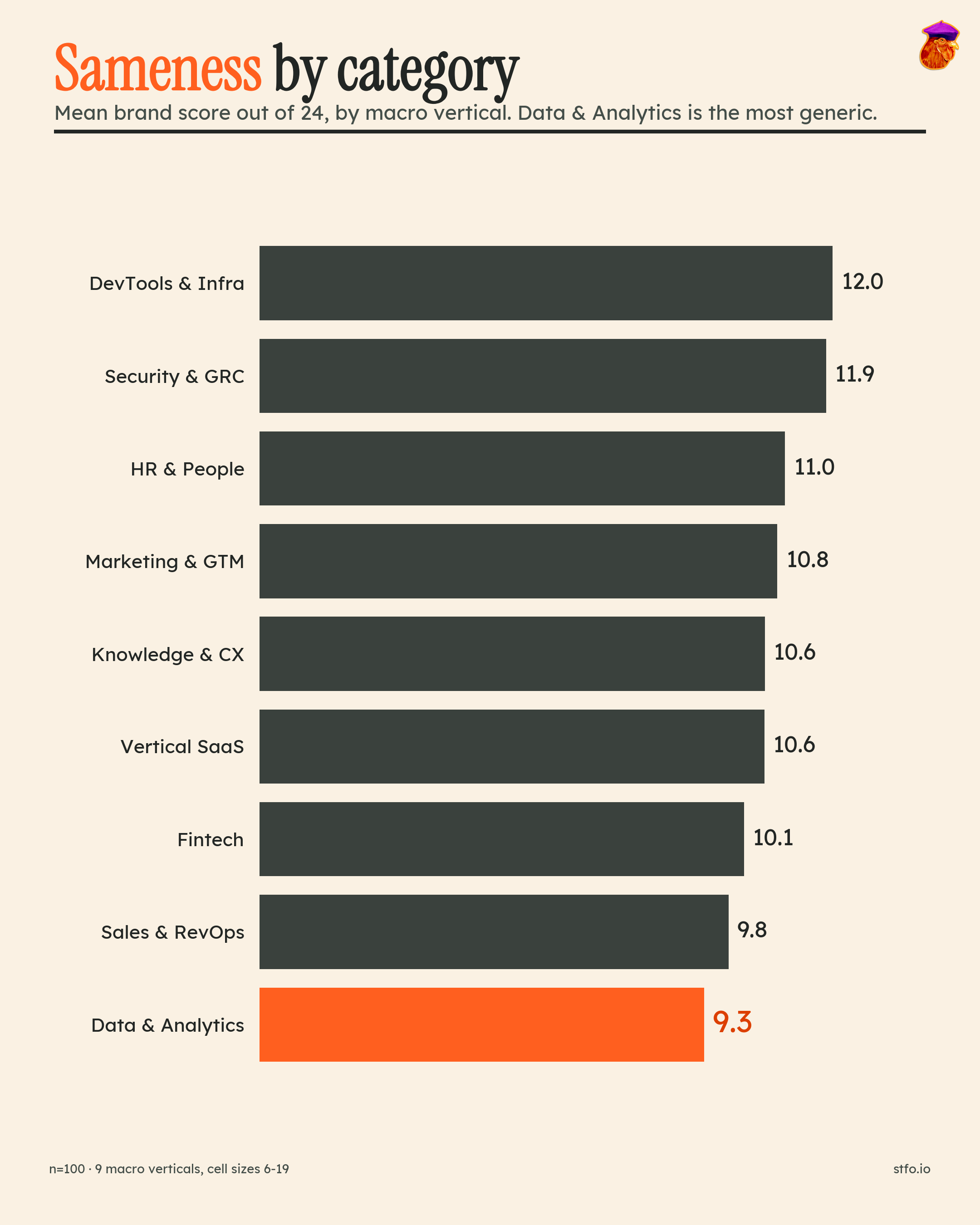
My read? DevTools and security companies sell to developers, and developers are notoriously hard to market to. They’re super cynical about marketing, they live on the web, they’ve seen every play. Which means the bar to get noticed by them is higher, and the brands that sell to them seem more willing to take a risk to clear it.
Our sample of 100 companies across 9 verticals is too small to be statistically significant, so don’t read too much into it. But it’s still interesting.
The distinctive few
I want to be clear about what the leaderboard is and isn’t. It is not an award ceremony… Wiz beating Mutiny by a point doesn’t make Wiz a “better brand.” Score it with a slightly different system, and the order may shift. In short, this is for your inspiration. Don’t read too much into it.
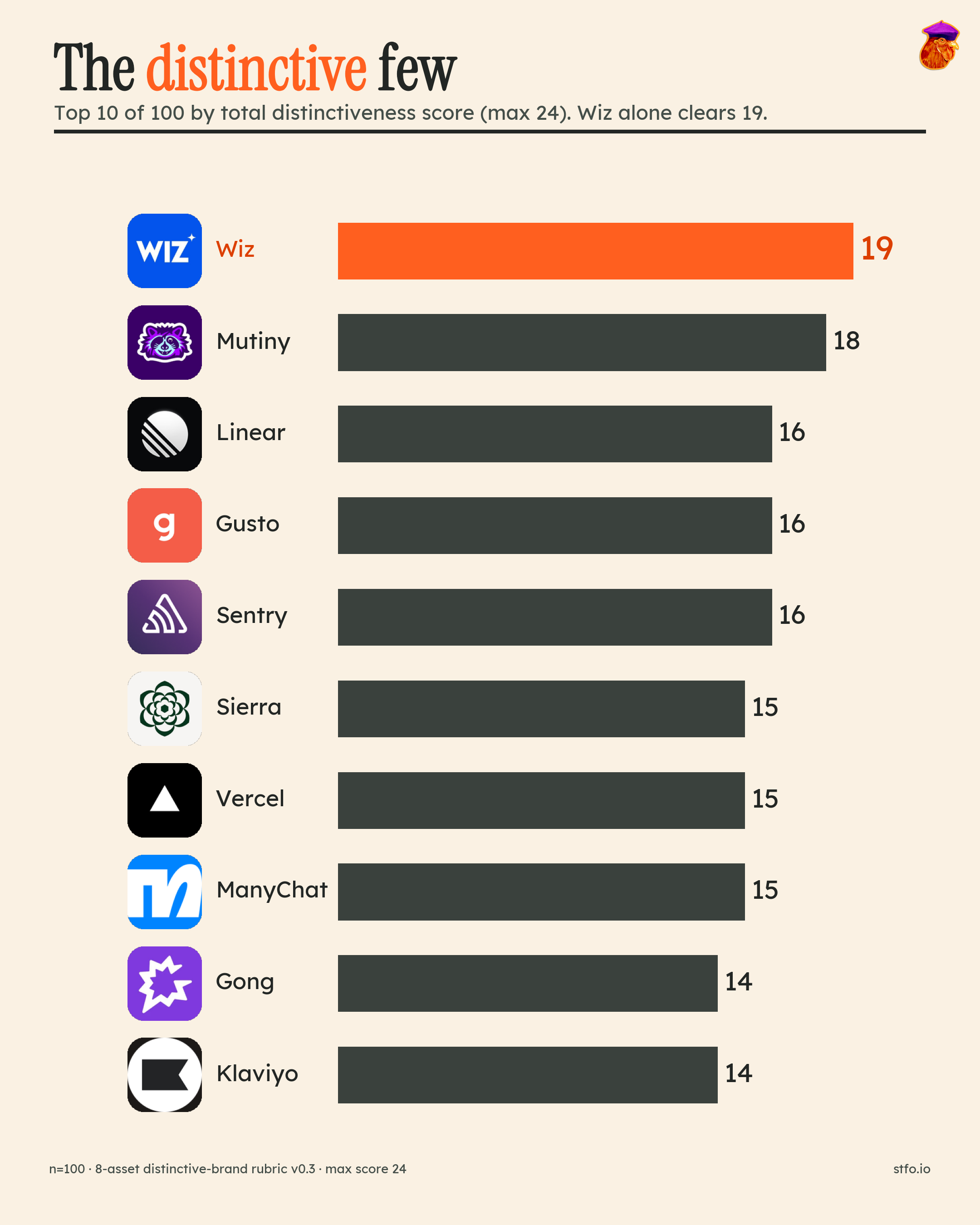
But the top of the list is worth looking at, because it shows what “distinctive” actually buys you when a company commits.
Wiz (19/24). The only company in the ownable band. A genuinely distinctive logo and icon, a cast of little cartoon characters, a recurring cloud-cluster device, the “Build and Run” line running through the messaging, and a colour system that holds together across everything we looked at. It’s distinctive across the whole surface area, not just the homepage. That’s the bit most companies miss. Distinctiveness isn’t one great hero shot. It’s the same recognisable world everywhere a buyer might run into you.
Mutiny (18/24). A mascot, and not just any mascot: a raccoon, there to lead a mutiny. The “Be the one buyers remember” tagline, which is almost too on-the-nose for this report. The flag motif. A soft multi-pastel palette and a consistent set of product-UI card mockups. Good breadth, held consistently. They built a small world and stayed in it.
Linear (16/24). One of the poster children for the new product-led, AI-era aesthetic. A distinctive wireframe-sphere mark, all overlapping orbital arcs. A near-total commitment to dark, a full dark-mode interface, which is still genuinely rare. And a founder, Karri Saarinen, who is consistently visible and vocal, which feeds the human-identity asset most of the cohort scores zero on. Worth noting Linear ties with Gusto and Sentry at 16. It edges third on a tiebreak, not by a clear margin.
Top 10, scored 0 to 24
The thing all three share isn’t a single brilliant asset. It’s breadth held consistently. Several hooks, the same everywhere. That’s the whole game.
What you should do now
You’ve seen the data. Here’s what to actually do with it.
Get your positioning right first. A distinctive asset on top of vague positioning just makes you famously generic. Decide who you’re for, what you do that’s different, and why it matters. Then make it retrievable. Worth retrieving, then easy to retrieve. In that order.
Pick an asset class nobody in your category owns. Look at Finding 3 again. Everyone piles into colour and typography, so those cancel out. The assets that build recognition fastest, sound and human identity, are sitting almost completely empty. Not a single brand in the study has a sound. Fourteen percent manage a recognisable human or mascot. That’s not a gap. That’s an open goal.
Commit to one thing that feels slightly too weird. Real distinctiveness is something a competitor can’t comfortably copy, which means it’ll feel like a risk before it works. Bibendum was a man made of tyres. Mutiny put a raccoon on the website. If your asset feels safe, it’s probably already taken.
Hold it across the whole surface, not one hero shot. This is the bit almost everyone misses. Wiz didn’t win on one great image. They built the same recognisable world everywhere a buyer might run into them: site, product, social, sales deck. Pick your hooks, then repeat them with a discipline that feels boring from the inside. That repetition is the entire mechanism.
That’s the playbook. Positioning, then one open asset, committed to hard, held everywhere. The companies at the top of that leaderboard aren’t more talented than you. They just decided to stand the f*ck out, and then didn’t blink.
This is exactly the work I do inside a GTM Sprint. I embed with your marketing and founding team, we lock the positioning, find the asset your category has left wide open, and build a way to actually ship it. If this study made you uncomfortable about your own brand, that’s the right reaction. Let’s talk.
So why doesn’t everyone do this?
If distinctiveness is this powerful, and the bar is this low, why isn’t every B2B company sprinting for it?
First, brand work doesn’t show up next quarter. Distinctive assets compound. Theoretically, they get stronger every time someone sees the asset next to your name, which means the payoff is a slow build, unlike direct response emails, for example. Case in point? Sonic asset is the clearest case: it’s the highest-opportunity asset in the study and the hardest to brief, which is why I think nobody’s done it (yet!!).
Second, it feels like a risk. Real distinctiveness means committing to something a competitor can’t comfortably copy, which means committing before you can prove it’ll work, which means somebody in charge with a lot to lose has to put their name on something that looks strange/weird/wacky/unprofessional. This is where most teams flinch and go back to the centre of the map, where everyone else already is.
In short, I believe B2B teams confuse polished with distinctive. And they are not the same thing. Polished gets you a clean, professional, completely generic brand. Distinctive gets you a stand-the-f*ck-out brand that prospects can’t help but notice, remember, and put into their shortlist.
Bibendum was a bet, in 1898. A weird-looking man made of tyres. Somebody had to look at that and say yes. A hundred and twenty-five years later, it’s still paying off.
Methodology & full rubric
100 B2B SaaS and AI companies across 9 macro verticals: DevTools and Infra, Security and GRC, HR and People, Marketing and GTM, Knowledge and CX, Vertical SaaS, Fintech, Sales and RevOps, Data and Analytics.
8 distinctive-brand assets scored 0 to 3 each (max 24): colour, logo, visual device, typography, taglines, human identity, product UI motif, music.
Scoring scale. 0 absent. 1 category default. 2 distinctive and theirs. 3 recognisable out of context.
Bands (out of 24). 0–6 invisible. 7–12 generic. 13–18 recognisable. 19–24 ownable.
Built on Jenni Romaniuk's work at the Ehrenberg-Bass Institute. Selection was AI-assisted and deliberately blind to Louis's own view of who's good at brand. First-pass scoring ran off a fixed rubric via AI agents; every final score was reviewed by hand.
Next read
Distinctive brand assets: why meaning-free beats meaningful (B2B edition)
Most B2B brands chase meaningful logos and taglines, and end up tasting like lukewarm water. The brands that get remembered are the ones willing to pick assets that don't obviously explain what they do. Here's why, and how to build a kit that actually sticks.
Daft Punk: 5 Marketing Lessons to Make Your Business Famous
I had this idea of doing a marketing analysis of Daft Punk ever since I've been doubling down on radical differentiation. I love the way they've been zagging when other electronic music artists were zigging.
Key terms
Distinctive Brand Assets
Distinctive brand assets are the meaning-free bits and bobs that make your brand uniquely yours. A colour, shape, sound, mascot, or phrase. The goal is to tickle different parts of the brain without competing with all the other crap floating around in people's heads. Meaningful logos are overrated.
Mental Availability
Mental availability is the probability that a buyer will think of your brand in a buying situation. It is the combined result of distinctive brand assets (Stage 3) and continuous reach (Stage 4). Most B2B companies ignore it because they're too busy chasing the 5% of buyers who are actively looking.
The Mental Shortlist
B2B buyers buy from brands already on their mental shortlist by the time they search. If you're not in their head before the trigger hits, you don't exist when it matters. The entire inbound industry needs reframing: the goal isn't to capture searchers, it's to be remembered before they search.
Differentiation
Differentiation in B2B is the practice of solving specific problems that alternatives leave unsolved for a specific group of people. Being different for the sake of it is a fool's errand. The difference must address an ignored struggle that your segment actually cares about.