SaaS Lost in Translation: 97 Website Localization Examples, Scored (2026)
We scored 97 B2B SaaS companies on what survives when their brand crosses into another language. The average company keeps 59% of its brand. And the other 41%? It turns into something any competitor could have shipped.
I grew up in a village of about 400 people in central France. My house was built with pouzzolane, volcanic rock. True story. If you’ve ever seen a bottle of Volvic, the mountains on the label are the extinct volcanoes near where I lived.

The Puy de Dôme. Extinct, I promise.
Don’t worry, we had electricity. Clean, drinkable water ran through the taps.
My parents were teachers. I’m the only one of my cousins who lives abroad. Nothing about that childhood said this kid would leave France, work in marketing, run his own business, and do it all in English.
So yeah, I’m the odd duck.
Fifteen years in Dublin later, I think in English. Given the choice, I’d rather work in English, which is a strange sentence for a Frenchman to type. I’m aware of it.
There’s a reason I’m still a “recovering Frenchman,” though. I still can’t read a French SaaS homepage without knowing, within about two sentences, whether it was written in French or run through a translation tool.
Don’t get me wrong. The grammar is fine. Every word is spelled correctly. But the rhythm is off, the words come in a slightly wrong order, the je-ne-sais-quoi is missing. So I stop trusting it.
And then the same thought, every time: “This company didn’t think my market was worth an hour of a native speaker’s time.”
Anyway…
My clients sell into places like Germany, France, the US and Canada, sometimes all at once. So the same question keeps coming up in positioning work, and I’ve never had a good answer: if a company stands the f*ck out in English, does it still stand out in German? Or does the edge quietly die at the border?
So I went and checked.
The six findings, in five seconds
| 59% | Most brands lose almost half at the border. 58 of the 97 companies keep less than 60% of their brand. |
| Voice | Voice goes first. Of the four things we scored, it’s the one that gets muted the most. |
| 50% | US companies lose the most abroad. Every other region sits at least ten points higher, except Canada. |
| The enemy | The fight stays home. The localized page keeps the product story and drops, softens or even flips the fight. |
| Fintech | Fintech good, devtools not so good. With a catch you’ll want to read. |
| 6 of 97 | Six companies prove it’s doable. They scored 11 out of 12, and they show exactly how. |
How I ran it
My trusty Claude and I picked a hundred mid-sized B2B tech companies (50 to 1,000 employees), all with evidence of more than one language version. Specifically, we:
- Built the candidate list from the companies in the distinctiveness study, G2 category lists, and lists of European SaaS companies.
- Screened them with a script. A company only stayed if we found real evidence of a second language (for example, language tags in the page code).
- Kept roughly 10 companies per industry group (fintech, analytics, and so on).
Then we locked the sample. Three companies dropped out along the way: one blocked every attempt to read its site, one had language versions with nothing behind them, and one removed its translations mid-study.
That leaves 97 companies and 157 company-language pairs, headquartered in Europe (49), the US (20), Latin America (12), Asia (11) and Canada (5).
A pair is one company plus one localized language. A company with an English site plus French and German versions gives you two pairs: English-to-French, and English-to-German.
Each localized page got scored against that same company’s main-language page. If a company is American and English-first, its Spanish site is judged against its English site. Each pair got scored on four criteria.
The four criteria we scored
| Positioning | Does the positioning survive? Is the page still claiming the same job and the same category? Or did it slide into a generic pitch? |
| Conviction | Does the conviction survive? Do they still pick a fight and blame something for the struggles their segment faces? In my book I call this the monster. |
| Voice | Does the voice survive? Is the personality still there, or did it forget its passport at home? Think rhythm, humour, bluntness, signature phrases. |
| Visual assets | Do the visual assets survive? The non-words. Same visual device, same layout, same photography? An English screenshot on a Japanese page is the brand failing to show up for that market. |
What each score means
The same scale for all four criteria. Read it as the gap between translation (the same words in a new language) and localization (the same brand in a new market):
| 0 | Vanished. It’s not there. |
| 1 | Blended in. Translated literally, and more generic than the original. |
| 2 | Carried. Faithful, intact, recognisably the same brand. |
| 3 | Rebuilt for the local market. Different from the English and the differences are local: local alternatives named, local struggle, the same monster (but it roars with an accent). |
Four criteria, three points each, so a pair can score up to 12. Every percentage in this report is a score out of 12.
Who did the scoring. Claude scored every pair against this scale, and every quote it used had to match the saved page word for word. A second AI, blind to the first one’s scores, re-checked the flagged items plus a random sample. I judged every French item myself, and my call overrode both. The full detail is in the method note.
Transparency note. You know me, but I’d still like to say it plainly. Weglot, the website translation tool, sponsored this study. They saw the method before we ran it and had no veto over it. They didn’t see the findings or the company names before publication, and their customer list was never used to build the sample.
Finding #1: Most brands lose almost half at the border
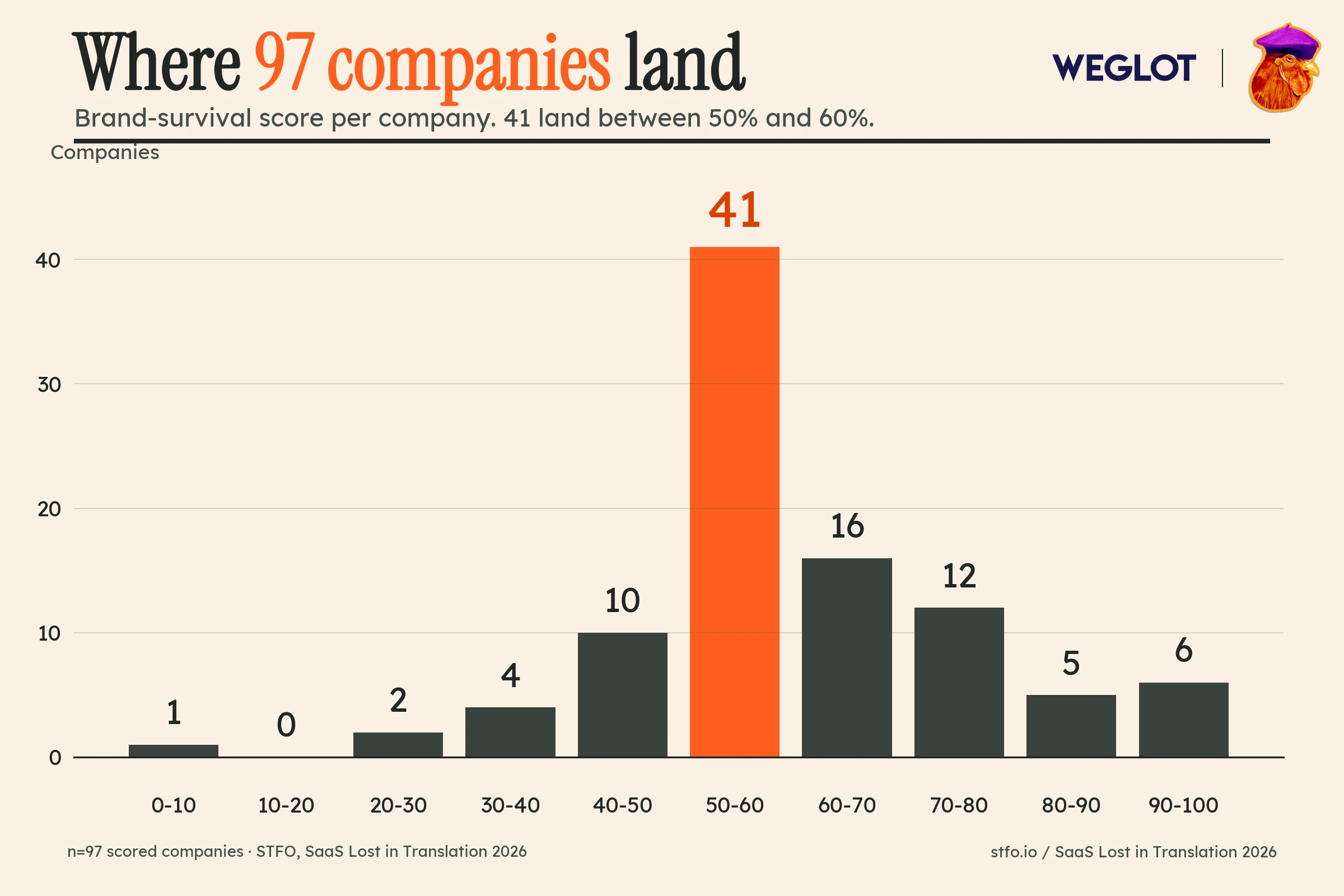
58 of the 97 companies keep less than 60% of their brand when they cross into another language. Only 11 keep more than 80%.
And 41 of them land in the same band, between 50% and 60%. That’s the middle of this market. It translates the words and ships.
Finding #2: Voice goes first
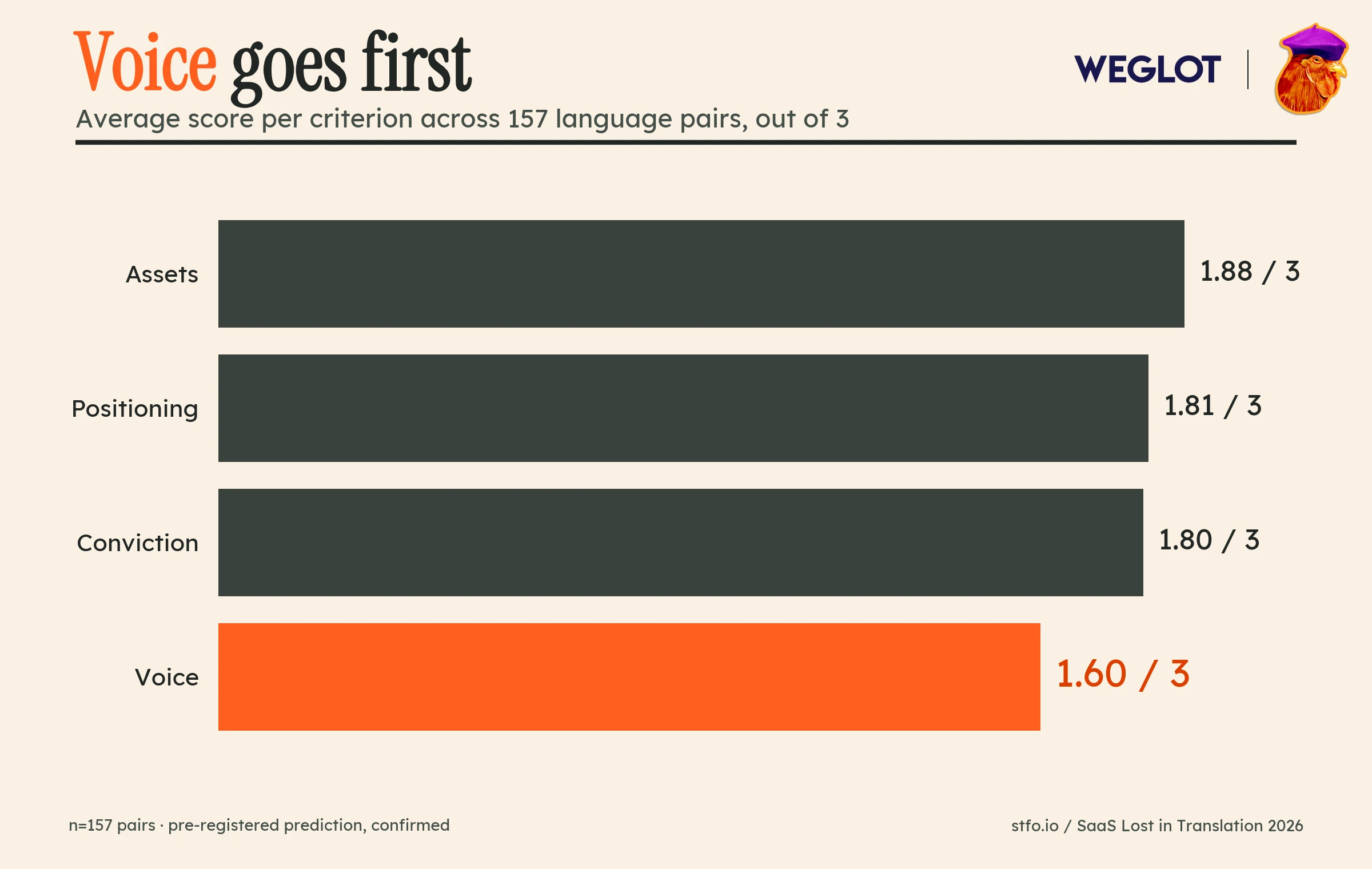
Across all 157 pairs, voice is what gets muted the most. It averages 1.60 out of 3. The other three sit between 1.80 and 1.88. I called this one before we ran the numbers, and it held.
I don’t know why, but all I can think about is Ariel giving her voice to the sea witch Ursula so she can grow legs and meet her prince. I know, it’s weird.
A few examples.
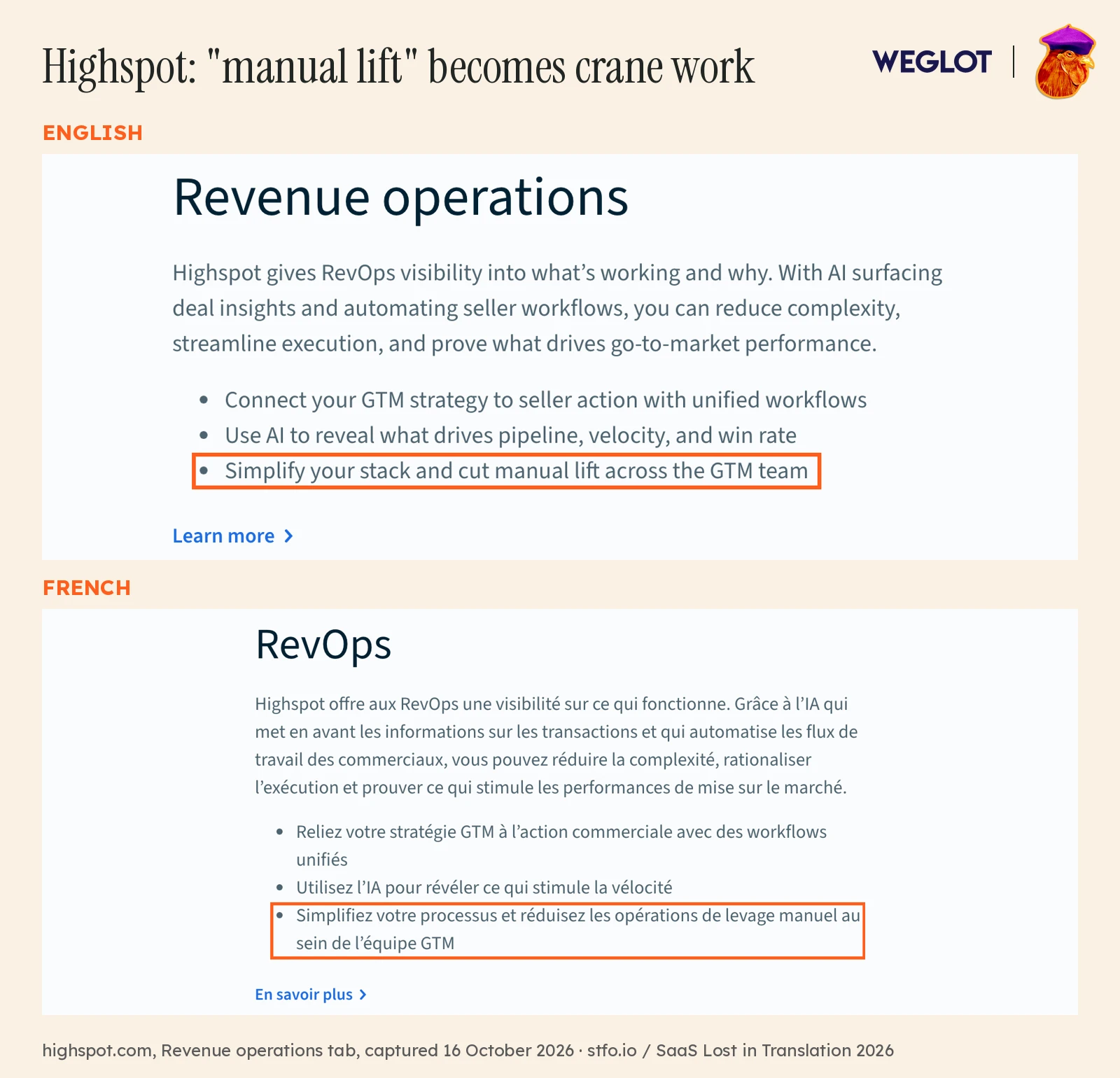
Highspot tells you in English to “cut manual lift across the GTM team.” In French: réduisez les opérations de levage manuel. That’s crane vocabulary, like, literally. A go-to-market team being asked to lift fewer heavy objects.
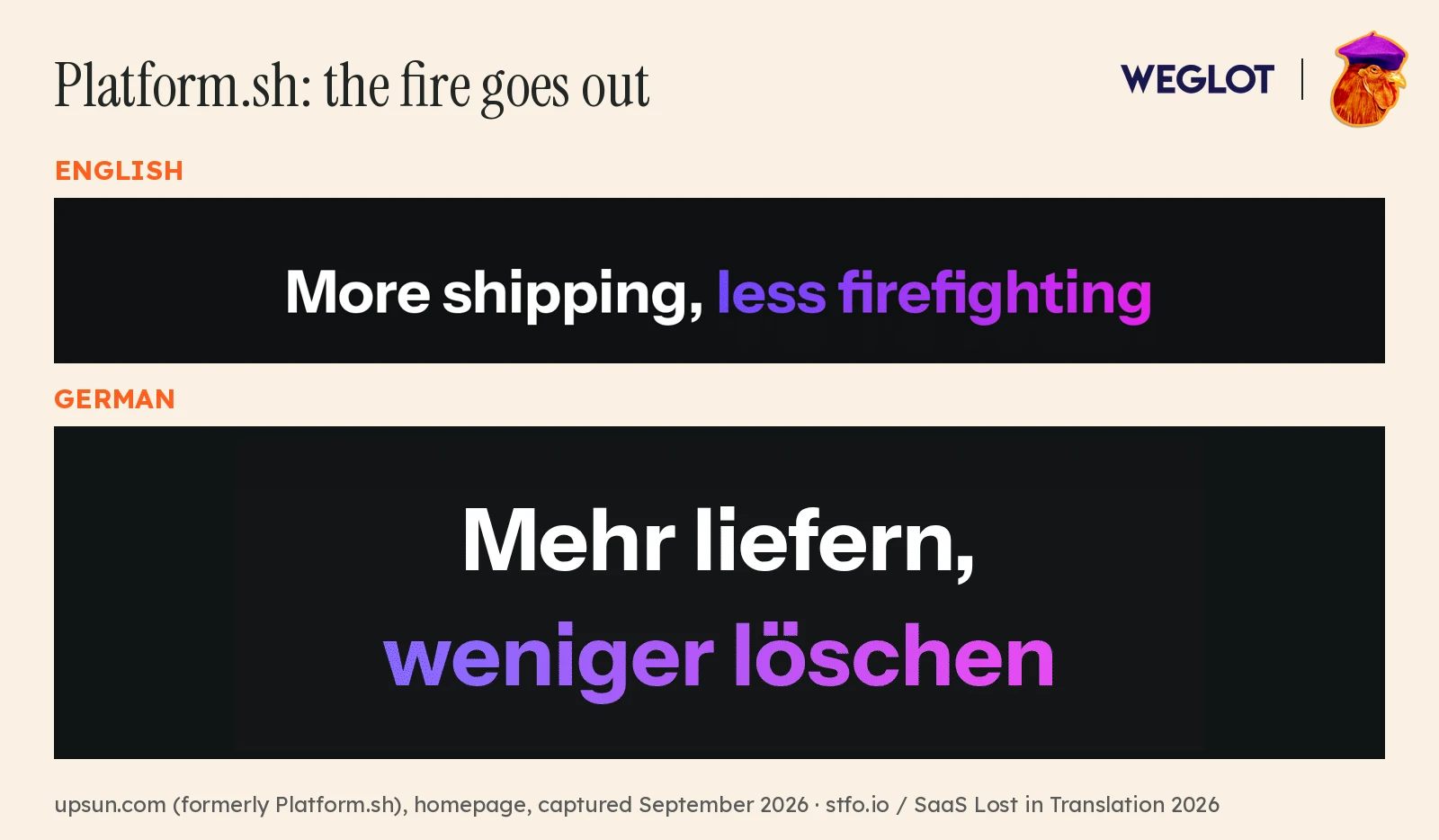
Platform.sh (now Upsun) runs “More shipping, less firefighting” in English. In German that becomes Mehr liefern, weniger löschen, and with no fire anywhere in the sentence, löschen reads as delete. Deliver more, delete less. The joke dies a slow death. The German About page even labels itself Übersetzt von AI: translated by AI.
Algolia was founded in Paris. Its English About page says “Our people & culture.” The French says Notre peuple et notre culture. But peuple means a people, in the sense of a nation. It’s never staff.
mabl’s English hero is “Don’t build tests, build trust.” Two beats, an imperative. The Japanese becomes “the AI test automation best suited to your team.” Our scorer’s note on that one: it “asserts nothing and would be at home on any competitor’s page.”
Frontify sells brand consistency. Its French homepage says le Brand Assistant, then a few lines later le Brand Assistante. Masculine article, feminine ending. Nobody read it back.
Finding #3: US companies lose the most abroad
Sort the companies by where they’re headquartered, and the US comes last. Its companies’ localized pages keep 50% of the brand. Europe, Asia and Latin America all sit between 61% and 64%.
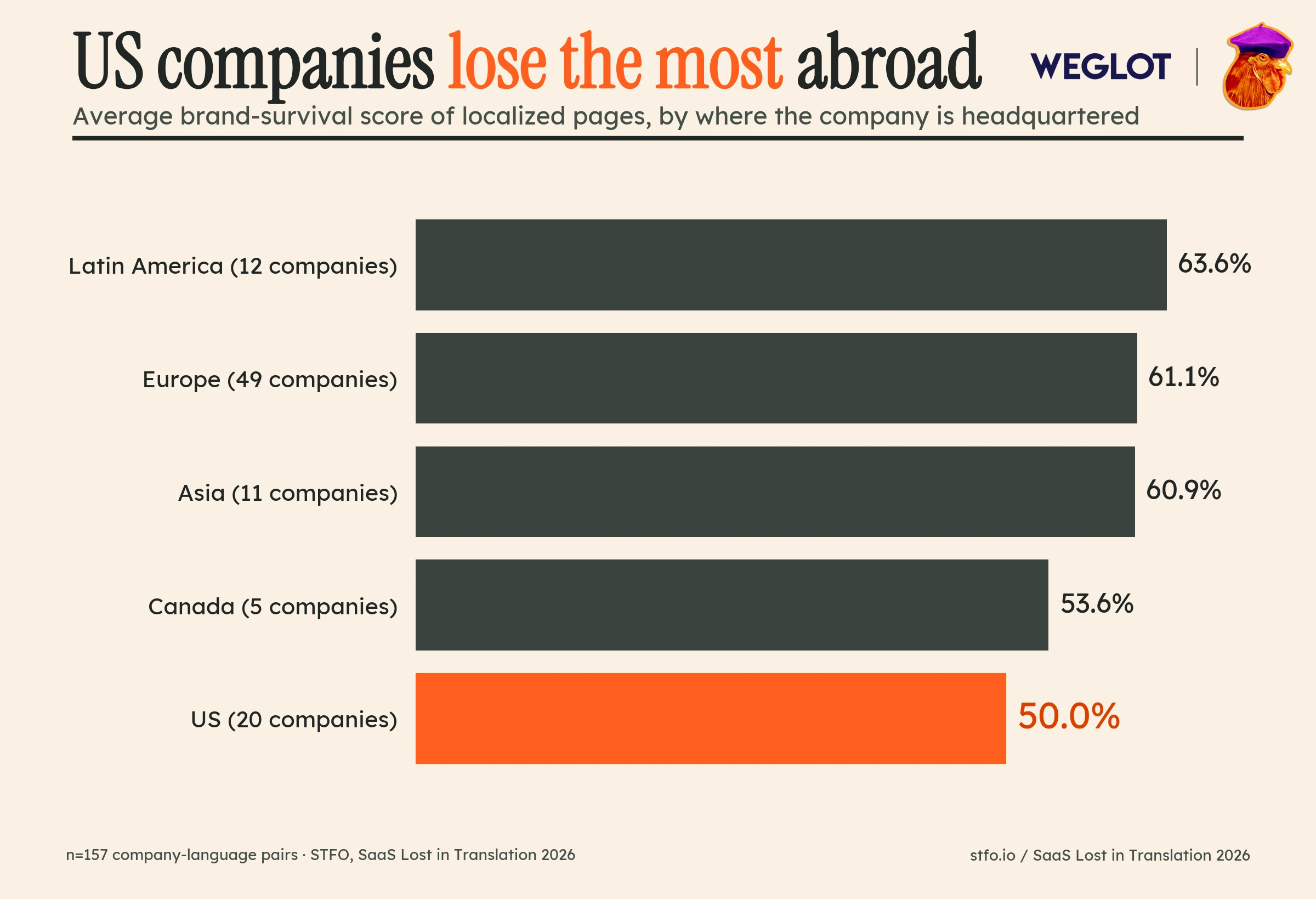
And it’s across the board. US companies score lowest of any region on all four criteria. The biggest gap is visual: their localized pages tend to keep the English screenshots and the English proof, and score 1.48 out of 3 on assets. Latin American companies score 2.18.
My guess? Europe and Latin America are exporters by default. Launch a SaaS in Belgium and you need French, Dutch and English before you’ve sold a single licence. A US company can grow for a decade without needing a second language. So when it finally adds one, nobody in the building reads it.
The data backs that up from the other side. The 10 companies in this study that translate into English from another language score 50% too, exactly the same as the Americans. What predicts the score is whether anyone on the team can read the page they just shipped.
(Canada has only 5 companies in the sample and Asia 11, so I wouldn’t lean on those two bars.)
Finding #4: The enemy stays home
When a company picks a fight on its English site, the localized site usually keeps the product story and drops the fight. It happens in three ways.
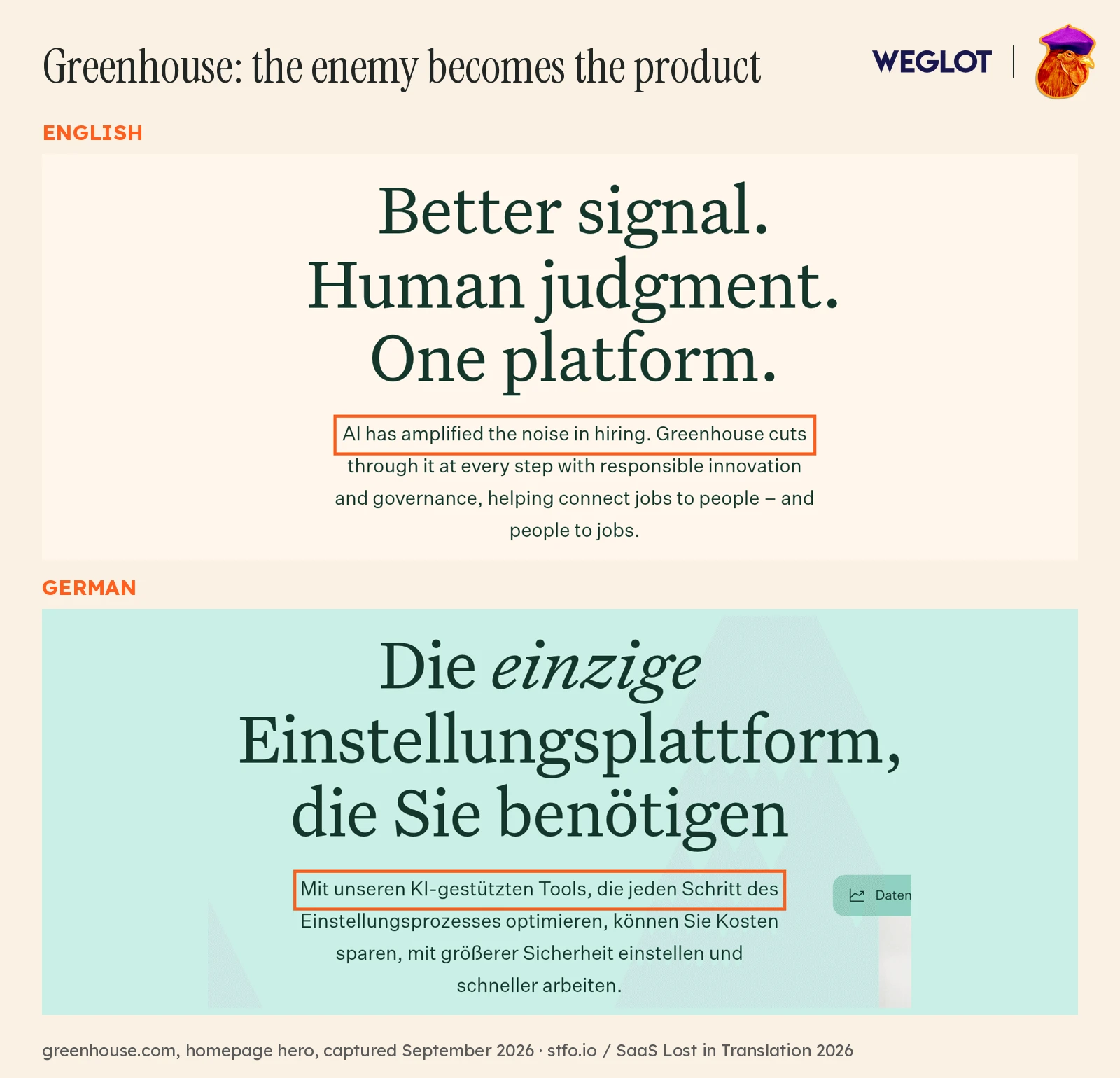
Inverted. The thing the main language fights becomes what the other language sells. Greenhouse’s English homepage says “AI has amplified the noise in hiring.” Its German hero leads with KI-gestützte Tools, AI-powered tools, as the headline benefit. The enemy became the product. Even the headline changes, from “Better signal. Human judgment. One platform.” to Die einzige Einstellungsplattform, die Sie benötigen, the only hiring platform you need. “Human judgment” goes missing along with the fight. Greenhouse scored 3 out of 12 in German, on a site that’s fully translated.
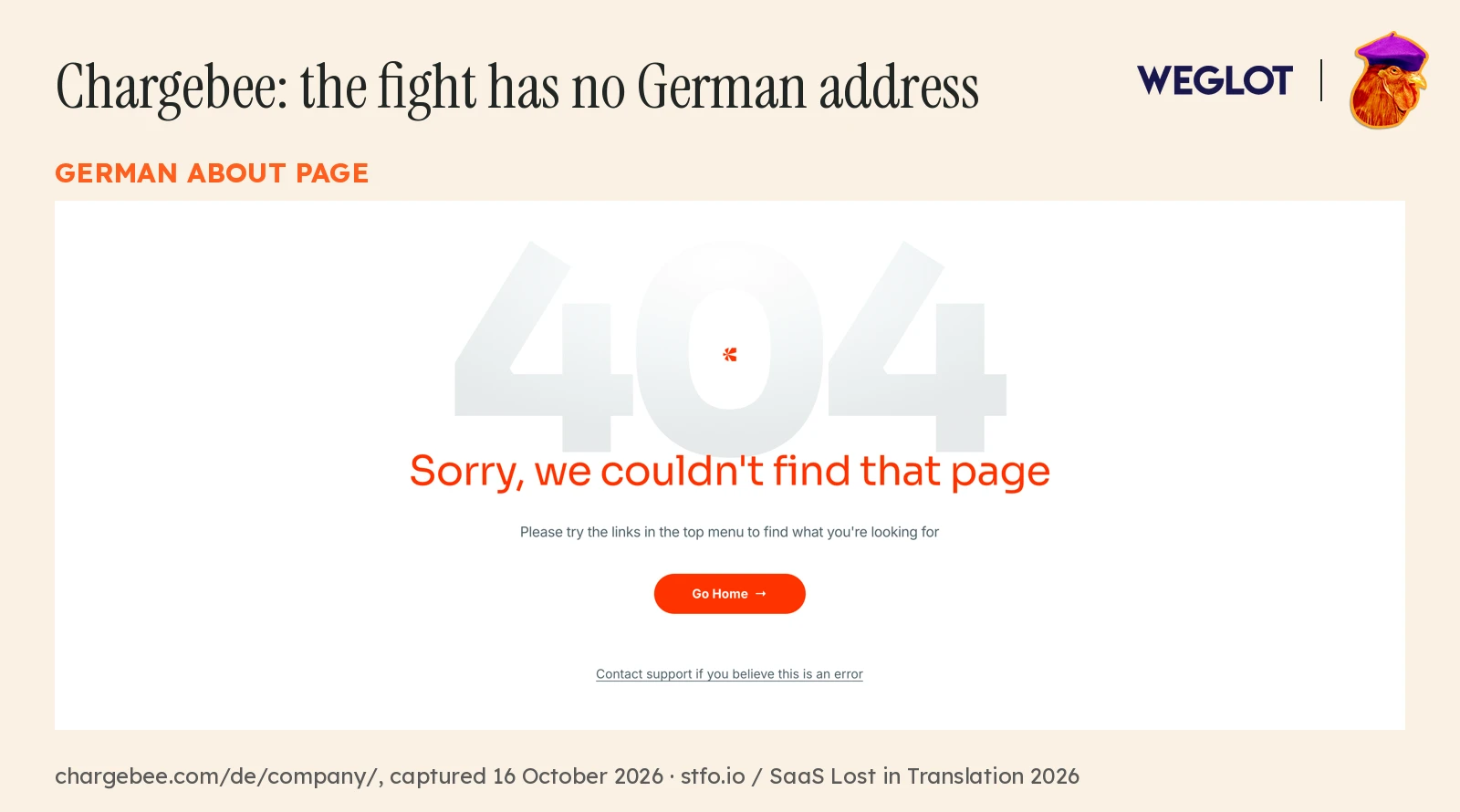
Homeless. The monster is there in the main language and nowhere else. Chargebee’s monster lives on its English About page. The German and French versions of that page both return a page-not-found error.
Softened. The stakes survive, but they go vague. Dataiku’s English hero is “See everything. Control cost. Mitigate risk.” In German: Verwalten Sie KI im großen Maßstab mit Zuversicht, manage AI at scale with confidence. Three concrete stakes collapse into one abstract reassurance, and reassurance is what every competitor is also selling.
One caveat: 31 of the 97 companies name no enemy on their main site either. For them there was no fight to lose in translation, so we didn’t penalise them.
Finding #5: Fintech good, devtools not so good
Fintech companies keep 67.4% of their brand abroad. Devtools keep 54.5%. And if we zoom in, a few interesting things show up.
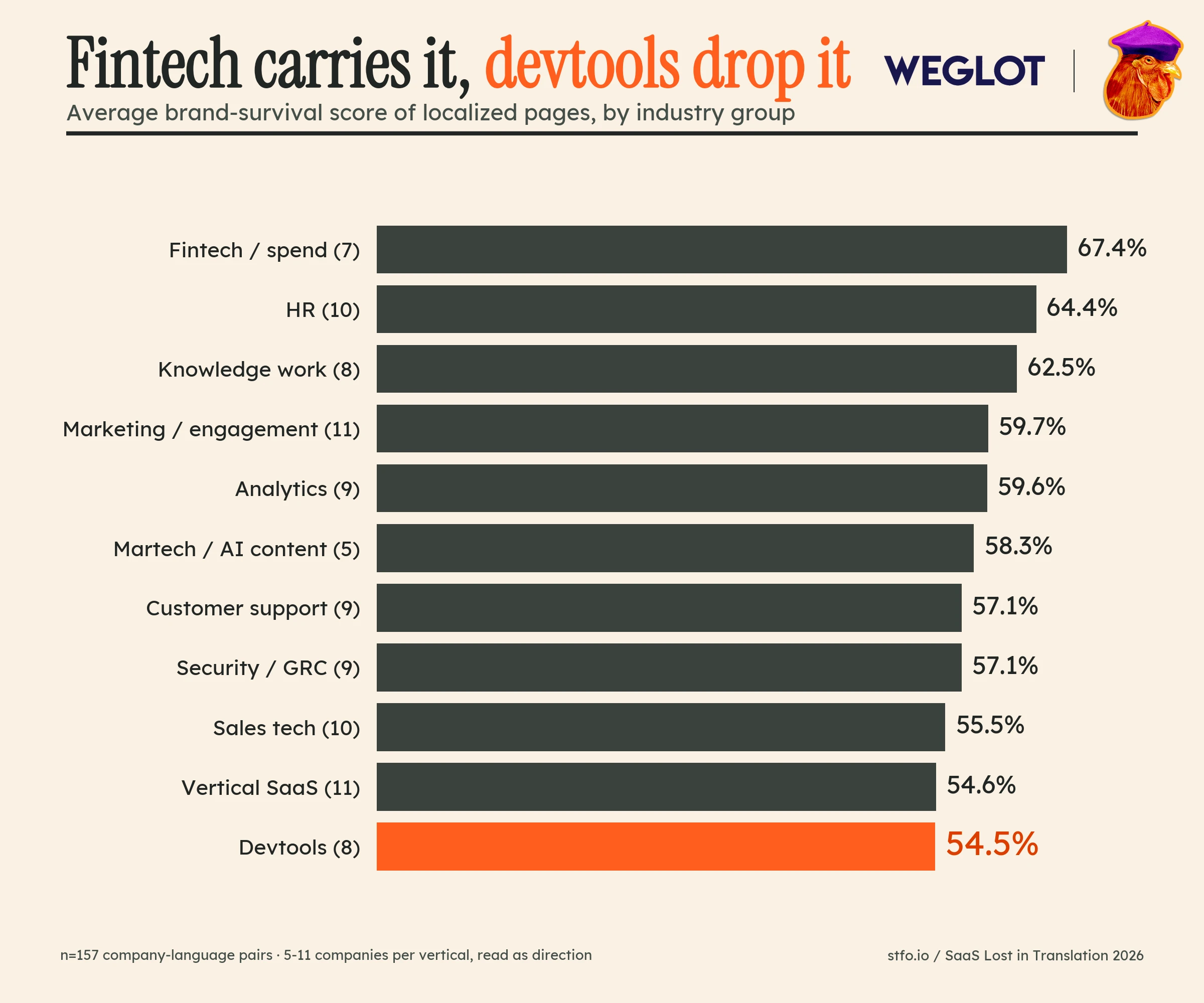
Fintech keeps the claim and drops the fight. Positioning and visual assets both average 2.45 out of 3, the best of any industry group. Conviction sits at 1.45, the worst.
But there’s a catch. Two of the six companies that nailed this study, Spendesk and Float, are fintechs. Take them out and fintech drops to 58.3%, right in the middle of the pack. So “fintech is good at this” really means “two fintechs are very good at this.”
Devtools lose their voice hardest, at 1.31, with vertical software (built for one specific industry) just behind at 1.33. My guess for devtools: English developer copy runs on in-jokes and puns, and those are the first thing to die in translation. Remember Platform.sh’s firefighting.
Knowledge work is the only group where voice holds on average, at 2.0. Tools for writing and thinking apparently hire people who care what words sound like. Who would have thought?!
(Each industry group has between 5 and 11 companies, so read these as directions.)
Finding #6: Six companies prove it’s doable
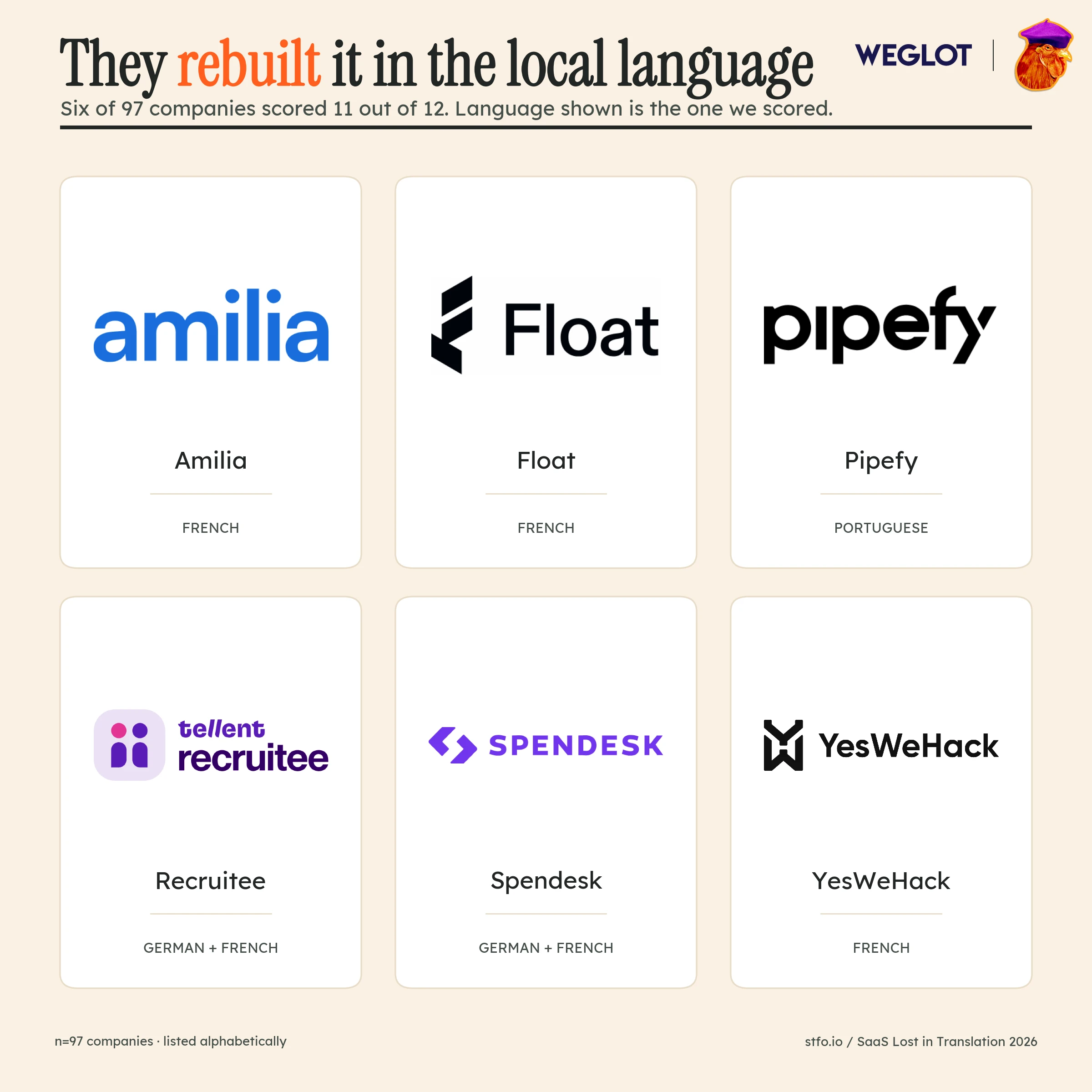
Six companies scored 11 out of 12: Amilia, Float, Pipefy, Recruitee, Spendesk and YesWeHack. They stand the f*ck out in every language they sell in. The localization industry has a word for what they do, transcreation: rewriting the message for each market so it reads like it was written there.
Amilia (French, Quebec)
Amilia makes everything about Quebec.
- The French hero claims something the English page never does: the best registration software au Québec.
- It picks a fight the English page doesn’t pick, against the virtual waiting room on registration day: Terminé les salles d’attente virtuelles! (No more virtual waiting rooms!)
- Then it takes a shot at vendors from outside the province: Fièrement québécois, proudly Québécois, a product built in Montreal by more than 140 local people.
- The customer logos are all local: Camp Mariste, Sports Montréal, Cosmodôme, L’École de danse de Québec.
- And it talks like Quebec: Obtenez l’heure juste, a Québec expression for getting the straight story, and Nous croyons dur comme fer, we believe it hard as iron. Nobody gets to those by translating.
Float (French, Canada)
Float goes after American software by name: La plupart des plateformes financières ont été conçues pour les États-Unis (most financial platforms were built for the United States).
- It backs that up with local proof: its AI is tested on millions of Canadian transactions, receipts and merchant records.
- And it adds a line with no English version at all: Fait avec ❤️ par des Canadiens, pour des Canadiens (made with ❤️ by Canadians, for Canadians).
Pipefy (Portuguese, Brazil)
Pipefy built whole sections that don’t exist in English, written for the way Brazilian companies run their back office.
- Its menu lists industries the English site doesn’t.
- Prices and proof are in reais, Brazil’s currency.
- Its short, punchy three-part line gets rewritten in Portuguese instead of copied: Crédito aprovado. Risco reduzido. Conformidade garantida. (Credit approved. Risk reduced. Compliance guaranteed.)
- One customer quote was written in Portuguese first, and the English page is the translation.
- Even the product screenshots have Brazilian file names. Somebody over there is doing the work.
Recruitee (German and French)
Recruitee adds someone to the German page who isn’t on the English one: the Betriebsrat, the works council, which German companies that have one must involve before rolling out HR software.
- It names the local alternatives: Excel-Listen, überquellenden Postfächern oder einem in die Jahre gekommenen ATS (Excel spreadsheets, overflowing inboxes or an old applicant tracking system).
- And it adds a fight about the EU AI Act that the English page doesn’t have.
Spendesk (German and French)
Spendesk turns “Expenses, minus the chase” into Spesen ohne Belegejagd. Belegejagd means receipt-hunt, a real German word that nobody would get to by translating.
- “Your team has time back” becomes Ihr Team hat wieder Luft, your team can breathe again.
- Its French page asks Spendesk, c’est quoi au juste ?, which is how a French person would actually say “So what is Spendesk, exactly?”
- It says courir après les factures (running after invoices) where English says chasing invoices.
- And it uses DAF, the real French job title, where English says CFO.
YesWeHack (French)
YesWeHack hits harder in French than in English: Une avalanche d’alertes, trop peu de risques avérés (an avalanche of alerts, too few real risks). Avalanche is a much stronger word than “too many.”
- It gives the monster local weapons the English page doesn’t have: RGPD (the French name for GDPR), NIS 2 and DORA.
- Its customer stories are French, with French job titles, from Orange France and Les Mousquetaires, the group behind Intermarché.
- It even explains its own English jargon: la philosophie « human-in-the-loop » (l’humain au cœur du processus).
That’s what the top of this market looks like. Which should tell you something about the middle.
What I think this is actually about
I didn’t run this study to point fingers, and I’m sure those companies are full of extremely competent people. So if it isn’t a competence problem, where does the 59% average come from?
I think it’s what happens when a good idea gets executed at 20% of its intensity. That’s the idea behind Be More Intense: most companies have the right idea in the first place, but they do it at a fraction of the strength it needed and then wonder why nobody noticed.
Half-arsing used to be free, and it isn’t any more. Every mediocre competitor now sounds polished, because the same tools that let you ship a German page in an afternoon let all of them do it too, so competent, grammatical, empty copy has become the market default. Which means the 41% you lose at the border is exactly the part that made you different.
What I can’t tell you is whether a weak German page costs you pipeline, because this study measures brand survival and doesn’t measure conversion. Anyone claiming they know what your 20% page earns you is guessing. The uncomfortable part is that most companies are guessing too: they assume the German page pulls organic traffic, and they assume that traffic converts, but most of them have never checked either.
So I’m not telling you to delete things. I’m telling you that half-arsing is no longer a free option. If a market is worth entering, it’s worth entering at full intensity, with one language done properly and a native speaker who’s allowed to rewrite the copy. I’d rather see one language at 100% than four at 20%, and a switcher with six flags in it is a vanity metric. And if a market isn’t worth that effort, the honest question is why it’s live at all.
Open your worst language page, then go and find out what it actually earns you.
If nobody in the building can tell you, that’s the real finding.
This is exactly the work I do inside a GTM Sprint. We lock the positioning first, then make sure it survives every market you sell into. If your worst language page made you wince, that’s the right reaction. Let’s talk.
Methodology
The sample. 100 B2B SaaS companies with 50 to 1,000 employees and real evidence of a second language version on their site, about 10 per industry group, locked before any scoring. 97 were scored. Three dropped out because the site blocked every request, the language versions had nothing behind them, or the company removed its translations mid-study.
What we scored. Each localized language was scored against the same company's main-language site on four criteria (positioning, conviction, voice and visual assets), each from 0 (vanished) to 3 (rebuilt for the local market). That gives a maximum of 12 per company-language pair, and every percentage in the report is a score out of 12.
The pages. Two pages per language, the homepage and the About page (or its nearest equivalent), captured between August and September 2026. Every quote the scorer used had to match the saved page word for word, checked by a script.
Who scored. Claude Opus scored every pair. A second AI (Claude Sonnet), blind to the first one's scores, re-checked every flagged item plus a random sample and changed 25% of the scores it checked. The two agreed on 64% of their calls, which is only fair agreement, so every disagreement went through a logged override step. Louis judged every French item himself, and his call overrode both.
The quotes in this report. French quotes were signed off by a native French speaker (Louis). Quotes in other languages were checked by a panel of five AI models from different labs. That is a cross-check, and it is not the same as review by a human native speaker.
Who paid. Weglot sponsored the study. They saw the method before we ran it, had no veto over it, and didn't see the findings or the company names before publication. Their customer list was never used to build the sample. We tried to detect each site's translation tool, but too few sites could be classified to report anything on it.
Know someone who'd squirm reading this?
Send it to the one person on your team who keeps calling the brand "clean." They'll thank you. Eventually.
And if someone sent you this, get the next report straight to your inbox. Original research on why B2B brands all look the same, roughly once a month.
One more click and you're in.
I've just emailed you a confirmation link. Click it or you're not on the list (that's the point, it proves you're a human who wants this). Check spam or Promotions if it's hiding.
Key terms
Distinctiveness
Distinctiveness is what makes your brand noticed, remembered, and shortlisted when buyers are ready to act. It is not the same as differentiation. Differentiation gives people a reason to choose you. Distinctiveness gives people a reason to remember you. You need one or the other. Ideally both.
Distinctive Brand Assets
Distinctive brand assets are the meaning-free bits and bobs that make your brand uniquely yours. A colour, shape, sound, mascot, or phrase. The goal is to tickle different parts of the brain without competing with all the other crap floating around in people's heads. Meaningful logos are overrated.
Point of View (POV)
A point of view is a collection of consistent messages inserted into everything you do and say, showing your segment you're committed to protecting them. It is not thought leadership. It is not random opinions. It is a coherent signal that transforms random acts of marketing into a narrative.
Positioning
Positioning is the upstream work of understanding how you address customer challenges that others overlook. It is built on five elements: job, alternatives, struggles, segment, and category. It is not a tagline exercise. The words come last, not first.